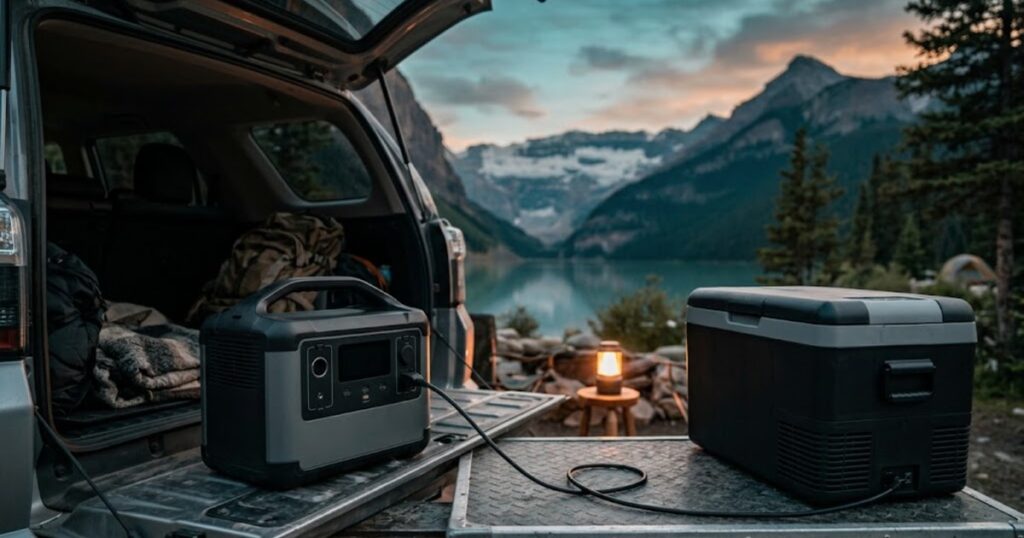
Yes. A current Goal Zero Yeti will run a 40-55L 12V compressor fridge from its 12V port: about 27 to 36 hours on a Yeti 500, 37 to 49 on a Yeti 700 and 81 to 108 on a Yeti 1500 in mild weather. That is arithmetic, not a test: nobody has published a run of any of the three on a compressor fridge, so the hours come from the battery size, two measured capacity tests and what a fridge uses in a day. What sets a Yeti apart is the 12V side. The ports are rated at 13.5V, the manual for the 500 and 700 says the DC outputs are regulated, and it says a port you leave switched on stays on. No default setting is waiting to turn the fridge off at 3 a.m.
How long will a Goal Zero Yeti 500, 700 or 1500 run a 12V fridge?
The formula is usable watt-hours divided by what the fridge averages over a day, compressor cycling included. For the fridge side we use the figures from our 12V fridge amp-draw guide: 25 to 40Ah a day for a mid-size compressor fridge in mild weather, which is 300 to 480Wh, and about 500Wh on a warm day. For the battery side there are two real measurements, both on the AC outlets. OutdoorGearLab got 560Wh out of a Yeti 700, 83% of the label, and 1,320Wh out of a Yeti 1500. Nobody has measured a Yeti 500, and nobody has metered the 12V port on any Yeti. So the 12V rows assume 90% of the label, the same factor Bluetti publishes for its own DC outputs, and the Yeti 500’s AC row assumes 85%. The AC rows add 10W for an inverter left on all day. That is Goal Zero’s own figure for the Yeti 1500 and an assumption on the other two.
| Unit and port | Usable Wh | Mild day, 300Wh | Typical, 400Wh | Warm, 500Wh |
|---|---|---|---|---|
| Yeti 500, 12V port | 449 (499 x 0.90) | 36 h | 27 h | 22 h |
| Yeti 500, AC outlet | 424 (499 x 0.85) | 19 h | 16 h | 14 h |
| Yeti 700, 12V port | 610 (677 x 0.90) | 49 h | 37 h | 29 h |
| Yeti 700, AC outlet | 560 (measured) | 25 h | 21 h | 18 h |
| Yeti 1500, 12V port | 1,355 (1,505 x 0.90) | 108 h | 81 h | 65 h |
| Yeti 1500, AC outlet | 1,320 (measured) | 59 h | 50 h | 43 h |
Read it as hours from a full battery to a dead one. On the 12V port a Yeti 500 is a day to a day and a half of fridge, a Yeti 700 is a day and a half to two, and a Yeti 1500 is three to four and a half days. In real heat, or with the fridge set as a freezer, the average can reach 70W, and then a Yeti 500 is done in about six hours and a 700 in under nine.
If the 12V ports turn out closer to the 87% that reviewers measured on Bluetti’s car ports, take about 3% off those rows. It does not change which unit you need.
Goal Zero says a Yeti 700 runs a fridge for 3+ days. Is that real?
It is a best case. Goal Zero’s product pages list its own Alta 50 fridge at 8.5W and promise 2+ days on a Yeti 500, 3+ days on a Yeti 700 and 6.5 days on a Yeti 1500. Divide the Yeti 700’s 677Wh by 8.5W and you get 80 hours, which is 3.3 days. So the claim is the label capacity over the fridge’s quietest average, with nothing taken off for losses. The Alta 50’s manual says where that average comes from: 8.0W with the fridge set to 35F in a 70F room, once it is already cold.
A fridge can do that. In the one published fridge run on any Yeti, Trail4Runner’s Dometic CFX 55 took 43% of an older Yeti 500X in 24 hours, which works out at about 9W. It was pre-chilled on house power and opened six times all day. Owners who meter a loaded fridge through a normal camping day report 13 to 22W. Plan on the table. Treat the 3+ days as what happens when the weather is mild and nobody goes in for a drink.
Should the fridge go on the 12V port or the AC outlet?
The 12V port. Goal Zero says so itself: its Yeti 1500 FAQ calls DC the more efficient choice every time and puts the 1500’s idle draw at roughly 10W with an AC port left on. Ten watts around the clock is 240Wh a day, most of what the fridge uses on a mild one. The table shows the result: the AC rows are between half and two-thirds of the 12V rows. OutdoorGearLab adds that its 83% figure for the Yeti 700 is an AC number and that the DC outputs do better. A Field & Stream reviewer saw the same thing on a 500X with a small TV: 7 to 9W from the 12V port, 15 to 17W through the inverter.
The 12V ports are also better than most. All three units have a car socket rated 13.5V and 12A, 162W, where the usual socket on a power station stops at 10A. A Dometic CFX3 45 pulls about 8A when the compressor starts, so there is room. Each also has a 6mm barrel port at 13.5V and 10A, which is the one Goal Zero’s own fridges plug into. One 500X owner found his fridge’s cigarette plug had backed out of the socket far enough to switch off, so the barrel port is worth using if your fridge lead allows it. The Yeti 1500 has two of those plus a 30A High Power Port.
One limit on the small two: the Yeti 500 and 700 cap their 12V ports at 13.5A combined. That is one fridge. Phones and lights go on USB.
Will a Yeti switch the fridge off overnight?
On a Yeti 500 or 700, no. This is where Goal Zero differs from the brands that time out an idle port. The user guide says the Yeti will not turn itself off while a port is switched on, even with no load, and gives the reason: so that intermittent and very low loads do not shut it down. A fridge resting between compressor cycles is that load. The guide lists no port timer for these two at all. The flip side is in the same guide: switch the ports off when you pack up, because they will sit there awake.
The Yeti 1500 has settings to check. Its menu has a 12V Timeout that turns the 12V output off when it detects no draw, selectable at 5, 15 or 30 hours. The manual’s menu map marks Off as the default, so out of the box nothing times the port out. Leave it off for a fridge. The setting that matters more is Port Restore, which also ships off according to that map. Going by the manual’s description, with it off a battery that runs flat and then refills from solar or the car does not switch the 12V port back on. The fridge stays dead until somebody presses the button. Turn Port Restore on before you leave a fridge unattended. And keep the charge profile on Performance, which the manual describes as giving you the full capacity; Battery Saver and Balanced are the other options. All of this is on the unit’s own screen, so check it there before the first trip.
The fridge’s own battery protection. Every compressor fridge has a low-voltage cutoff meant to protect a car’s starter battery. Dometic’s High setting cuts out at 11.8V and waits for 12.6V before it restarts. A port rated at 13.5V sits above all of that, so on paper any setting works on a current Yeti. Low is still the one to use on a power station: it leaves the most room for a long or thin cable, and the station has its own battery management. We found no independent voltage reading at a 6th-gen port under load, so the 13.5V is Goal Zero’s rating, not a measurement.
Yeti 500, 700 or 1500: which one for a fridge?
The 700. It has the same 12V ports as the 500, weighs 20.3 lb against 16.1, and the extra 178Wh is what turns one comfortable night into a mild weekend. The Yeti 500 is the right box if the fridge only has to cover an overnight and you drive or get sun the next day; the math gives it 22 hours even at the warm figure.
The Yeti 1500 is a different kind of purchase. It is the only one of the three that carries a fridge through a long weekend with nothing coming in, and its 2,000W inverter runs things the others cannot. It also weighs about 53 lb, and Goal Zero’s own figure for filling it from a car socket is 13.6 hours. Buy it if it will live in the truck and feed more than a fridge. If the fridge is the whole job, the 700 does it for less than half the weight.
Names matter with this brand. Goal Zero has sold a Yeti 1000 Lithium, a Yeti 1000 Core and now a 6th-generation Yeti 1000, and both a Yeti 1500X and the 2026 Yeti 1500. The numbers on this page are for the 6th-generation LiFePO4 units: Yeti 500 (499Wh), Yeti 700 (677Wh) and Yeti 1500 (1,505Wh).
How do you keep it going past the first days?
Drive. First thing to know: the car charging cable is not in the box with any of the three. It is sold separately as the 12V Car Charging Cable Yeti (6th Gen), and Goal Zero lists it as not compatible with the older X-line units, so check which cable a listing is selling. Goal Zero quotes 5 hours to fill a Yeti 500 from a car socket, 6 hours for a Yeti 700 and 13.6 for a Yeti 1500. Divide each battery by its time and all three come out at about 100 to 113W going in. Against a fridge averaging 15 to 22W that nets 80 to 100W, so a mild fridge day costs you three to five hours of driving to put back. That holds a 500 or a 700 level on a trip where you move most days. It will not refill a Yeti 1500. Goal Zero confirms the Yeti charges and powers gear at the same time. The car-charging guide covers the faster wiring options.
Solar. The Yeti 500 and 700 take up to 200W of panel; the 1500 takes far more. Expect less than the label. On the older 500X a reviewer logged 64 to 87W from 100W panels on a sunny spring day. A 100W panel at three-quarters of its rating for five good hours is about 375Wh, which covers a mild fridge day. The night is not the problem it is on a small station: 14 hours of dark at a warm 22W average is 308Wh, and a Yeti 500 has about 449Wh to give on the 12V port. Panel sizing is in the solar sizing guide.
Already own a Yeti 500X or a Yeti 1000 Core?
Both are gone from Goal Zero’s store, so this part is for owners. They work, and the 500X is the only Yeti with real fridge runs in print.
Yeti 500X (505Wh). Trail4Runner ran a Dometic CFX 55 on its 12V port for 24 hours with no solar and no driving. It used 43% of the battery, the fridge app showed 13.5V arriving, and the author projected up to 55 hours. A Field & Stream reviewer ran a Dometic to empty in about 25 hours, which is roughly a 20W average. Our math for the 500X lands between the two: 27 to 36 hours in mild weather. Three things to know. A reviewer and an owner each report the 500X switching its outputs off after about 30 hours, which the manual does not mention, so look at the fridge once a day. The manual does describe a battery-safe mode that drops the 12V car port when the pack voltage gets low while the other ports carry on. And a few owners of the Dometic CFX3 35 report the 12V breaker tripping or a compressor-start warning on the fridge, with no confirmed fix. Goal Zero’s own fridge manual tells 500X owners to set battery protection to Low. Do that.
Yeti 1000 Core (983Wh). Goal Zero lists all three of its 12V outputs as regulated, and the same math gives 53 to 71 hours in mild weather. We found no published fridge run on a Core and no copy of its manual, so whether it shares the 500X’s 30-hour habit is an open question. Check it daily until you know.
Neither needs Goal Zero’s 12V regulated cable. That accessory is for the older Yeti Lithium 1000, 1400 and 3000, whose 12V output was not regulated. Goal Zero’s page for it says the X-line units have regulation built in.
When is a Yeti the wrong answer?
When the number you need is in a hot week, not a mild weekend. Our rule of thumb from the fridge runtime guide is about 500Wh per fridge-day and 1,000Wh for a two-day weekend. A Yeti 500 falls just short of one of those days and a 700 covers a little over one. If that is short for your trips, the choice is the 53 lb Yeti 1500, a panel, or a different 1kWh unit. The sizing guide walks through the sum for your own kit.
The same working for other brands: the Jackery Explorer 1000, the Bluetti AC70 and AC180, the Anker SOLIX C1000 and the EcoFlow River 3.
And if the real question is whether you need a second battery at all for one night, that is its own page: can you run a 12V fridge off your car battery overnight?
The picks
Goal Zero Yeti 700
The fridge pick. 677Wh LiFePO4, a 13.5V / 12A car port and a 10A 6mm port, 560Wh measured out of the AC outlets by OutdoorGearLab. By the math, a day and a half to two days of fridge on the 12V port in mild weather.
Goal Zero Yeti 500
Enough for an overnight in any weather the fridge will see, and a day and a half when it is mild. Same 12V ports as the 700 in a 16 lb box. Nobody has published a capacity test of it, so its hours lean hardest on assumptions.
Goal Zero Yeti 1500 (6th generation)
Three to four and a half mild fridge days by the math, 1,320Wh measured on AC by OutdoorGearLab, and a 30A High Power Port for bigger 12V loads. About 53 lb, and a car socket takes 13.6 hours to fill it. Turn Port Restore on. Make sure the listing is the 2026 LiFePO4 unit, not the older 1500X.
Goal Zero 12V Car Charging Cable for Yeti (6th Gen)
Not in the box with any of the three, and the thing that makes a 500 or a 700 last a road trip. About 100 to 113W into the station by Goal Zero’s own charge times. It does not fit the older X-line units.
Goal Zero Nomad 100 solar panel
A 100W folding panel is the size that covers a mild fridge day on a Yeti 500 or 700. Expect 60 to 85W from it in good sun, going by what a reviewer logged from 100W panels on the older 500X. Whatever panel you buy, check that its plug suits the Yeti’s 8mm input.
What to skip
The AC outlet for the fridge; an idling inverter eats most of a mild fridge day. Planning a trip on the 3+ days claim; it is the label divided by a fridge at its quietest. The Yeti 1500 if you have to lift it in and out of the car every trip. A splitter to run two fridges from a Yeti 500 or 700; the 12V ports share 13.5A. The 12V regulated cable for any Yeti on sale today; it was made for the old Yeti Lithium line. A used Yeti 500X bought for fridge duty; it is an older battery chemistry rated for 500 cycles and it comes with the 30-hour reports. And a thermoelectric cooler in place of a compressor fridge; it draws 40-60W without cycling and would empty a Yeti 500 in well under half a day.
The receipts: what I read and watched
- ManufacturerYeti 300 / 500 / 700 user guide ↗ – Goal Zero (PDF)States that all DC outputs are regulated, that the Yeti does not turn off automatically while a port is on even with no load, and that the 12V ports cannot exceed 13.5A combined. Car port 12A, 6mm port 10A. No port timeout is listed.
- ManufacturerYeti 500 portable power station ↗ – goalzero.com499.2Wh LiFePO4; car port 162W at 13.5V / 12A; 6mm port 135W at 13.5V / 10A; 182W combined; 16.1 lb; car charger 5 hours; in the box: station, AC cord, user guide; Alta 50 fridge at 8.5W, 2+ days.
- ManufacturerYeti 700 portable power station ↗ – goalzero.com677.37Wh LiFePO4; the same two 12V ports and 182W combined limit; 20.3 lb; car charger 6 hours; Alta 50 fridge at 8.5W, 3+ days.
- ManufacturerYeti 1500 portable power station ↗ – goalzero.com1,505.28Wh LiFePO4; car port 13.5V / 12A, two 6mm ports at 10A, High Power Port 30A / 405W; 52.75 lb; 12V car charger 13.6 hours; Alta 50 6.5 days.
- ManufacturerYeti 1000 / 1500 (6th generation) user guide ↗ – Goal Zero (PDF)Port settings: AC, 12V and USB timeouts of 5, 15 or 30 hours when enabled, Off marked as the default in the menu map; Port Restore, default Off; charge profiles Performance (default), Battery Saver, Balanced, Custom.
- ManufacturerBefore you buy: Yeti 1500 power station FAQ ↗ – Goal Zero blogIdle draw with an AC port left on is roughly 10W; DC is described as always the more efficient choice.
- Expert reviewGoal Zero Yeti 700 review ↗ – OutdoorGearLab560Wh delivered from the AC outlets, 83% of the advertised 677Wh; notes that DC and USB outputs are more efficient; 21.2 lb on their scale.
- Expert reviewGoal Zero Yeti 1500 review ↗ – OutdoorGearLab1,320Wh measured from the advertised 1,505Wh; 53.1 lb on their scale. The review prints 89%; the two watt-hour figures work out at 88%.
- ManufacturerAlta 50 fridge user guide ↗ – Goal Zero (PDF)Average draw 8.0W when set to 35F at 70F ambient, after reaching temperature; battery protection Low / Medium / High, default High, Low recommended on a Yeti 200X or 500X; ships with a 6mm fridge cable.
- Manufacturer12V Car Charging Cable Yeti (6th Gen) ↗ – goalzero.comSold separately; 120 to 150W; fits the 6th-generation Yeti 300, 500, 700, 1000, 1500 and PRO 4000; not compatible with the X-line.
- ManufacturerCan I run devices while charging the Yeti? ↗ – Goal Zero help centrePass-through charging is supported.
- Expert reviewGoal Zero Yeti 500X power station: fridge test and review ↗ – Trail4RunnerDometic CFX 55 on the 500X’s 12V port: 43% of the battery in 24 hours with no solar or vehicle charging, 13.5V shown in the Dometic app, about 4A with the compressor running. Reader comments report a 30-hour output shut-off and trips with a CFX3 35.
- Expert reviewGoal Zero Yeti 500X review ↗ – Field & StreamA Dometic fridge ran about 25 hours; a small TV drew 7 to 9W from the 12V port against 15 to 17W from the AC outlet.
- Expert reviewReview: Goal Zero Yeti 500X ↗ – YuenXReports an automatic shut-off after 30 idle hours and a 7W inverter draw with nothing plugged in; 64 to 87W of input from 100W solar panels.
- Owner reportsNew Goal Zero Yeti 500X ↗ – Overland Bound forumAn owner found the fridge’s 12V plug had backed out of the 500X socket far enough to switch off; another estimates about 40 hours with a Dometic CFX3 55.
- ManufacturerGoal Zero Yeti 500X manual ↗ – ManualsLibUp to 505Wh; 12V car port 10A, regulated; a battery-safe mode that disables the car port at low pack voltage; no timed shut-off described.
- ManufacturerYeti 1000 Core ↗ – goalzero.com983Wh NMC; 6mm, car and High Power 12V outputs all listed as regulated; no longer available.
- ManufacturerYeti Lithium 12V regulated cable ↗ – goalzero.comFor the Yeti 1000, 1400 and 3000 Lithium; not needed for Yeti X power stations.
- Expert reviewJackery power station for vanlife ↗ – FarOutRideCompressor start current: about 7A for a small Dometic, 8.2A for a CFX3 45.
- ManufacturerDometic CFX series manual: battery monitor ↗ – ManualsLibOlder CFX line (CFX28 to CFX65DZ), 12V cutoff and restart: Low 10.1/11.1V, Med 11.4/12.2V, High 11.8/12.6V. The CFX3 and CFX2 differ on two figures: Low restarts at 11.4V and Medium cuts out at 11.2V (Dometic’s battery monitor page). High is the same.
- ManufacturerHow long can a Bluetti run a 12V portable fridge? ↗ – Bluetti AustraliaThe capacity x 0.9 formula for DC outputs that the 12V rows borrow.
- Field testGoal Zero Yeti 700 EXCELS in Real-World Conditions! ↗ – Adventure Gear TV (YouTube)Independent review of the Yeti 700. No figure taken from it.
- Field testDOMETIC CFX3 PAIRED WITH GOAL ZERO YETI 500X WITH NOMAD 50 SOLAR (HOW LONG WILL IT LAST) ↗ – DrewDayToday (YouTube)A Dometic CFX3 on the older 500X with a 50W panel. No figure taken from it.
FAQ
Will a Goal Zero Yeti 500 run a 12V fridge overnight?
Yes, with room. From a full charge on the 12V port the math gives a 40-55L fridge 27 to 36 hours in mild weather and about 22 on a warm day. No published fridge test exists for the Yeti 500, so treat that as a calculation and run it at home for a night first.
How long will a Yeti 700 run a Dometic CFX3 or an ICECO?
Owners meter a CFX3 45 at 13-14W average at 70F and an ICECO VL35 at about 21W across warmer days. The Yeti 700’s roughly 610 usable watt-hours on the 12V port divided by those gives about 44 to 47 hours and about 29.
Does a Goal Zero Yeti turn its 12V port off by itself?
Not a Yeti 500 or 700: the user guide says a port left on stays on, even with nothing drawing. The Yeti 1500 has an optional 12V timeout that the manual shows as off by default. The older Yeti 500X is the exception, with two reports of outputs switching off after about 30 hours.
Do I need Goal Zero’s regulated 12V cable for a fridge?
No, not on anything sold in the last few years. It was for the old Yeti Lithium units. Goal Zero says the X-line has regulation built in, and the 6th-generation ports are rated at a fixed 13.5V.
Can a Yeti charge from the car or a panel while it runs the fridge?
Yes. Goal Zero says the Yeti supports pass-through charging. From a car socket expect about 100W going in, which is several times what a fridge averages, so the battery climbs while you drive.
Is a Yeti 1500 overkill for a fridge?
For a fridge alone, usually. It is three or more mild days of cold in a 53 lb box. It makes sense when the same battery also has to run a kettle, tools or a home outage, or when you camp for long weekends with no driving and no sun.