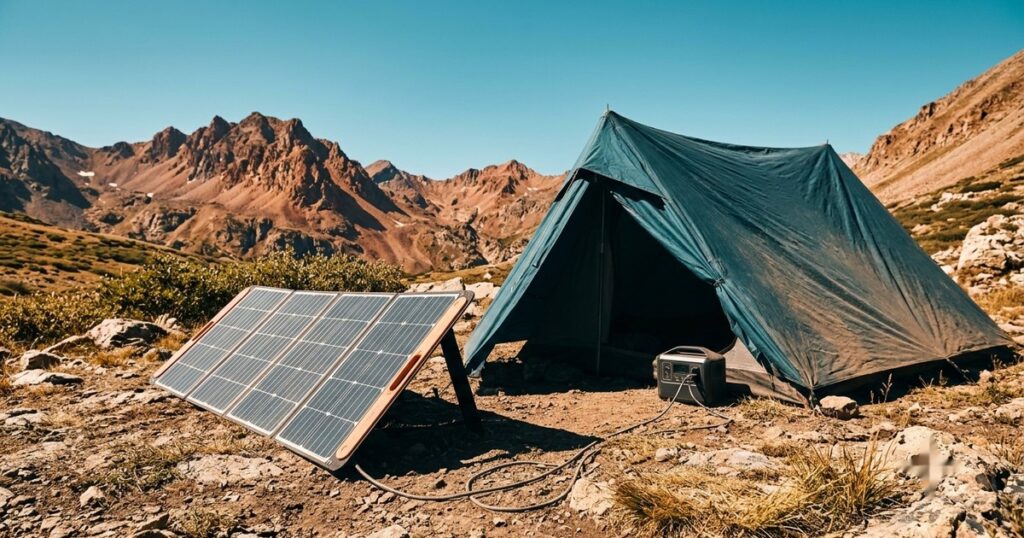
Short version: a 200W portable panel is the workhorse most campers want – it recharges a midsize power station in a single sunny day and comfortably replaces what a 12V fridge pulls. A 100W panel keeps phones, lights and a small battery topped up. You only need 300W or more if you’re running a fridge plus Starlink plus everything else, hard, every day.
The catch nobody prints on the box: you get about 60% of a panel’s rated watts in the real world, and only for the few hours the sun is high. So sizing solar isn’t about the big number on the label – it’s about peak sun hours and an honest derate. Here’s the math, a panel-to-draw table, four picks worth owning, and what to skip.
The two numbers that decide it
A 200W panel in a spot with 5 peak sun hours: 200 × 0.6 × 5 ≈ 600Wh a day. That’s roughly a 12V fridge’s daily draw, replaced by lunchtime.
Peak sun hours is not daylight hours – it’s the equivalent hours of full-strength sun, and most places get 4 to 6 a day. The 0.6 derate accounts for the gap between lab rating and reality: heat, imperfect angle, cloud, dust, cable losses. Independent testing puts real foldable-panel output at 50-80% of rated; 60% is a safe planning number. Build your daily harvest from those two and you’ll know what a panel actually does for you.
Match the panel to what you’re running
Work out your daily watt-hours (the power sizing guide has the device table), then pick a panel that harvests at least that much in your typical sun. Rough guide:
| Panel (rated) | Real harvest (~5 sun hrs) | Covers |
|---|---|---|
| 60-100W | ~180-300 Wh/day | Phones, lights, a small power bank, a tablet |
| 200W | ~480-600 Wh/day | A 12V fridge, or a full midsize power-station recharge |
| 300W | ~720-900 Wh/day | Fridge + Starlink, or faster recharges |
| 400W+ | ~960-1200 Wh/day | A loaded setup, a group, or cloudy-climate insurance |
Two honest notes. A single 100W panel feels slow on a 1kWh+ power station – it’ll trickle, not refill. And buy a bit more panel than the math says: you’ll rarely get perfect sun, and an oversized panel just finishes earlier in the day. For staying put somewhere for days, a panel is a better spend than a bigger battery – the battery is the buffer, the panel is the refill.
A small battery changes the sum, because the panel can make more in a day than the station can hold. Will an EcoFlow River 3 run a 12V fridge works through that case, where the limit is the night and not the panel.
The picks
BougeRV 200W Portable Solar Panel
The value workhorse and the size most campers should buy. The fiberglass-reinforced build stays noticeably cooler than fabric panels in midday sun, so it holds closer to its rated efficiency when it matters most. 200W is the sweet spot: a full midsize power-station recharge in a good day, or a fridge’s daily draw replaced by lunch. Comes with the common MC4 connectors, so check the adapter for your power station.
Jackery SolarSaga 100W
The light, grab-and-go panel for sunny weekends and smaller setups. The newer 100W Air uses a four-panel fold and bifacial cells, weighs around 3.3 lb, and plugs straight into a Jackery station (or others with the right adapter). It won’t refill a big battery fast, but for keeping phones, a camera and a small power station happy on a bright trip, it’s the easy choice and packs down small.
EcoFlow 160W Solar Panel
The one to buy if your trips get wet. Where most foldable fabric panels are only IP65 and can suffer permanent damage in heavy rain, the EcoFlow 160W is IP68 – genuinely rugged for shoulder-season and coastal camping. A touch heavier and pricier per watt, but if you camp where the weather turns, it’s the panel that survives. Pairs cleanly with EcoFlow stations.
BougeRV 100W N-type Panel
The efficient compact pick. It uses N-type cells with a 16-busbar design for up to ~25% conversion – top-tier cell tech in a 100W foldable – so it squeezes more out of a small footprint and weak light than older mono panels. The smart choice if you want 100W but want the most modern, efficient version of it, especially in marginal sun.
What to look for
- The connector. Most panels use MC4; most power stations want XT60 or a proprietary port. A cheap MC4-to-XT60 adapter sorts it, but confirm before you buy so you’re not stuck on day one.
- IP rating. Fabric foldables are often only IP65 and hate heavy rain. IP68 (like the EcoFlow) shrugs it off. Match the rating to your weather.
- Cell tech. N-type / high-busbar monocrystalline panels (~25% efficiency) pull more from the same area and from weak light than older cells. Worth it in cloudy climates.
- Kickstand and angle. A panel flat on the ground loses a lot. The good ones have sturdy kickstands so you can tilt them at the sun – and re-aim a couple of times a day.
- Weight and fold. You carry this. A four-fold 100W is genuinely packable; a 400W is a two-hands job. Buy the size you’ll actually bother to set up.
A panel is easiest to live with when it matches the station it feeds. If you have not picked the power station yet, start with the power station brands worth knowing, then buy the panel to suit.
What to skip
- Tiny 20-40W panels for a power station. They trickle so slowly they barely keep up with the station’s own standby draw. Fine for a phone, useless for a battery.
- No-name fabric panels. The bargain ones delaminate, lie about their wattage and fail the first time they get properly wet. Spend a little more on a panel that names its real output.
- Expecting the rated watts. A 200W panel is a ~120W panel in the real world. Size on the 60% figure and you won’t be disappointed at the campsite.
- Fixed roof panels for car camping. A portable, tiltable panel you can chase the sun with beats a flat-mounted roof panel for actual daily harvest. Roof panels suit full-time rigs, not weekenders.
Pair it right: what size power station you need · best power stations for car camping · running a fridge off it · powering Starlink Mini.
The receipts: what I read and watched
- Expert reviewBest Portable Solar Panels for Camping, Tested ↗ – OutdoorGearLabIndependent testing of real-world output, durability and charge speed across portable panels.
- Hard numbersDocuments the 50-80% real-vs-rated output and the panel-to-station sizing used here.
- Expert reviewN-type cell efficiency (~25%) and fiberglass-build cooling behind the BougeRV picks.
- Expert reviewBest Solar Panels for Camping in 2026 ↗ – EcoFlowIP68 vs IP65 durability difference and the 200W-recharges-a-midsize-station figure.
FAQ
How much solar do I need for camping?
For most car campers, a 200W panel – it harvests roughly 480-600Wh in a typical sunny day, enough to offset a 12V fridge or refill a midsize power station. 100W suits phones, lights and small batteries; 300W+ is for running a fridge plus Starlink hard or camping in cloudy weather.
How much power does a 100W solar panel actually produce?
About 50-80W in direct sun, and only for the few peak-sun hours of the day – so figure roughly 180-300Wh over a typical day with 4-6 peak sun hours. The rated 100W is a lab figure you’ll rarely see in the field; plan on about 60% of it.
Will a solar panel recharge my power station in a day?
A 200W panel can fully recharge a midsize (around 1kWh) power station in a single good day of sun, roughly 4-8 hours. A 100W panel on the same battery will trickle rather than refill. Match the panel to the battery and to your daily draw using the table above.
Do I need an adapter to connect a solar panel to my power station?
Usually yes. Most panels output over MC4 connectors while power stations take XT60 or a proprietary input, so a cheap MC4-to-XT60 (or brand-specific) adapter bridges them. Confirm the connector before you buy so you’re not stranded at camp.