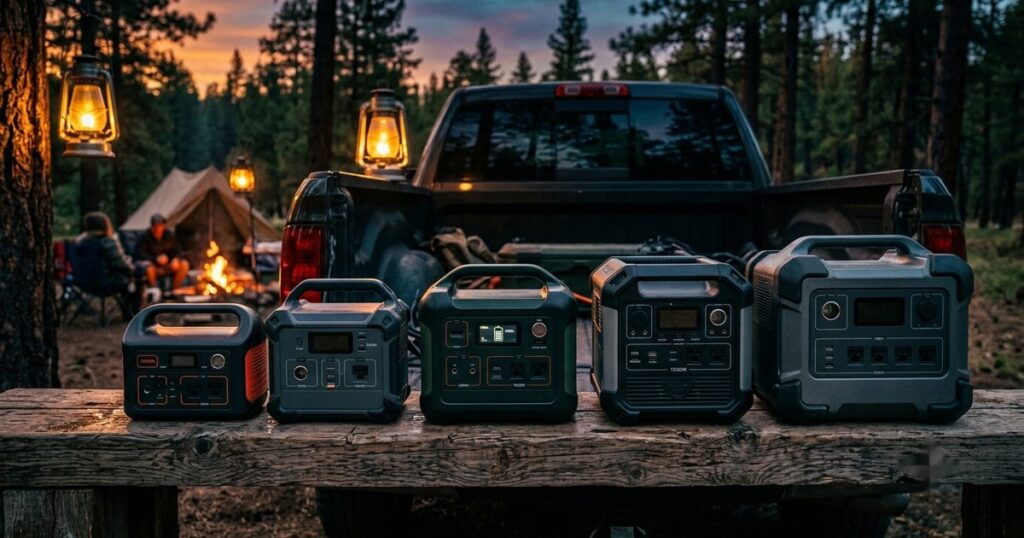
Walk into the power-station world and it feels like there are fifty brands. There aren’t. There are four you’ll be choosing between – EcoFlow, Bluetti, Anker SOLIX and Jackery – and one premium outlier (Goal Zero) worth knowing about. Everything else is either a rebadge, a no-name, or a niche player you don’t need to think about yet.
So instead of a spec dump, this is what actually helps: what each brand is for, where it’s strong, and the catch each one carries. Get the brand right and the model almost picks itself. One rule before we start – on any of these, buy the LiFePO4 (LFP) version. It lasts roughly three to four times as many charge cycles as the older lithium (NMC) packs, and on most of these brands it’s now standard. The exception is Jackery, which is exactly the catch we’ll get to.
Bluetti – the value play. Most watt-hours for your money, long warranty.
Anker SOLIX – the challenger. A trusted electronics name with EcoFlow-tier features, usually less fuss.
Jackery – the famous one. Fine if you buy the LiFePO4 models (the v2 or Plus series); skip the old lithium Explorers.
The four brands at a glance
| Brand | Battery (current line) | Where it sits | Best for |
|---|---|---|---|
| EcoFlow | LiFePO4 (Delta line) | Premium all-rounder | Most people who want one box that does it all |
| Bluetti | LiFePO4 | Value | The most watt-hours for your money |
| Anker SOLIX | LiFePO4 | Premium challenger | EcoFlow features, usually less fuss |
| Jackery | LiFePO4 (Plus series only) | Household name | Brand familiarity – buy the Plus, skip the old Explorers |
Goal Zero sits outside this table on purpose – it’s a different buy (premium, American-made, smaller). More on it at the end. Now the brand by brand.
EcoFlow – the safe default
If you asked me to pick one brand for someone who just wants a power station that works and doesn’t want a research project, it’s EcoFlow. The current Delta line is all LiFePO4, backed by a 5-year warranty, and their signature trick is fast wall-charging – the X-Stream system that made the brand’s name, around 80 minutes to full on the Delta 2. That Delta 2 pack is rated about 3,000 cycles; the newer Delta 3 (late 2024) pushed that to around 4,000 with a roughly 55-minute refill. The app is mature, the units are expandable, and the resale-and-support ecosystem is the deepest in the category. The Delta 2 topped Outdoor Life’s testing as its Best Overall pick.
The catch: you pay for the polish, and the marketing is relentless (constant ‘sales’ off an inflated list price). Ignore the theatre and judge it on the unit – the hardware is excellent.
EcoFlow Delta 2
The all-rounder. 1024Wh of LiFePO4, 1800W output (enough for most camp gear short of a high-draw kettle), and fast wall-charging at about 80 minutes to full. Expandable with an add-on battery if you outgrow it. The default recommendation for a reason – if you’re not sure what to buy, buy this.
Bluetti – the value play
Bluetti is what you buy when you want the most battery for your money and you’re not chasing the last 10% of polish. Everything in the current range is LiFePO4, the warranty is strong (5 years standard, up to 10 on the home-backup EP900), and unit-for-unit you usually get more watt-hours than the equivalent EcoFlow or Anker. The AC180 does 0-80% in about 45 minutes and is rated for roughly 3,500 cycles; step up to the AC200L and you’re at 2048Wh, into proper home-backup-plus-camping territory.
One mark against it: Bluetti took real criticism a few years back for reliability and customer service, and you’ll still find those old horror stories if you search. The reviews since (The Solar Lab literally called it a ‘redemption’) say they’ve largely fixed it – but it’s why they sit a notch below EcoFlow and Anker on the trust ladder rather than at the top.
Bluetti AC180
The value sweet spot. 1152Wh of LiFePO4 – a touch more capacity than the Delta 2 – 1800W output, four AC outlets, and a 0-80% charge in about 45 minutes. If you want the most usable battery for the money and a long warranty, this is the brand’s calling card.
Planning to hang a fridge off one? Will a Bluetti AC70 run a 12V fridge has the runtime for the AC70 and the AC180, and the ECO mode setting that can switch the fridge off overnight.
Anker SOLIX – the challenger coming on strong
This is the one to watch. Anker spent years as the trusted name in phone chargers and power banks, then brought that trusted-electronics reputation into power stations and closed the gap on EcoFlow fast. The whole SOLIX line is LiFePO4, the build quality is excellent, and the app and reliability reputation rode in on Anker’s existing name – which is a real head-start most newcomers don’t get. Their C1000 was named Best for Solar by Outdoor Life (it delivered close to 90% of rated capacity in testing), and the late-2025 C2000 Gen 2 bumped cycle life to around 4,000 and cut idle power draw – a small spec that matters a lot if you leave it powering a fridge.
Why ‘challenger’ and not ‘winner’ yet: the lineup is younger and thinner than EcoFlow’s, and the long-term reliability record simply has fewer years behind it. But if you want EcoFlow-tier features from a name you probably already trust, Anker is the smart-money pick right now.
Anker SOLIX C1000 (Gen 2)
The challenger’s best all-rounder. 1024Wh LiFePO4, a stout 2000W output (3000W peak – it runs more high-draw gear than most rivals this size), full charge in about 49 minutes, and around 4,000 cycles. Trusted-name build without EcoFlow’s price theatre. The one I’d cross-shop hardest against the Delta 2.
Jackery – the famous one (with a catch)
Jackery is the brand your non-camping friends have heard of, and that name recognition is real. One catch trips people up: not all Jackerys are LiFePO4. The classic Explorer units and even the Explorer 3000 Pro still use older NMC lithium, while only the ‘Plus’ and ‘v2’ models switched to LiFePO4. So ‘buying a Jackery’ isn’t one decision: the Explorer 1000 v2 is the LFP one, while an older lithium Explorer on the same shelf is a shorter-lived battery for similar money.
One more thing: an Outdoor Life tester reported casing cracks on a Jackery unit, so build-quality consistency is a question mark, not a guarantee. The verdict on Jackery is simple – buy the v2 (or a Plus) and you’ve got a solid LFP station from a name you trust; buy the old Explorer and you’re paying brand tax for last-generation chemistry.
Jackery Explorer 1000 v2
The right Jackery to buy. 1070Wh of LiFePO4, 1500W output (3000W surge), and a roughly 1-hour wall recharge. The current-generation LFP model from the name everyone knows. If you specifically want a Jackery, this is it – just don’t let a store steer you to a cheaper old-chemistry Explorer.
Honorable mention: Goal Zero
Goal Zero is the premium, American-designed option, and it earns a mention for one reason: Outdoor Life rated its Yeti 700 the most reliable unit they tested. The newer Yeti line (700, 500, 300, and the Pro models) is LiFePO4 with a 5-year warranty; the older NMC stock carries just 2 years, so check which you’re looking at. The downside is plain: you get fewer watt-hours per dollar than any of the big four, and the range leans smaller. Buy Goal Zero if reliability and a US-based brand matter more to you than value, or if you want a compact, rugged unit you’ll keep for a decade.
Goal Zero Yeti 700
The reliability pick for people who’ll pay for it. 677Wh of LiFePO4, rugged and water-resistant, with the build reputation to back a long hold. Smaller and pricier per watt-hour than the big four, so this is a ‘I want it to just keep working’ buy, not a value one.
So which one’s right for you?
Most battery for the money? Bluetti AC180.
Trusted name, modern features, less price theatre? Anker SOLIX C1000.
You specifically want Jackery? The Explorer 1000 v2 – a LiFePO4 model, not the old lithium Explorers.
Reliability and American-made over value? Goal Zero Yeti 700.
Notice none of these is a bad choice. At this point the four big brands are all making good LiFePO4 hardware – the differences are about ecosystem, value and how much you trust the name, not about one being a lemon. Match the brand to what you actually weigh, then pick the model in your capacity range. If you’re not sure what that capacity is, start with the sizing guide below.
What to skip
- Buying on the famous name alone. Jackery’s recognition is real, but an old non-LFP Explorer is last-generation chemistry. The name doesn’t guarantee the better battery.
- The cheapest no-name ‘solar generator’ on page two. The bargain brands skimp where it doesn’t show – the BMS and the cells – and the warranty is worthless if support never answers. Stick to the names here.
- An NMC unit to save a little. If two units are close and one is LiFePO4, take the LFP every time. It’s the difference between ~500-800 cycles and 3,000-4,000.
- More watt-hours than you’ll use. Brand matters less than buying the right size. A 2kWh box you carry half-empty is wasted money and weight – size it to your actual draw first.
Pair it right: what size power station you need · best power stations for car camping · how much solar you need · charging it while you drive.
The receipts: what I read and watched
- Expert reviewThe Best Portable Power Stations, Tested and Reviewed ↗ – Outdoor LifeNamed the EcoFlow Delta 2 Best Overall, the Goal Zero Yeti 700 most reliable, and the Anker SOLIX C1000 best for solar (near-90% of rated capacity).
- Expert reviewBluetti AC180 portable power station review ↗ – MightyGadgetDocuments the AC180’s LiFePO4 pack (~3,500 cycles), 0-80% in ~45 min, 5-year warranty, and value-tier positioning.
- ManufacturerJackery’s own list confirming only the Plus / v2 models are LiFePO4 – the classic Explorers and 3000 Pro are still NMC.
- ManufacturerVerbatim: the newer LiFePO4 Yetis carry a 5-year warranty, older NMC units just 2 years.
- Hard numbersOctober 2025 release: ~4,000-cycle LiFePO4 and reduced idle draw – the evidence Anker keeps iterating fast.
- Expert reviewBluetti power station review: the redemption ↗ – The Solar LabIndependent reviewer’s take that Bluetti has recovered from its earlier reliability and support criticism.
FAQ
Which power station brand is the most reliable?
On the testing that’s out there, Goal Zero has the edge – Outdoor Life rated its Yeti 700 the most reliable unit it tried. Among the higher-volume brands, EcoFlow and Anker SOLIX have the strongest reputations, with all-LiFePO4 lines and 5-year warranties. Bluetti is solid now after fixing earlier complaints. None of the four big names is a coin-flip on reliability anymore.
Is EcoFlow or Jackery better?
For most people, EcoFlow – its current Delta line is all LiFePO4 and charges faster. Jackery is only a match when you buy its LiFePO4 ‘Plus’ or ‘v2’ models; its older Explorer units use shorter-lived NMC chemistry. Compare a Delta 2 to a Jackery 1000 v2, not to an old Explorer.
Is Anker SOLIX a good brand?
Yes – it’s the strongest of the newer entrants. Anker brought its trusted-electronics reputation into power stations, the whole SOLIX line is LiFePO4, and reviewers rate the build and value highly (the C1000 was named best for solar by Outdoor Life). The only knock is fewer years of long-term track record than EcoFlow.
What’s the best power station brand for camping?
There’s no single winner – it depends what you weigh. EcoFlow is the safe all-rounder, Bluetti gives the most capacity per dollar, Anker SOLIX is the trusted-name challenger, and Jackery works if you stick to the Plus series. Pick the brand that matches your priority, then choose a model in your capacity range.