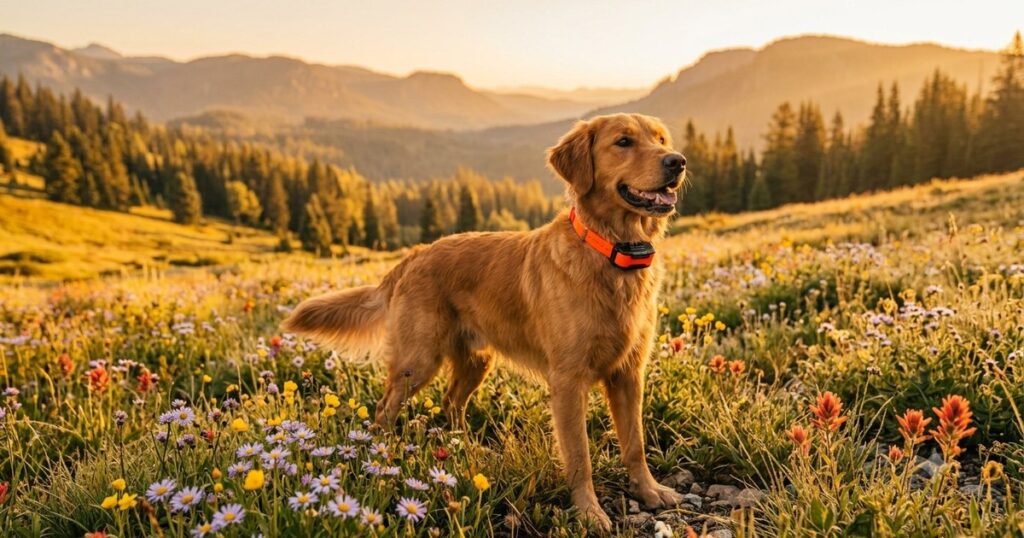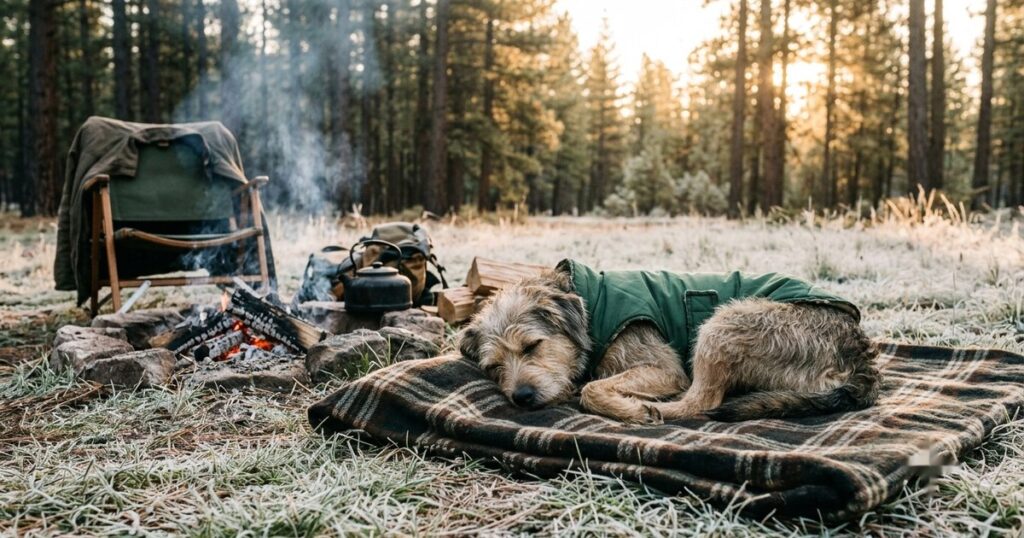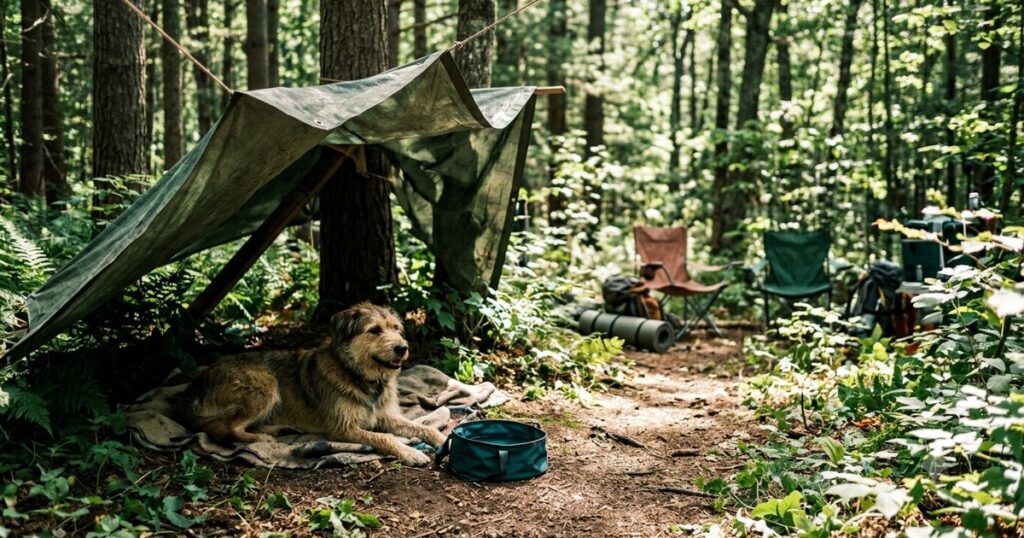
Here’s the honest version before you spend a cent: most of keeping your dog cool at camp is free. Shade, constant water, moving air, and doing your walking at dawn and dusk instead of through the middle of the day. Get those four right and you’ve solved most of the problem. The gear – cooling vests, gel mats – helps at the margins, and only if you buy the right type for your climate.
The other half of this guide is the part that matters more than any purchase: knowing what overheating looks like before it gets serious. Dogs don’t sweat their way cool the way we do – they pant, and panting has limits. So we’ll do the safety rules first, sourced from the vets, then the gear that’s actually been measured to work.
Know the danger signs (this bit is not optional)
The numbers, per VCA Animal Hospitals: a dog’s body temperature above 103F is abnormal, above 106F is heat-stroke territory, and 107-109F is where organ failure starts. That window is narrower than most owners think, and a dog that wants to please you will run itself into it.
The progression to watch for, per the AKC’s vet-reviewed guidance: it starts as heavy panting, fast breathing, heavy drooling, bright red gums and skin that feels hot. It escalates to wobbling, glassy eyes, pale or bluish gums, vomiting, and collapse. The early signs are your cue to stop the day, not to push through to the viewpoint.
If it happens: get the dog into shade, pour tepid – not ice-cold – water over the belly, paws and groin, get air moving over them, offer small sips, and head for a vet. That’s the AKC first-aid protocol, and cooling on the way rather than waiting matters.
Two more rules from the vet sources. Humidity is the sneaky one – dogs cool almost entirely by panting, which is evaporation, and muggy air blunts it (Cornell’s Riney Canine Health Center covers the mechanics). A humid 85F day can be harder on a dog than a dry 95F one. And flat-faced breeds, overweight dogs, seniors and puppies overheat first – a bulldog struggles at temperatures a heeler shrugs off. Know which dog you brought.
And the one everyone knows but bears repeating because it keeps killing dogs: never leave a dog in the car. The AVMA’s numbers: on a 75F day the inside of a car hits about 100F in 20 minutes. Cracked windows don’t change it.
The ground test your dog can’t do for you
Sun-baked ground burns pads, and your dog will walk on it anyway. The vet-cited rule is the seven-second hand test: press the back of your hand to the ground and hold it. Can’t manage seven seconds, it’s too hot for paws – asphalt can hit 125F on a 77F day. Walk on grass or dirt, go early, or wait it out. We’ve covered the full kit for this in how to protect your dog’s paws on the trail.
The gear that helps (and the climate catch)
Cooling gear splits into two types that work completely differently, and buying the wrong type for your climate is the most common mistake. Evaporative gear (cooling vests) is a swamp cooler for your dog: soak it, wring it, and it cools as the water evaporates. Works brilliantly in dry air, fades as humidity climbs past roughly 50-60%, and does close to nothing above 70%. Conductive gear (pressure-activated gel mats) just soaks heat out of whatever lies on it – humidity-proof, but it only works while your dog is actually on it. One is for the trail, the other is for camp.
| Approach | How it cools | Where it shines | The catch |
|---|---|---|---|
| Shade + water + timing | Removes the heat load | Everywhere, always, free | Needs discipline, not money |
| Evaporative vest | Evaporation off a wet vest | Dry climates, dogs on the move | Fades in humidity; dry vest = warm layer |
| Pressure-activated gel mat | Conduction into the gel | Rest time at camp, any humidity | Only works while the dog lies on it |
Yes, the free column wins the table. That’s the honest ranking. The gear earns its place on top of the free stuff, not instead of it.
Ruffwear Swamp Cooler Dog Vest
The classic three-layer evaporative vest: soak, wring, buckle on, re-wet when it dries. Dog Gear Review’s thermal-camera testing measured the covered areas running 3-4C cooler than uncovered fur, and Treeline Review clocked a huge surface-temperature drop in direct sun. The honest caveats: it needs dry air to work, and a vest that’s dried out is just insulation – testers flag the forgotten re-wet as the number one usage failure. In humid country, skip it and put the money into shade and airflow.
The Green Pet Shop Cool Pet Pad
The camp counterpart to the vest, and the one that works in any humidity because it’s conduction, not evaporation. Pressure-activated gel, no water, no power, no freezer: the maker rates it at about three hours of cooling under a dog, self-recharging in 15-20 minutes off-dog, running several degrees below body temperature. Rover’s reviewer found it held its cool with a dog parked on it. Two real caveats: it heats through in direct sun, so it lives in the shade or the tent – and the gel is non-toxic but not chew-proof, so it’s not for dogs that eat their bedding.
Ruffwear Bivy Collapsible Dog Bowl
Water access is the non-negotiable, and this is the bowl that removes every excuse: 1.8 liters, weighs about three ounces, welded waterproof fabric so it doesn’t seep, folds flat and clips to anything. Straight talk: a cheap silicone twin-pack does the same job at camp – this one earns its keep when weight and packability matter on the trail. Buy either, but have a bowl within reach of the dog all day, every day.
What the measurements actually say
Worth being straight about the size of the effect, because ‘cooling vest’ sounds like air conditioning and it isn’t. The big numbers – like that 80F surface drop – are surface temperature, mostly the sun-heated outside of the coat. The controlled study on military working dogs measured core temperature and found vested dogs ran about 0.6C cooler during work in the heat. That sounds small; the researchers called it clinically meaningful for heat-stroke risk, and it stacks with shade and timing. Useful margin, not a force field. No vest makes a 95F afternoon hike safe for a bulldog.
What to skip
- Cooling bandanas and reflective-only wraps. Dog Gear Review’s thermal testing found reflective-only gear merely slows heating, and a bandana covers too little dog to move the needle. Cute, not cooling.
- Dog umbrellas and clip-on sunshades. The tarp you already own makes more shade for the whole camp, dog included. Spend nothing.
- Ice-pack vests for camping. They work until the ice melts, which is quickly, and now you’re managing frozen packs off-grid. Wrong tool for a campsite.
- Shaving a double-coated dog. The coat insulates against heat as well as cold and shields the skin from sun – the vet consensus (Cornell among them) is don’t. Brush out the undercoat instead.
- An evaporative vest in a humid climate. Below roughly 60-70% humidity it’s a real tool; above that it’s a damp jacket. Buy for the air you actually camp in.
More for camping with your dog: keeping them warm when the season flips · protecting their paws on hot ground · the off-grid GPS tracker guide. Cold water all week comes from a 12V fridge – sized to your battery with the runtime math.
The receipts: what I read and watched
- Field testDo Dog Cooling Vests Really Work? ↗ – K9 of Mine (YouTube)Hot-weather test of the Ruffwear Swamp Cooler – the field test behind our vest pick.
- Expert reviewDo Dog Cooling Vests Actually Work? We Tested 9 with a Thermal Camera ↗ – Dog Gear ReviewThermal imaging measured 3-4C cooler under evaporative vests; flags that a dried-out vest becomes a warming layer and humidity kills the effect.
- Expert reviewBest Dog Cooling Vests of 2026 (Tested by a Dog Trainer) ↗ – Treeline ReviewDirect-sun test on a 90F day: the Swamp Cooler took a dark coat’s surface temperature from 172F to 91.5F in three minutes; evaporative gear needs dry climates.
- Hard numbersCooling vests and working-dog body temperature in moderately hot conditions ↗ – PMC (peer-reviewed study)Military working dogs in evaporative vests ran a 0.62C lower mean body temperature – modest, and clinically meaningful for heat-stroke risk.
- Hard numbersHeat Stroke in Dogs ↗ – VCA Animal HospitalsThe thresholds used here: above 103F abnormal, above 106F heat stroke, 107-109F organ failure.
- Hard numbersHeatstroke in Dogs: Signs, Treatment, and Prevention ↗ – American Kennel Club (vet-reviewed)The sign progression and first aid: tepid water on belly and paws, airflow, small sips, then the vet.
- Hard numbersSummer heat safety tips for dogs ↗ – Cornell Riney Canine Health CenterDogs cool almost entirely by panting; humidity blunts it; flat-faced, overweight and senior dogs overheat first; don’t shave double coats.
- Hard numbersPets in vehicles ↗ – AVMAA 75F day puts the inside of a car at about 100F in 20 minutes; cracked windows don’t change it.
- Expert reviewHot pavement: preventing and treating pad burn in dogs ↗ – ElleVet SciencesThe seven-second back-of-hand test, and asphalt reaching ~125F on a 77F day.
- Expert reviewReal-world use: the pressure-activated pad held its cooling with a dog lying on it, no water or power needed.
- ManufacturerCool Pet Pad product page ↗ – The Green Pet ShopManufacturer numbers cited: ~3 hours of cooling per session, 15-20 minute self-recharge, non-toxic gel, keep out of direct sun.
FAQ
How hot is too hot to camp with a dog?
There’s no single cutoff – it depends on humidity and the dog. As a working rule, above about 85F most dogs need their exertion managed, and a humid 85F is harsher than a dry 95F because panting is evaporation and muggy air defeats it. Flat-faced breeds, heavy dogs, seniors and puppies run into trouble well before fit adult dogs. Plan the day around dawn and dusk and let the dog rest in shade through the middle.
Do dog cooling vests actually work?
Yes, with conditions. Thermal-camera testing shows evaporative vests keep the covered area several degrees cooler, and a controlled study on working dogs measured about 0.6C lower core temperature during exercise. The conditions: the air must be reasonably dry, and the vest must stay wet – a dried-out vest is just an insulating layer. In humid climates they’re not worth it.
Do cooling mats work for dogs?
Pressure-activated gel mats genuinely run cooler than the dog lying on them and work regardless of humidity, which is their advantage over vests. Expect a few degrees of relief for around three hours at a stretch, with a short self-recharge once the dog moves off. Keep the mat in shade – direct sun heats it through – and skip it for dogs that chew their bedding.
How do I know if my dog is overheating?
Early: heavy panting, fast breathing, thick drool, bright red gums, hot skin. Serious: wobbling, vomiting, pale or bluish gums, collapse. Treat the early signs as the end of exercise for the day. If it progresses, move to shade, pour tepid (not ice-cold) water over belly, paws and groin, get air moving, offer small sips, and get to a vet.
Should I shave my dog for summer?
Not if it’s a double-coated breed. The coat insulates against heat as well as cold and protects the skin from sunburn – shaving it can make the dog hotter. Brush out the loose undercoat so air can move through instead. Single-coated breeds can be trimmed, but ask a groomer before going short.