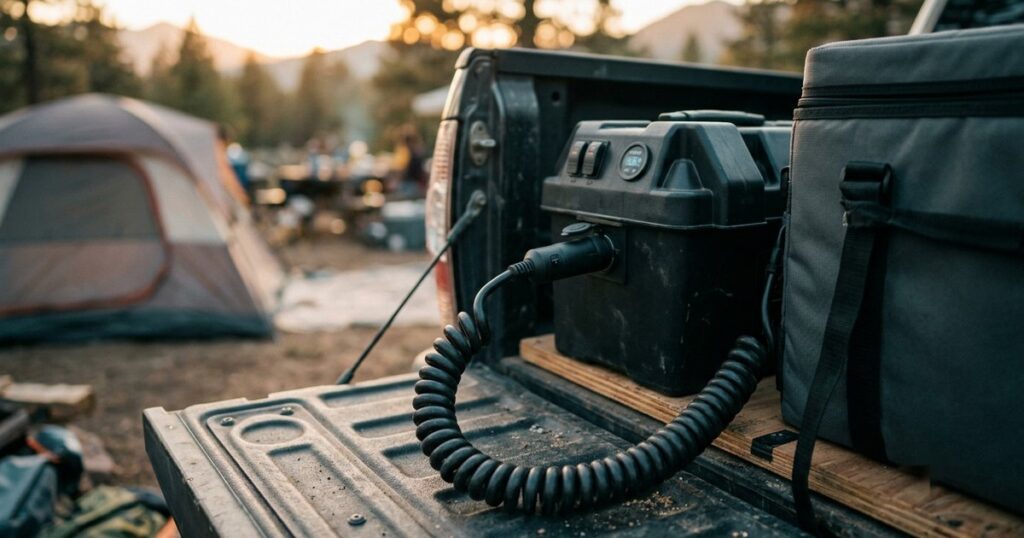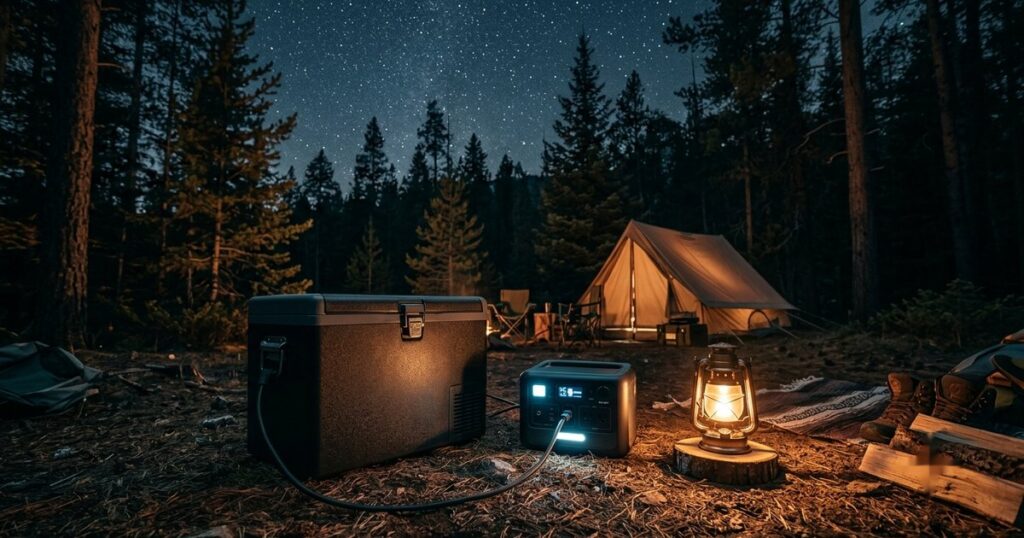
Most people buy twice the power station they need. The boxes are sold on one big number – the watt-hours – and the marketing nudges you to round up “just in case,” so you end up lugging a 20kg slab to run a phone charger and a string of fairy lights. The right size is almost always smaller, lighter and cheaper than you think.
There’s exactly one piece of math that gives you the answer, and it fits on a beer mat. Work through it once and you’ll know whether you need a 300Wh runt or a 2000Wh monster. I’ll give you the formula, the real-world device draws to plug into it, four honest sizing tiers, and the mistakes that quietly cost people the most money.
The only formula you need
Work out your daily watt-hours, multiply by how many nights between charges, then divide by 0.85 because no power station gives you all its rated capacity (more on that below). That’s it.
Everything else is detail. The two numbers you have to get right are your daily watt-hours and your nights between charges. Let’s nail both.
Step 1: add up your daily watt-hours
Watt-hours (Wh) are watts × hours. A 10W fan running 5 hours is 50Wh. Add up everything you’ll run in a typical 24 hours. Here are realistic figures – not the nameplate maximums, the actual daily draw campers report – so you can build your number without guessing.
| What you’re running | Typical daily energy | Notes |
|---|---|---|
| 12V compressor fridge (35-60L) | 300 to 500 Wh/day | The big one. Cycles on and off; more in heat |
| Phone charging (x2) | 30 to 50 Wh/day | A phone battery is only ~12-20Wh |
| Tablet / laptop | 50 to 90 Wh/day | One full laptop charge is ~60-90Wh |
| LED camp + string lights | 20 to 60 Wh/day | LEDs sip power; run all evening for pennies |
| Fan (12V, overnight) | 60 to 120 Wh/day | Summer sleeping; runs for hours |
| CPAP (no humidifier/heater) | 100 to 250 Wh/night | Turn OFF the heated humidifier off-grid |
| Starlink Mini | 240 to 360 Wh/day | Roughly 10-15W, but it runs all day |
| Drone / camera batteries | 40 to 100 Wh/day | Depends how much you fly/shoot |
A common car-camping setup – a fridge, phones, some lights and a bit of device charging – lands around 400 to 600Wh a day. Add a CPAP or Starlink and you’re closer to 700-900Wh. Note how badly the fridge dominates: it’s usually more than everything else combined, which is why the fridge clusters (amp draw and runtime) get their own posts.
The overnight fan row in the table above is not only for people. If a dog sleeps in the tent in summer, a small fan is worth the watt-hours: our guide to keeping a dog cool while camping notes that cooling gear works better with moving air.
Step 2: multiply by nights, divide by 0.85
Say your daily budget is 500Wh and you want two nights between charges. That’s 1000Wh of energy. But a power station rated “1000Wh” will not hand you 1000Wh – call it 850. So divide by 0.85: you actually want a unit rated around 1175Wh. A ~1000Wh unit gets you most of the way and a small top-up from the car or a panel closes the gap; a 1200Wh+ unit does it with room to spare. See how quickly “I need a huge battery” turns into “a midsize one is fine”?
The honest sizing tiers (skip the math if you want)
If you’d rather not add anything up, find yourself in this list:
- Phones, lights, a speaker (no fridge): ~200 to 400Wh. A small unit or even a big USB power bank. Don’t buy a 1000Wh slab to charge a phone.
- A 12V fridge for a weekend, plus the usual devices: ~600 to 1000Wh. The sweet spot for most car campers. A ~1000Wh LiFePO4 unit is the do-it-all.
- Fridge plus CPAP or Starlink, or 3 to 4 nights: ~1000 to 1500Wh, ideally with a solar panel to stretch it.
- A week off-grid, a group, or anything with a heating element (kettle, mini AC): 2000Wh+ and solar, full stop. Resistive heat eats batteries alive; size up and recharge from the sun.
Once you know your tier, the next question is whose box to buy. There are really only four brands to choose between, and the power station brand guide says which one suits which camper.
The thing that changes everything: solar
A solar panel doesn’t just “add a bit” – it changes the question from “how big a battery do I need to last the trip” to “how big a battery do I need to last one cloudy day.” A 100-200W portable panel in decent sun can put back roughly what a 12V fridge pulls in a day. Pair a midsize power station with a panel and a weekend unit comfortably does a week. If you camp in the same spot for days, solar is a better spend than a bigger battery.
The honest caveat: panels make their rated watts in lab sun, not under a tree at 8am. Plan for maybe 60-70% of the rated figure on a good day, less when it’s cloudy or the panel’s flat on the ground instead of angled at the sun. Buy a bit more panel than the math says, and tilt it.
Why you never get the number on the box
That 0.85 in the formula isn’t pessimism, it’s physics. Independent testers consistently measure 80 to 90% usable capacity out of a power station’s rated watt-hours. The losses go to the inverter turning battery DC into mains AC (a pure sine inverter runs ~85% efficient), the battery management system, and the always-on display. OutdoorGearLab’s bench tests and teardown channels like HOBOTECH show the same thing: a “1000Wh” unit delivers more like 850Wh to your gear.
One practical trick that buys back a chunk of that loss: run your 12V fridge off the power station’s DC output (the car socket or a DC port), not the AC outlet. Going battery to AC to the fridge’s own adapter back to DC wastes energy at every step. Battery straight to 12V skips the inverter and is noticeably more efficient. Field testers see fridges last meaningfully longer on DC than plugged into the AC socket.
For that trick worked through on one model line, see whether a Jackery Explorer 1000 will run a 12V fridge: the 12V port against the AC outlet, in hours.
The mistakes that cost the most
- Confusing watts with watt-hours. Watts (W) is how much it can push at once; watt-hours (Wh) is how much it stores. A 2000W unit with a tiny battery is a sprinter with no stamina. For camping, watt-hours is the number that matters, plus enough watts to start your biggest single device.
- Overbuying “just in case.” The single most common and most expensive mistake. Do the math, then add a sensible buffer, not a panic doubling. A panel beats a bigger battery for longer trips.
- Buying an AC-only mindset. A unit with good 12V DC output runs a fridge more efficiently than one you only ever plug into the AC socket. Check the DC ports.
- Ignoring battery chemistry. Newer units use LiFePO4 (LFP): ~3000+ cycles and happier in heat, versus the old NMC packs at ~500-800 cycles. For something you’ll keep for years, LiFePO4 is worth holding out for.
- Forgetting the recharge. A big battery you can’t refill is a one-shot. Check how fast it charges from the wall and the car, and whether it takes the solar input you’ll actually carry.
Watch someone actually test one
If you want to see real capacity testing rather than spec sheets, HOBOTECH’s channel is the gold standard for it – he meters the real usable watt-hours out of these units. Here’s his rundown of the current EcoFlow Delta 3 line, the range most car campers are choosing from:
Next, the specifics: best power stations for car camping · how long a power station runs a 12V fridge · how many amps a 12V fridge really draws · best 12V fridge for overlanding.
The receipts: what I read and watched
- Field testMeters the genuine usable watt-hours and charge speeds of the current Delta 3 line.
- Expert reviewHow We Test Power Stations (usable-capacity methodology) ↗ – OutdoorGearLabBench tests confirm units deliver ~80-90% of rated Wh once inverter/BMS losses are counted.
- Expert reviewBest Portable Power Stations of 2026 (tested) ↗ – GearJunkieIndependent picks and capacity/output testing across the current EcoFlow, Anker, Jackery and Bluetti line.
- Hard numbersWalks the usable-capacity discount (~85%) and the runtime math used in this guide.
- Hard numbersHow Much Power Does a 12V Camping Fridge Use ↗ – National LunaReal-world daily fridge draw figures behind the 300-500Wh/day estimate.
FAQ
What size power station do I need for a weekend of car camping?
If you’re running a 12V fridge plus phones and lights, a ~1000Wh unit is the safe weekend pick, and you can often get away with 600-800Wh if you add a solar panel or top up from the car. No fridge? 300-400Wh is plenty. Do the math: daily watt-hours × nights ÷ 0.85.
Is 1000Wh enough for camping?
For most people, yes. A 1000Wh unit gives roughly 850Wh usable, which covers a 12V fridge (~300-500Wh/day) plus device charging for a long weekend. Add a panel and it stretches to a week. It only falls short if you run a CPAP every night plus a fridge, or anything with a heating element.
Should I get a bigger battery or a solar panel?
For trips longer than two or three nights in one spot, a solar panel is usually the better spend. A 100-200W panel can replace roughly a fridge’s daily draw in good sun, so a midsize battery plus a panel outlasts a much bigger battery on its own, for less weight and money.
Why can’t I use all the watt-hours the power station is rated for?
Inverter losses (turning battery DC into mains AC), the battery management system and the display all draw power, so you get about 80-90% of the rated figure to your devices. That’s why this guide divides by 0.85. Running 12V gear off the DC output instead of the AC socket recovers some of it.
What does a 12V fridge actually add to my power needs?
A compressor fridge is the single biggest load in most camp setups – around 300-500Wh a day, more in hot weather. It typically uses more than everything else combined. We break the numbers down in how many amps a 12V fridge draws.