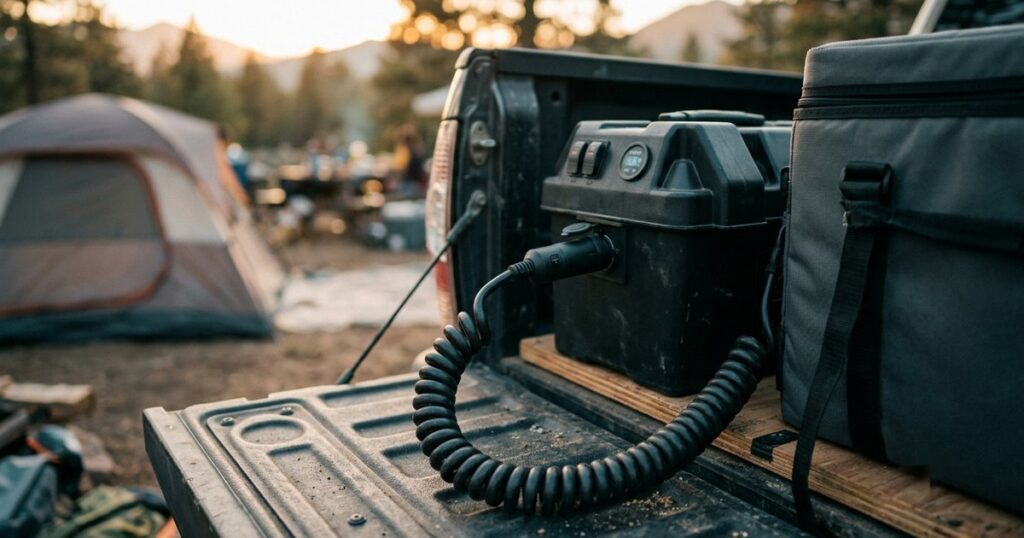
Yes. A Jackery Explorer 1000 v2 runs a 40-55L 12V compressor fridge for about 45-65 hours in mild weather and 25-45 hours in real heat, if the fridge is on the 12V car port. The 1000 Plus adds roughly 18% to those numbers. Plug the same fridge into the AC outlet and you lose a third of that runtime to the inverter. Two settings decide whether it makes it through the night: turn off Jackery’s Energy Saving auto-off, and set the fridge’s battery protection to Low. The rest of this page is the working.
How long will a Jackery 1000 actually run a 12V fridge?
Nobody has published a metered 12V-port capacity test for the v2 or the Plus, so this table is built from what has been measured: the rated watt-hours, the AC efficiency two reviewers measured (85% for the v2 at OutdoorGearLab, 83% for the Plus at Trusted Reviews), a conservative 90% for the DC path, and the inverter’s own idle draw, which The Solar Lab metered at about 17W on the same-generation 2000 v2. The formula is simple: usable watt-hours divided by what the fridge averages over a day, compressor cycling included.
| Unit and port | Usable Wh | Mild, 35W avg | Warm, 45W avg | Hot or freezer, 70W avg |
|---|---|---|---|---|
| Explorer 1000 v2, 12V port | ~963 | 27 h | 21 h | 14 h |
| Explorer 1000 v2, AC outlet | 910 (measured) | 20 h | 17 h | 11 h |
| Explorer 1000 Plus, 12V port | ~1,138 | 33 h | 25 h | 16 h |
| Explorer 1000 Plus, AC outlet | 1,052 (measured) | 23 h | 19 h | 13 h |
| Original Explorer 1000 (NMC, discontinued), 12V port | ~902 | 26 h | 20 h | 13 h |
Those fridge averages are deliberately pessimistic. They are what you plan around. What owners actually meter is lower: a Dometic CFX3 45 on a Jackery 500 at 70F averaged under 7W with the lid shut and 13-14W in real use; a CFX3 55IM on a Goal Zero drew about 6.5W in cool weather and 18W at 80F; an ICECO VL35 on an Explorer 1500 through a watt meter averaged 21W across a week that ran from the low 60s to the mid 80s. At a measured 15W mild or 22W warm on the 12V port, the v2 lands at 64 or 44 hours and the Plus at 76 or 52. That is why Jackery’s own 45-60 hour claim for the v2 is not marketing; it is about right for a 45L fridge that is not being opened every ten minutes in the sun.
The number that moves everything is ambient temperature. The same CFX3 55IM went from roughly 0.5 amp-hours an hour at 30-65F to 1.4 at 80F on the same power station. That is nearly three times the draw. Shade the fridge, pre-chill it on shore power, keep it full, and the table above is your worst case rather than your average. Our 12V fridge amp-draw guide has the full set of metered numbers by model.
Should the fridge go on the 12V port or the AC outlet?
The 12V port, every time. Two people have measured the difference on the same fridge and the same station. Mike Sokol ran a Vitrifrigo compressor fridge on an Explorer 1500: 28W average through the 12V port, 45W average through the AC inverter and the fridge’s own power brick, which is 37% more energy for the same cold. A Wrangler owner ran an ICECO VL45 on a Bluetti AC70P (864Wh) for twelve hours each way: 25% of the battery via DC, 37% via AC. The reason is that a 1kW inverter idles at 12-18W whether or not the compressor is running, and 12-18W is about what the fridge itself averages. You are paying for two fridges and cooling one.
The port’s limit is 10A, which is 120W. A Dometic CFX3 45 pulls 7-8A when the compressor starts, so the fridge gets the port to itself. Lights, fans and phones go on the USB ports. And use the fridge’s own 12V lead straight into the socket: Dometic’s support pages blame splitters, pigtails and extensions for most of the low-voltage alerts they see.
Why does the fridge shut off at 3 AM?
Two separate mechanisms, and both are settings rather than faults.
Jackery’s Energy Saving mode. Both the 1000 v2 and the 1000 Plus turn their outputs off after twelve hours if the load on the car port stays at or below 2W. A compressor fridge idles at 0.6-1W between cycles. On a cold night with the lid shut, a well-insulated fridge can go a long time between cycles, and Jackery does not document whether each cycle resets the twelve-hour timer. Do not find out at 3 AM. Hold the AC button and the main power button together until the Energy Saving icon disappears, or switch it off in the app, before the first overnight run.
The fridge’s own battery protection. Every compressor fridge has a low-voltage cutoff to stop it flattening a car’s starter battery. Dometic’s High setting cuts out at 11.8V and will not restart until it sees 12.6V. The original Explorer 1000 holds a regulated 13.2V on its car port; Jackery has not published the figure for the v2 or the Plus, and a regulated 12V output plus a little cable drop under compressor start can sit right on that 11.8V line. Set the fridge to Low, which is what Dometic itself recommends for any supply that is not a starter battery. The power station has its own BMS; it does not need the fridge protecting it.
v2 or Plus: which one for a fridge?
The v2 if the fridge is the job and you recharge daily. It is 1,070Wh, 24 lb, refills from the wall in about an hour and a half, and takes 400W of solar, which means a single SolarSaga 200 panel puts a mild-weather fridge day back in a few hours of sun. The Plus if you want two or three nights without plugging in, or the fridge plus a laptop and a Starlink, or you can see yourself adding a battery pack later. It is 1,264Wh, 32 lb, 2,000W on the inverter, expandable to about 5kWh, and it charges from a car socket in 7 hours instead of the v2’s 12. Neither will keep up with a hot-weather fridge on driving alone; Off Grid Benchmark put about 450Wh into a v2 over a four-hour drive. If you drive a lot and camp hot, that is the case for a panel or an alternator charger, covered in the car-charging guide.
Skip the original Explorer 1000. It is NMC chemistry rated for 500-800 cycles against 4,000 for the two LiFePO4 units, Jackery lists it as out of market, and the refurbished listings are not cheap enough to make up for it.
The picks
Jackery Explorer 1000 v2
The weekend fridge unit. 1,070Wh LiFePO4, 85% measured AC efficiency, 12V/10A car port, 1.6 hour wall recharge, 24 lb. Turn off Energy Saving before the first night.
Jackery Explorer 1000 Plus
The multi-day unit. 1,264Wh LiFePO4, 2,000W inverter, expandable with up to three battery packs, 7 hour car-socket recharge. Buy it for the expansion, not the extra 18%.
Jackery SolarSaga 200W
The panel that turns a two-day fridge into an indefinite one. Rated 200W; Off Grid Benchmark measured 340-380W from a pair. One is enough for a mild-weather fridge day.
Dometic CFX3 45
The fridge with the best-documented draw: under 7W sealed and 13-14W in use at 70F on a Jackery. Set its battery protection to Low from the app and it will not argue with the car port.
ICECO VL45
Dometic-class Secop compressor for less money. Metered at 25% of an 864Wh Bluetti per twelve hours on DC at 72-74F indoors, and about 13Ah a day in August heat.
What to skip
A 12V splitter or an extension lead on the fridge cable; Dometic blames them for most low-voltage alerts. Running the fridge on AC to “be safe”; it is the opposite. Any 12V fridge with a thermoelectric (Peltier) cooler instead of a compressor; those draw 40-60W continuously with no cycling and will flatten the v2 in under a day while barely cooling. And a second fridge on the same car port; the 10A ceiling is real.
The receipts: what I read and watched
- ManufacturerJackery Explorer 1000 v2 Portable Power Station ↗ – jackery.com1,070Wh LiFePO4, 1,500W/3,000W AC, car port 12V/10A, 1.58 h wall / 12 h car / 7.5 h solar, 23.8 lb, charges at 0-45C.
- ManufacturerJackery Explorer 1000 Plus Portable Power Station ↗ – jackery.com1,264.64Wh LiFePO4, 2,000W/4,000W AC, car port 12V/10A, expandable to 5,056Wh, 32 lb, 1.7 h wall recharge.
- ManufacturerExplorer 1000 Plus user manual ↗ – Jackery (PDF)Energy Saving mode: outputs off after 12 h at AC 25W / USB 2W / car port 2W or less; disable by holding AC + main power.
- ManufacturerHow to disable Jackery auto shut down ↗ – jackery.comThe 12-hour low-load thresholds and the button combination, listed for both the 1000 v2 and the 1000 Plus.
- ManufacturerExplorer 1000 v2 or 1000 Plus? ↗ – uk.jackery.comJackery’s own fridge claim: v2 45-60 h, Plus 53-72 h for a 30-45W 12V fridge, using capacity x 0.85 / watts.
- ManufacturerJackery 1000 vs 1000 Pro vs 1000 Plus vs 1000 v2 ↗ – jackery.comOriginal Explorer 1000 and 1000 Pro listed as out of market; 1,002Wh NMC, 500 cycles to 80%.
- Expert reviewJackery Explorer 1000 v2 Review ↗ – OutdoorGearLabMeasured energy output 910Wh of 1,070 (85%); 563Wh per hour charging; 24.4 lb on the scale.
- Expert reviewJackery 1000 v2 Review ↗ – The Solar Lab87.5% efficiency at a 1,479W load; about 1 h 35 min to a full AC charge.
- Expert reviewJackery Explorer 1000 Plus Review ↗ – Trusted Reviews1,052Wh delivered at a 1kW load, 83% efficiency; 1.365kWh consumed to recharge.
- Hard numbersJackery Explorer 2000 v2 Review ↗ – The Solar LabAbout 17W standby with the inverter on; the same-generation platform, used here as the idle-draw proxy.
- Hard numbers12V vs 120V fridge in a van or RV ↗ – Off Grid BenchmarkA 1kW inverter idles at 12-18W, 290-430Wh a day; CFX3 50 480Wh/day, VL45 432Wh/day on 12V.
- Hard numbersInverter loss: 12-volt vs 120-volt energy usage ↗ – RVelectricity (Mike Sokol)Same fridge on an Explorer 1500: 28W average via 12V DC (54 h) against 45W via the AC inverter (33 h).
- Owner reportsFridge power consumption: AC vs DC vs insulated ↗ – JL Wrangler ForumsICECO VL45 ProS on a Bluetti AC70P (864Wh), 72-74F: 37% per 12 h on AC, 25% on DC, 24% with an insulated jacket.
- Owner reportsMy Jackery / Dometic test run ↗ – JL Wrangler ForumsExplorer 500 + CFX3-45 on the 12V port at 70F, lid shut: 70 h with 8% left; in real use, 100% to about 70% per night.
- Hard numbersICECO VL35 ProS review ↗ – Gnomad Home508Wh per day through a watt meter on an Explorer 1500 over 123 hours, low 60s to mid 80s F; idle 0.6W between cycles.
- Hard numbersAlpicool C20 portable refrigerator ↗ – hagensieker.com10% of a Jackery 500 every six hours at 70F; 48 hours with power to spare; compressor about 3 minutes in every 20.
- Hard numbersReview: Dometic CFX3 55IM 12-volt fridge ↗ – RECOIL OFFGRIDOn a Goal Zero Yeti 1500X: about 0.5Ah/h at 30-65F and 1.4Ah/h at 80F; protection levels Low 10.1V, Med 11.2V, High 11.8V.
- Hard numbersICECO VL45 review ↗ – RVB PrecisionAbout 6.3Ah in the first 24 h in a cool garage; 110Ah AGM from 100% to 65% over 72 h in low-90s heat.
- Hard numbersTrail tested: CFX3 power consumption ↗ – trail4runner.com48-hour shunt test of three Dometics at 34F: CFX3 75DZ 31.1Ah/day, 55IM 24.8, CFX50 21.7.
- Expert reviewJackery Explorer 1000 v2 review ↗ – Off Grid BenchmarkA 60W-rated Dometic CFX3 ran about 14 h flat out and closer to 22 h with cycling; a 4-hour drive added about 450Wh.
- Expert reviewJackery Explorer 1000 Plus review ↗ – Off Grid Benchmark12V cooler plus lights, phone, speaker and laptop: 26-28 hours; 100 minutes to recharge from AC.
- Owner reportsJackery 1000 power generator overview ↗ – Overland Bound forumJackery 1000 plus an ICECO at 37F uses about 14% overnight and is back to full by noon on a panel.
- Expert reviewJackery power station for vanlife ↗ – FarOutRideThe 10A car port is the limit: a Dometic pulls about 7A at compressor start, the CFX3 45 8.2A.
- Expert reviewJackery Explorer 1000: what you should know before buying ↗ – RV With TitoThe original Explorer 1000’s car port measured a steady 13.2V under load.
- ManufacturerDometic CFX series manual: battery monitor ↗ – ManualsLib12V cutoff and restart: Low 10.1/11.1V, Med 11.4/12.2V, High 11.8/12.6V.
- ManufacturerRecommended battery protection settings (CFX3) ↗ – Dometic supportHigh or Medium from a starter battery; Low from an accessory or dual battery.
- ManufacturerCFX says ALERT VOLTAGE LOW even though it is plugged in ↗ – Dometic supportDo not use splitters, pigtails or extensions on the 12V lead.
- ManufacturerICECO VL45 portable refrigerator/freezer ↗ – icecofreezer.com55W rated; 0.347kWh per 24 h in the lab; three-stage battery protection.
- ManufacturerJackery SolarSaga 200W solar panel ↗ – jackery.com200W rated, 14.33 lb; the v2’s 7.5-hour solar recharge spec assumes 200W of panel.
- Field testJackery 1000 Plus 2000w LiFePO4 Modular UPS Solar Generator Power Station Review ↗ – HOBOTECH (YouTube)Independent review of the 1000 Plus with a capacity run-down.
- Field test24 Hour – 93F Degree – 12v Fridge Test! ICECO VL45 vs SetPower RV45s ↗ – Jasonoid (YouTube)24-hour consumption of a 45L compressor fridge at 93F, on camera.
FAQ
How long will a Jackery 1000 run a 12V fridge overnight?
A 45L compressor fridge on the 12V port uses roughly 10-20% of an Explorer 1000 v2 over an eight-hour mild night, and 20-30% on a warm one. Owners running a Jackery 1000 with an ICECO report about 14% overnight at a 37F setpoint. One night is never the problem; day three is.
Can the Jackery 1000 v2 run a fridge and charge from solar at the same time?
Yes. Both units pass power through, and the v2 takes up to 400W of solar. Jackery’s own advice is to keep pass-through loads under about 200W for battery longevity, and a fridge is a fraction of that. A single SolarSaga 200 puts a mild-weather fridge day back in a few hours of decent sun.
Why does my fridge say low voltage on a Jackery that shows 90%?
The fridge’s battery protection is set to High or Medium and the car port’s regulated 12V, minus a little cable drop on compressor start, is dipping under its cutoff. Set the fridge to Low. Dometic recommends exactly that for any supply that is not a starter battery.
Is the Jackery 1000 Plus worth it over the v2 for a fridge?
Only for the expansion or the second big load. The Plus is 18% more capacity for 8 lb more weight, which on its own is not a reason. Add a battery pack, or a laptop and a Starlink, and it becomes one.
Will a Jackery 1000 run a 12V fridge in winter?
Discharging is fine down to 14F. Charging is not: LiFePO4 will not accept a charge below 32F and the unit waits until it warms up. Keep the station inside the tent or vehicle overnight and the fridge will draw so little in the cold that it hardly matters.