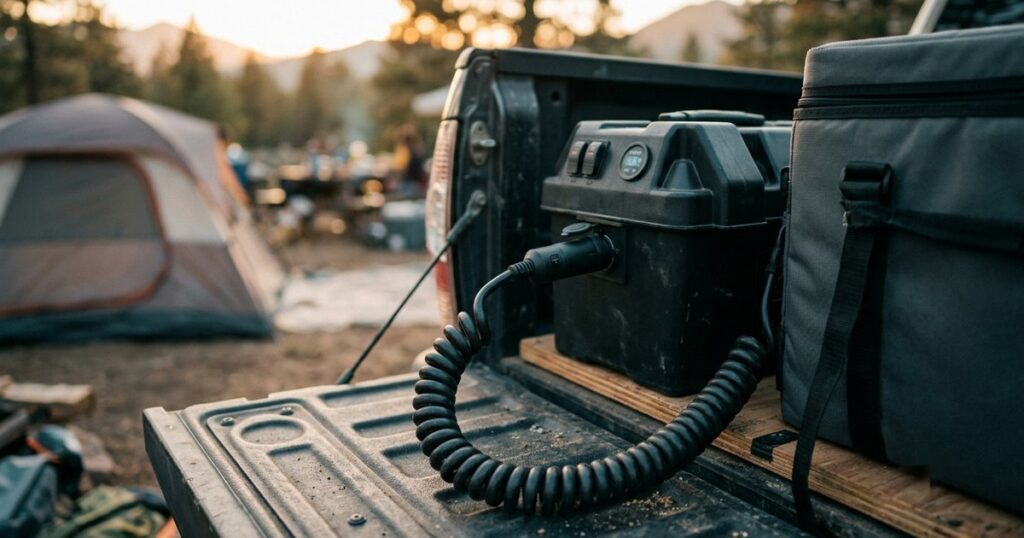
Short answer: yes, for one night, on a healthy battery, in mild weather, if you drive the next day. A mid-size 12V compressor fridge takes about 9 to 13 amp-hours out of the battery over a ten-hour night. A common mid-size starter battery holds around 55 to 70. That is roughly a fifth of the battery, and the truck starts in the morning.
The trouble starts with the word “overnight”. The stories that end with jumper cables are almost never about one night. They are about a second night, a hot afternoon parked at camp, or a full day where the truck never moved. The fridge kept sipping the whole time, and a starter battery was never built to be sipped from. Here is the math, the three settings that decide how it goes, and the insurance to carry if you are going to do it anyway.
The overnight math, in two numbers
Number one: what the fridge takes. A compressor fridge pulls roughly 3 to 5 amps while it runs (GNOMAD Home measured 33 to 55 watts on an Iceco), but it cycles, so the number that matters is the average. Trail4Runner metered three Dometic fridges from 50 to 75 litres at a 34F setpoint through Victron shunts and logged 0.90 to 1.29 amp-hours per hour over the first day. GNOMAD Home logged a thirstier 1.76 on that small Iceco across five days that swung from the mid-eighties in the afternoon to the low sixties before dawn. Call it 9 to 13 Ah for a ten-hour night with an efficient fridge, and up to about 18 Ah for a hard-working one. (The long version is in our amp-draw guide.)
Nights are the easy shift. It is cooler, nobody opens the lid, and the food is already cold. No published test I could find splits night from day, so these figures use the 24-hour average, which if anything overstates the night.
Number two: what the battery holds. Starter batteries are sold on cranking amps, so the capacity is the number nobody looks at. Interstate’s Group 35 AGM is printed at 55 Ah with 100 minutes of reserve capacity. Where a label only gives reserve capacity (minutes at 25 amps), Clarios, one of the largest car battery makers, gives a rough conversion: multiply by 0.6. On East Penn’s Deka spec sheet an H6 AGM is listed at 120 minutes and an H8 at 170, which the rule turns into about 72 Ah and about 100 Ah. The rule runs a little generous against printed ratings (it would call that 55 Ah Interstate a 60), so read the table as the good case.
What one night costs
| Starter battery | Efficient fridge, mild night (9-13 Ah) | Hard-working fridge, warm night (~18 Ah) |
|---|---|---|
| Group 35, 55 Ah | 16-24% of the battery | 33% |
| H6 class, ~72 Ah | 13-18% | 25% |
| H8 class, ~100 Ah | 9-13% | 18% |
Those percentages assume a battery that is healthy and was full when you parked. Add a little for the car itself: Optima calls 25 milliamps of key-off draw acceptable and says 85 is not unusual on newer vehicles, which is under 1 Ah a night. The fridge is the load that counts.
Why a starter battery hates this job
A starter battery is built for a two-second burst and an immediate recharge. Battery University describes the design as many thin plates in parallel for high surface area, and says it plainly: the starter battery does not allow deep cycling. Its cycle-life table puts numbers on it.
| How deep each discharge goes | Starter battery | Deep-cycle battery |
|---|---|---|
| 30% | 130-150 cycles | 1,000 and more |
| 50% | 100-120 cycles | 400-500 |
| 100% | 12-15 cycles | 150-200 |
Read that against the first table. Every fridge night is a discharge somewhere between 15 percent and a third, so each one is a cycle off a budget of roughly 130 to 150. Use the fridge this way every camping weekend and that budget lasts a few seasons, not the life of the truck. Flatten the battery completely and the budget is about a dozen.
Optima is stricter still. Its advice for long battery life is to never let voltage drop below 12.4 volts. On the Battery Council chart that Battery University reproduces for flooded starter batteries, a rested 12.45 V is 75 percent charged and 12.24 V is 50 percent. So by the battery maker’s own standard, even one fridge night dips into the zone it tells you to stay out of. You can do it. It is not free.
Cold makes the morning harder from both ends. AAA’s figures: a battery loses about 35 percent of its strength at 32F and about 60 percent at 0F, while the engine can need up to twice the current to turn over. The fridge runs less on a cold night, so the drain is smaller, but so is the margin you are draining from.
The three settings that decide how it goes
1. Battery protection: set it to High
The fridges covered here all have a low-voltage cutoff with three levels, and the level it left the factory on is not always the right one. BougeRV ships on High; one Expedition Portal owner found both his ARB and his Dometic on Medium. The makers broadly agree on what a starter battery needs:
- ARB: “High is best if the fridge is connected to the vehicle’s starting battery.” High switches off at 11.8 V and restarts at 12.6 V.
- Dometic: High or Medium on a starter battery, Low only on an accessory or dual battery. The older CFX35W manual prints the same thresholds as ARB (High off at 11.8 V, Medium 11.4 V, Low 10.1 V) and says High for a starter battery.
- BougeRV: High with a car battery. Its High cuts out at 11.3 V; Medium is 10.1 V and Low is 9.6 V.
- Iceco (VL45/60 ProS): High cuts out at 11.1 V, Medium 10.1 V, Low 9.6 V.
Notice that “High” is not one number. It is 11.8 V on an ARB and 11.1 V on an Iceco. And notice where those sit against the battery chart: a rested starter battery at 11.89 V is empty. The reason the cutoff is not useless is that the fridge does not go by resting voltage. Dometic’s support page spells it out: the CFX3 uses the voltage with the compressor running, not the battery’s no-load voltage, and that reading is lower than what the battery shows at rest.
The practical meaning: the cutoff is a backstop, not a fuel gauge. It can work. That same Expedition Portal owner says both fridges, even on Medium, cut off in time on stock batteries, and the truck started at eleven-point-something volts, “if a little slow”. But Medium on his ARB is 11.4 V. Medium on a BougeRV or an Iceco is 10.1 V, and Low is 9.6. Pick High, which leaves the most margin whatever the badge, and treat a morning start as likely, not guaranteed.
2. The socket: is it even on with the key out?
Plenty of people find out at 6 a.m. that the fridge has been off since they locked the doors. Whether a 12V socket stays live is in the owner’s manual, and it varies by vehicle and by socket:
- Chevy Silverado (2019 on): “Power is always supplied to the outlets.” 15 amp limit.
- Jeep Wrangler JL: the front outlet only works with the ignition in ON or ACC. The rear cargo outlet can be fed from the battery at all times or from the ignition, depending on which slot the 20 amp fuse sits in (F43 or F45).
- Subaru Forester: outlets work only with the ignition in ACC or ON, 120 watt limit.
The same manuals carry the warning. Jeep’s names coolers specifically as accessories that will “degrade the battery even more quickly”. Chevrolet’s says equipment left plugged in with the vehicle off “will drain the battery”. The automakers are not telling you it cannot be done. They are telling you whose problem it is.
If your socket dies with the key, leaving the ignition in ACC all night is the wrong fix, because it powers more than the socket. A fridge that is already cold will coast for a while with the lid shut, but that is a workaround. The right fix is a socket wired to the battery.
3. The cable: thin wire trips the cutoff early
ARB’s own tips page says most factory cigarette sockets “are designed to power no more than a cell phone”. Push a compressor’s start-up current through thin wire and the voltage at the fridge sags below the battery’s, so the fridge thinks the battery is lower than it is and shuts off. Dometic’s fix list for its low-voltage alert includes: “Do not use splitters, pigtails or extensions.”
On High, with the factory socket, that sag works in your favour, since the fridge quits early and the battery keeps more. It also means warm food. ARB sells a dedicated wiring kit as the alternative to the factory socket: 20 feet of 10 AWG with a built-in 15 amp fuse and a threaded socket. With a proper feed the cutoff reads closer to the truth, and High is doing the protecting instead of the wiring.
ARB fridge wiring kit
The heavier feed ARB sells in place of the factory socket: 20 feet of cable with an in-line fuse, eyelets for the battery terminals and a dedicated threaded socket. ARB’s tips page calls the cable 10 AWG and the listing calls it 8-gauge (6mm). Either way it runs from the battery, so the socket stays live with the key out and the fridge reads the battery instead of the wiring.
What owners report (it splits exactly where the math says)
The single-battery thread on IH8MUD, a Land Cruiser forum, reads like the table above with names attached:
- One owner drove 5 to 7 hours a day for three days with 10 to 12 hours parked each night. Started every morning.
- One runs an Engel 40 on an Optima YellowTop: starts after 48 hours parked, does not start after 72.
- One parked mid-morning Saturday on a hot weekend. Dead Sunday morning.
- One in Sacramento: miss a single day of driving in summer and the fridge kills the battery.
The pattern is not luck. Drive every day and the fridge works on a starter battery more or less indefinitely. Park for a day in the heat and it does not. One poster on Expedition Portal gave up on the single-battery approach for the other half of the reason: he never drove enough each day to recharge the battery fully, so each morning started a little lower than the last.
If you are doing it anyway: the checklist
- Battery protection on High. Check it; do not assume.
- Pre-chill at home on wall power, food and drinks included. Every degree the fridge has to pull out of warm cans at camp comes out of the starter battery.
- Eco mode overnight. GNOMAD Home measured the Iceco’s compressor at about 33 watts in Eco against 55 in Max.
- Plug straight into a socket you know is live. No splitter, no extension.
- Shade and airflow. National Luna’s test fridge ran its compressor 18 to 20 percent of the time at 70F ambient and 30 to 50 percent at 109F.
- Drive the next day, and for hours, not minutes.
- Carry a jump starter. It is the backup the forum regulars keep recommending.
- Tired battery, or a hard frost coming? Skip it. The table assumed a healthy, full battery.
NOCO Boost GB40
Item seven on the list. NOCO rates it at 1,000 amps and up to 20 jump starts per charge, for gas engines up to 6.0 litres and diesels up to 3.0. It gets the engine running; it does not undo the wear on the battery.
When to stop using the starter battery
The honest dividing line is how long the truck sits.
Road trip, moving every day: the starter battery is fine. High cutoff, jump starter in the door, done.
Base camp, parked two nights or more: the fridge needs its own battery. The no-wiring answer is a power station on the fridge’s 12V lead. A 1,000Wh unit runs a mid-size fridge about two days on its own, and the starter battery is never part of the conversation. The runtime table is in how long a power station runs a 12V fridge, and sizing for the rest of your kit is in what size power station you actually need.
EcoFlow Delta 3 Plus (1,024Wh)
The one we already recommend for fridge duty: about two days of fridge on the DC socket, and it recharges from the car while you drive.
Every weekend, all season: wire the truck once. A second battery behind a DC-DC charger runs the fridge for days and cannot strand you, because it is not the battery that starts the engine. The full build, with cable and fuse sizes, is in the dual-battery guide. If you are still choosing between power station brands, start with which power station brands are worth buying.
What to skip
- Low or Medium “so the beer stays cold”. Medium on a BougeRV or Iceco is 10.1 V. That is a flat battery with cold beer in it.
- Idling the engine to top up. The owner who quit the single-battery approach was driving every day and still never got the battery back to full. A short idle at camp will not do better.
- A thermoelectric cooler. No compressor, no duty cycle: as covered in the amp-draw guide, it pulls a constant 4 to 5 amps every hour it is on. Ten hours is 40 to 50 Ah, which is most of a mid-size starter battery.
- Trusting the dash voltmeter the moment you stop. Battery University says a battery needs at least four hours of rest before open-circuit voltage means anything, and that battery makers recommend 24.
Build the rest of the rig: how many amps a 12V fridge really draws · how long a power station runs a 12V fridge · the dual-battery setup, sized right · best 12V fridge for overlanding · charging a power station while driving
I have not metered a fridge on a starter battery myself. Every number above comes from the tests, manuals and owner reports listed here.
The receipts: what I read and watched
- Hard numbersCFX3 power consumption test ↗ – Trail4RunnerThree Dometic fridges at 34F on Victron shunts: 0.90, 1.03 and 1.29 Ah per hour over 24 hours.
- Expert reviewIceco VL35 ProS review ↗ – GNOMAD Home2,612.9Wh over 123.43 hours (1.76 amps average), ambient mid-eighties to low sixties; compressor about 55W in Max, 33W in Eco.
- Hard numbersHow much power does a 12V camping fridge use ↗ – National LunaCompressor duty cycle at 21C, 32C and 43C ambient.
- Hard numbersBU-201: How does the lead acid battery work ↗ – Battery UniversityCycle life of starter versus deep-cycle batteries at 30, 50 and 100 percent depth of discharge.
- Hard numbersBU-903: How to measure state of charge ↗ – Battery UniversityThe BCI open-circuit voltage chart for starter batteries, and the rest time a reading needs.
- ManufacturerThe RC x 0.6 rule of thumb.
- ManufacturerMTX-35 AGM spec page ↗ – Interstate BatteriesGroup 35: 55 Ah, 100 minutes reserve capacity.
- ManufacturerDeka automotive battery spec sheet ↗ – East Penn (PDF)Reserve capacity by group size (H6 AGM 120 minutes, H8 AGM 170).
- ManufacturerWhat is normal for parasitic draw ↗ – OptimaKey-off draw figures and the 12.4 volt rule.
- ManufacturerFridge freezer tips and tricks ↗ – ARB USACutoff voltages for Low, Medium and High, which to use on a starting battery, and the wiring kit spec.
- ManufacturerRecommended battery protection settings ↗ – Dometic supportHigh or Medium on a starter battery; Low on an accessory or dual battery.
- ManufacturerCFX says ALERT VOLTAGE LOW even though it is plugged in ↗ – Dometic supportVoltage is measured under load; no splitters, pigtails or extensions.
- ManufacturerDometic CFX35W operating manual ↗ – Dometic (PDF)Battery monitor switch-off and restart voltages, and High for a starter battery.
- ManufacturerBougeRV portable fridge user manual ↗ – BougeRV (PDF)Cut-out and cut-in voltages per protection level; High with a car battery.
- ManufacturerIceco VL45/60 ProS manual ↗ – Iceco (PDF, hosted by Lowe’s)Cut-out and cut-in voltages per protection level.
- Manufacturer2023 Jeep Wrangler owner’s manual, power outlets ↗ – ManualsLibFront outlet on ON or ACC only; rear cargo outlet by fuse position (F43 or F45); the cooler warning.
- ManufacturerChevrolet Silverado owner’s manual, power outlets ↗ – chsilverado.comPower is always supplied to the outlets; 15 amp limit; the battery-drain warning.
- ManufacturerOutlets live only in ACC or ON; 120 watt limit; the battery-discharge warning.
- Hard numbersWinter battery preparation ↗ – AAA Oregon/IdahoBattery strength lost at 32F and 0F.
- Owner reportsARB fridge, single battery ↗ – IH8MUDWho started after two days parked, who did not after three, and who was flat inside a day.
- Owner reportsHow does a fridge not drain away your battery? ↗ – Expedition PortalCutoffs that worked on stock batteries, and the jump-pack advice.
- Owner reportsRunning a fridge off the main car battery for a few nights in a row ↗ – Expedition PortalThe recharge-time problem: never enough driving each day to get the battery back to full.
- ManufacturerBoost GB40 ↗ – NOCOPeak amps, jump starts per charge and engine sizes (maker’s figures).
- Field testWhy is my ARB fridge cutting out all the time? ↗ – Stranger In A Strange Van (YouTube)On an ARB fridge that keeps cutting out.
- Field testRunning a Fridge without a Dual Battery setup – 12v Fridge on 1 BATTERY ↗ – Aussie Arvos (YouTube)On running a 12V fridge from a single battery.
FAQ
Will a 12V fridge drain my car battery overnight?
It will take about 9 to 13 amp-hours out of it over ten hours with an efficient compressor fridge in mild weather, which is about 15 to 25 percent of a mid-size starter battery. A healthy battery starts the car after that. A second night without driving, or a hot day parked, is where it stops starting.
What battery protection setting should I use on a starter battery?
High. ARB and BougeRV say so outright, and Dometic says High or Medium. Low is meant for a dedicated or auxiliary battery and cuts out as low as 9.6 to 10.1 volts depending on the brand, far below where an engine will crank.
How long can a car battery run a 12V fridge?
On paper a 55 Ah battery holds two full days of fridge. In practice you want the engine to start afterward and the battery to survive the season, so the useful answer is one night, or about 24 hours with a large battery, before the car needs a proper drive.
Why does my fridge shut off when the car battery is fine?
The fridge measures voltage at its own plug while the compressor is running, and thin factory socket wiring drops voltage under that load. The fridge sees a lower number than the battery really has and trips its cutoff. Remove any splitter or extension first; the lasting fix is a heavier fused cable run from the battery.
Does the fridge run when the car is off?
Only if that 12V socket stays live with the ignition off. Some do (Chevy Silverado), some do not (Subaru Forester, the front socket on a Jeep Wrangler JL), and some can be switched by moving a fuse. The power outlet page in your owner’s manual says which.
Is a jump starter enough of a backup?
As a way to get the engine running, yes: NOCO rates the GB40 for up to 20 jump starts on a charge. It does not undo the wear on the starter battery, which is why regular fridge campers move to a power station or a second battery.