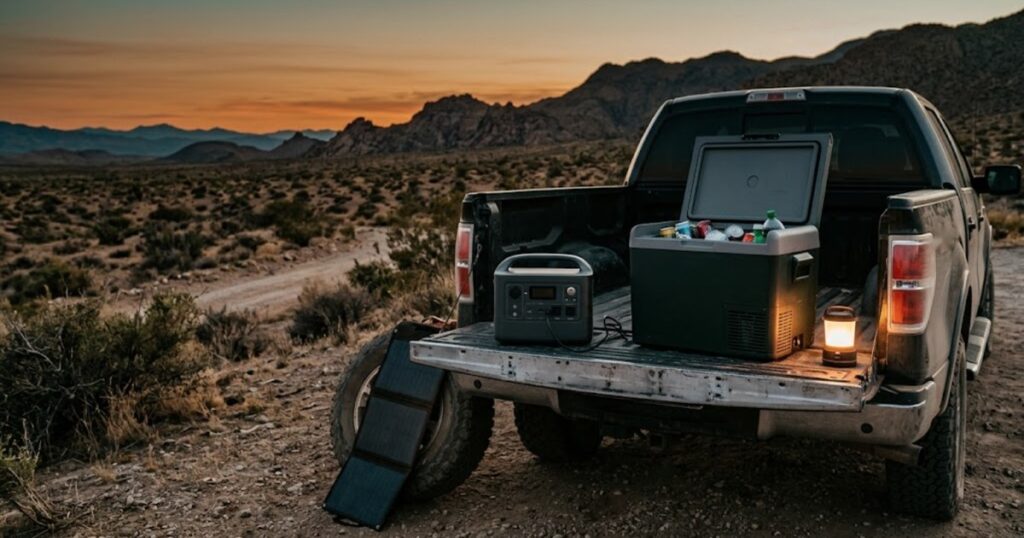
Yes. An Anker SOLIX C1000 Gen 2 runs a 40-55L 12V compressor fridge for roughly 38 to 56 hours on its 12V car socket at the draw owners actually meter, and the original C1000 is within an hour or two of that. Put the same fridge on the AC outlet and the inverter takes a third to a half of it. The setting that catches people is in the app, not on the box: Car Port Saving Mode switches the 12V socket off after five hours under 3W, and a shut fridge on a cool night sits under 1W between compressor cycles. Turn that mode off before you leave phone signal, set the fridge’s battery protection to Low, and the numbers below hold.
How long will an Anker SOLIX C1000 run a 12V fridge?
Three rows of this table are measured and one is not, and I would rather you knew which. The Technology Man put an 8A load on the Gen 2’s 12V socket and ran it flat: 844Wh. His write-up calls that 86%; against the 1,024Wh on the label it is 82%, so the table uses the watt-hours. Nobody has published the same test for the original C1000, so its 12V row is the Gen 2’s ratio applied to 1,056Wh, and it is marked as scaled. The AC rows are measured for both: Trusted Reviews got 890Wh from the original at a 200W load and Notebookcheck got 850Wh from the Gen 2 at 250W. They also carry the inverter’s own idle, which The Technology Man measured at about 17W on the Gen 2; the original has no published figure, so it borrows the same 17W. Divide usable watt-hours by what the fridge averages over a day, compressor cycling included, and you get hours.
| Unit and port | Usable Wh | Mild, 35W avg | Warm, 45W avg | Hot or freezer, 70W avg |
|---|---|---|---|---|
| C1000 Gen 2, 12V socket | 844 (measured) | 24 h | 19 h | 12 h |
| C1000 Gen 2, AC outlet | 850 (measured) | 16 h | 14 h | 10 h |
| C1000, 12V socket | ~870 (scaled, no test) | 25 h | 19 h | 12 h |
| C1000, AC outlet | 890 (measured) | 17 h | 14 h | 10 h |
Those fridge averages are pessimistic on purpose. They are what you plan around. What owners meter is lower: a Dometic CFX3 45 averaged 13-14W in real use at 70F, and an ICECO VL35 averaged 21W over five days that ran from the low 60s to the mid 80s. At 15W mild or 22W warm on the 12V socket, the Gen 2 lands at 56 or 38 hours and the original at 58 or 40.
The one owner log with percentages sits at the ugly end, which is useful. An Expedition Portal member ran a 75-litre ICECO on an original C1000 in the back of an Xterra, days pushing 90F and nights in the 40s: 100% down to about 60% overnight and 20% or less by the end of the day. That is about 35W around the clock, the first column of the table, from a fridge nearly twice the size this page is about. Anker’s own numbers run the other way. Its Australian fridge guide gives a 40L fridge about 53 hours on a C1000 Gen 2, which only works if every watt-hour on the label comes out of the socket. At the 844Wh that was measured, the same fridge gets about 42. Our 12V fridge amp-draw guide has the metered numbers by fridge model.
Should the fridge go on the 12V socket or the AC outlet?
The 12V socket. The Technology Man left the Gen 2’s inverter on with nothing plugged in for twelve hours and lost 20% of the battery, about 17W. He did the same with only the DC side on and it was still at 100%. The Solar Lab measured the idle at 13.8W. Either way the inverter burns about what a fridge averages on a mild night, so on AC you are running two fridges and cooling one. His verdict was the same: run intermittent loads like a portable fridge off the car outlet.
Nobody has metered one fridge both ways on a C1000, but people have on other stations, and the gap is not small. Mike Sokol got 28W average on 12V and 45W through the inverter with the same fridge on a Jackery. A Wrangler owner logged 25% per twelve hours on DC and 37% on AC with an ICECO on a Bluetti. Anker’s guide says the 12V route is 10-15% more efficient. The people who metered it got three times that.
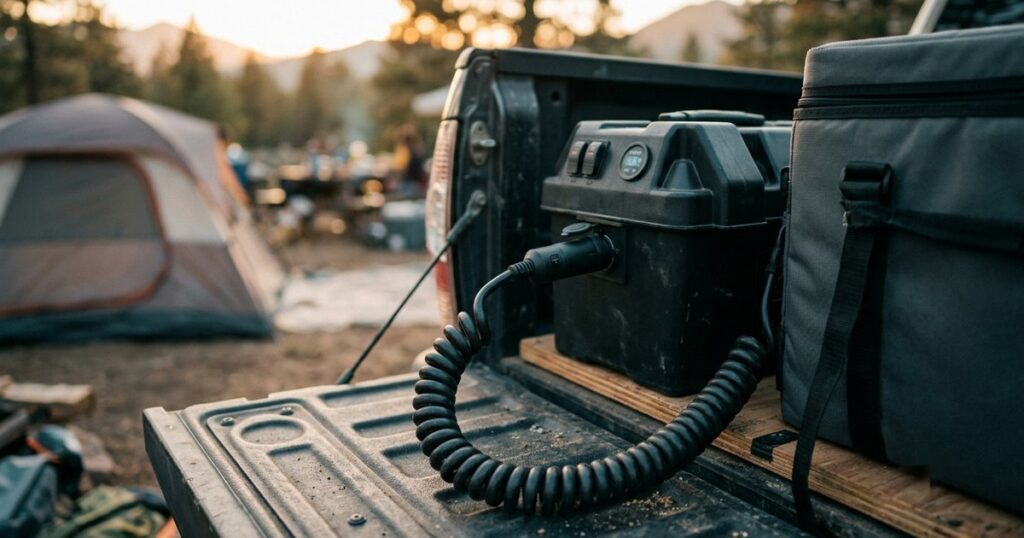
Both generations have one 12V socket rated at 10A and no small barrel-type DC ports. A Dometic CFX3 45 pulls about 8A when the compressor starts, so the fridge gets the socket to itself, on a short, thick lead, with no splitter. Anker’s FAQ adds one habit worth keeping: plug the fridge in first, then press the car-socket button. Doing it the other way round can trip the overload protection.
Why does the fridge shut off overnight on an Anker?
Two settings, and the first one is Anker’s.
Car Port Saving Mode. Anker’s FAQ for the original C1000 spells it out: at 3W or more the port stays on, and under 3W it turns off after five hours unless you disable Car Port Saving Mode in the app. The Technology Man found the same rule on the Gen 2, where the app calls it Car Output Power Saving Mode, and had to switch it off for his own test. A compressor fridge idles at about 0.6W between cycles. Lid shut, cold night, good insulation, and five hours can pass without the compressor starting. Assume the mode is on out of the box. The only documented way to turn it off is the Anker app; neither manual gives a button sequence, so pair the station at home, not at the trailhead.
If you are buying an original C1000 second-hand, this matters more. Owners on Anker’s community forum had fridges cut out after an hour or two on launch firmware, when the rule was under 10W for an hour. Later firmware stretched it to five hours, one owner reported that version 1.4.4 stopped the socket dropping out when car charging restarted with the engine, and some first-batch units were replaced outright. Update the firmware and run the fridge off it for a full day at home before you trust it with food.
The fridge’s own battery protection. Every compressor fridge has a low-voltage cutoff meant to protect a car’s starter battery. On the same forum thread one owner’s fridge kept cutting out after a couple of hours on its High setting, 11.8V, and ran about fifteen hours on Low, 10.1V. Anker says the original’s socket is regulated to around 13.4V, so the sag was in the lead when the compressor kicked in, not in the station. Set the fridge to Low, which is what Dometic recommends for anything that is not a starter battery. The station has its own battery management; the fridge does not need to guard it.
C1000 or C1000 Gen 2: which one for a fridge?
The Gen 2 for most people. It is 1,024Wh against 1,056, and that 32Wh is under an hour of fridge. In exchange it is 24.9 lb instead of 28.4, rated for 4,000 cycles instead of 3,000, and refills from the wall in under an hour. It is also the only one of the two whose 12V socket has been bench-tested, and I could not find one owner report of it cutting a fridge off, which is more than the first batch of originals can say.
The original if you want more than two days without recharging. It takes one BP1000 expansion battery for 2,112Wh in total, and it has a built-in light. The Gen 2 has neither. Anker’s product page for the BP1000 says in so many words that it is not compatible with the C1000 Gen 2, so what you buy is what you have. If the plan is a fridge plus a CPAP or a laptop for three nights in the shade, that is the case for the older unit.
How do you keep it charged on a trip?
Not from the cigarette socket. Anker’s datasheet puts the original at 10.7 hours that way, at 120W. The Technology Man saw about 100W into the Gen 2 and called it over ten hours. A Gadgeteer reviewer drove for ninety minutes and gained 16%, and the Xterra owner above gave up because his vehicle socket ran hot. A hundred watts covers a fridge while you drive and puts very little back.
The two things that refill it are an alternator charger and a panel. Anker’s alternator charger is rated up to 800W with the engine running and wires to the starter battery with a 7-metre cable and a 100A fuse, so it is an afternoon’s install, not a plug. Anker publishes no charge time for either C1000 with it, and both stations list 600W as the ceiling on that input, so do not count on the full 800. Solar goes in through the same port, up to 600W. Anker’s own FAQ calls anything above 60% of a panel’s rating normal, which makes a 200W panel a 120W-and-up panel; over five decent hours that is still more than a fridge uses in a day. The trade-offs are in the car-charging guide and the solar sizing guide.
Weighing this against another brand? The same working is done for the Jackery Explorer 1000 and the Bluetti AC70 and AC180.
The picks
Anker SOLIX C1000 Gen 2
The weekend-and-a-bit fridge unit. 1,024Wh LiFePO4, 844Wh measured out of the 12V socket, no measurable drain with only DC on, 24.9 lb. No expansion port and no light. Switch Car Output Power Saving Mode off in the app before the first night.
Anker SOLIX C1000 (first generation)
The one that grows. 1,056Wh LiFePO4, 890Wh measured on AC, and Anker says its car socket holds about 13.4V. Takes one BP1000 for 2,112Wh. 28.4 lb. Update the firmware before it carries food.
Anker SOLIX BP1000 expansion battery
Doubles the first-generation C1000 to 2,112Wh for another 20 lb. It does nothing on its own and Anker says it does not fit the C1000 Gen 2, so check which station you own before you order.
Anker SOLIX Alternator Charger
What lets either station keep up with a fridge on a driving trip: up to 800W with the engine running against about 100W from the socket. Wires to the starter battery. Not for EVs. No published charge time on a C1000 yet, so treat the headline watts as a ceiling.
Anker SOLIX PS200 200W solar panel
One panel carries a fridge through a sunny day and puts some back. Its lead goes straight into the station. Plan on 120W and up, not 200, and nothing at all in a shaded camp.
Dometic CFX3 45
The best-documented draw in its size: owners meter 13-14W on a 70F day. Three-level battery protection, which you set to Low on a power station.
What to skip
Running the fridge on the AC outlet because the plug was closer; it is the expensive way. Leaving the saving mode on because the fridge ran fine in the driveway at noon; it will run fine until the first cool night. A 12V splitter so the fridge can share the socket; the 10A limit is real and Dometic blames splitters and extensions for most of its low-voltage alerts. A BP1000 for a Gen 2; it does not fit. A thermoelectric cooler in place of a compressor fridge; it draws 40-60W without cycling and will flatten either station in under a day. And counting on the drive home to refill the station from the cigarette socket.
The receipts: what I read and watched
- ManufacturerAnker SOLIX C1000 Gen 2 portable power station ↗ – ankersolix.com1,024Wh LiFePO4, 2,000W AC, car socket 12V/10A, 600W solar input, 24.9 lb, 4,000 cycles to 80%.
- ManufacturerAnker SOLIX C1000 portable power station ↗ – ankersolix.com1,056Wh LiFePO4, 1,800W AC, car socket 12V/10A, 600W solar input, 28.44 lb, 3,000 cycles, one BP1000 expansion battery.
- ManufacturerAnker SOLIX C1000 instructions and FAQ ↗ – Anker (PDF, hosted by Home Depot)12V port turns off after 5 hours under 3W unless Car Port Saving Mode is disabled in the app; socket regulated to about 13.4V; plug the device in before pressing the car-socket button; capacity x 80% runtime rule; 60% of a panel’s rating is normal.
- ManufacturerAnker SOLIX C1000 Gen 2 user manual ↗ – ManualsLibSolar input windows, charge at 0-40C, discharge at -20 to 40C, 12-hour default standby.
- ManufacturerAnker SOLIX C1000 datasheet ↗ – Anker (PDF)Car-socket recharge 10.7 hours at 120W.
- Expert reviewAnker Solix C1000 Gen 2 power station review ↗ – The Technology Man844Wh from the 12V car outlet at 8A, 907Wh on AC at 1kW, about 17W inverter idle, no measurable DC idle, the 3W / 5-hour car-output saving rule, about 100W from a car socket.
- Expert reviewAnker Solix C1000 Gen 2 power station review ↗ – Notebookcheck850Wh at a continuous 250W load; 1.6 kg lighter than the first generation.
- Expert reviewAnker SOLIX C1000 Gen 2 review ↗ – OutdoorGearLab890Wh measured output (87%), 25.2 lb on the scale, no expansion option.
- Expert reviewAnker SOLIX C1000 Gen 2 review ↗ – The Solar LabInverter idle draw of about 13.8W with nothing plugged in.
- Expert reviewAnker SOLIX C1000 review ↗ – Trusted ReviewsFirst generation: 0.89kWh at a 200W load (84%), 0.95kWh at 750W; at least nine hours to recharge from a car socket.
- Expert reviewAnker SOLIX C1000 review ↗ – OutdoorGearLabFirst generation: 897Wh measured output (85%), 28.65 lb on the scale.
- Owner reportsSolix C1000 DC plug shuts off automatically ↗ – Anker CommunityFirst-generation owners: fridges cut off after 1-2 hours on early firmware, 5 hours after updates, some units replaced; one fridge kept cutting out on its 11.8V setting and ran about 15 hours on 10.1V.
- Owner reportsRecommendations on smallish power stations for a portable fridge ↗ – Expedition PortalICECO 75 Pro on a C1000 in a truck at about 90F: 100% to about 60% overnight, 20% or less by the end of the day; the vehicle socket ran hot charging at 120W.
- Expert reviewAnker SOLIX C1000 portable power station review ↗ – The GadgeteerNinety minutes of driving on the car socket added 16%.
- ManufacturerHow to power a camping fridge ↗ – Anker SOLIX AustraliaAnker’s own figure of about 53 hours for a 40L fridge on a C1000 Gen 2, its advice to use the DC output, and its 10-15% estimate of the AC penalty.
- ManufacturerAnker SOLIX BP1000 expansion battery ↗ – ankersolix.com1,056Wh, 19.97 lb, works with the C1000 and C1000X; not compatible with the C1000 Gen 2.
- ManufacturerAnker SOLIX Alternator Charger ↗ – ankersolix.comUp to 800W from the alternator; 7 m battery cable and 100A fuse in the kit; not for electric vehicles.
- Hard numbersInverter loss: 12-volt vs 120-volt energy usage ↗ – RVelectricity (Mike Sokol)Same fridge, same station: about 28W average on 12V DC against 45W through the AC inverter.
- Owner reportsFridge power consumption: AC vs DC vs insulated ↗ – JL Wrangler ForumsICECO VL45 ProS on a Bluetti AC70P at 72-74F: 37% per 12 h on AC, 25% on DC.
- Owner reportsMy Jackery and Dometic test run ↗ – JL Wrangler ForumsDometic CFX3 45 averaging about 13-14W in real use at around 70F.
- Expert reviewICECO VL35 ProS review ↗ – Gnomad HomeMetered for 123 hours: about 21W average from the low 60s to the mid 80s F, and 0.6W idle between compressor cycles.
- Expert reviewJackery power station for vanlife ↗ – FarOutRideCompressor start current: about 7A for a small Dometic, 8.2A for a CFX3 45. Why a 10A socket runs one fridge.
- ManufacturerRecommended battery protection settings (CFX3) ↗ – Dometic supportHigh or Medium from a starter battery; Low from an accessory or dual battery.
- ManufacturerCFX says ALERT VOLTAGE LOW even though it is plugged in ↗ – Dometic supportDo not use splitters, pigtails or extensions on the 12V lead.
- Field testRecord-Breaking Charge Speed? Anker Solix C1000 Gen 2 Power Station Review ↗ – The Technology Man (YouTube)The Gen 2 bench test on camera.
- Field testAnker Solix C1000 – Full Review & Test ↗ – TDCatTech (YouTube)The first-generation C1000 reviewed and tested.
FAQ
How long will an Anker SOLIX C1000 run a 12V fridge overnight?
A 45L compressor fridge on the 12V socket uses roughly 15% of a C1000 Gen 2 over an eight-hour mild night and about a third on a hot one, worked from the 844Wh measured out of the socket. The one owner log on the original shows 40% overnight, but that was a 75-litre fridge in a truck that had been at 90F all day. One night is easy. The third morning is where either unit needs sun or a drive.
How do I stop the 12V socket on an Anker C1000 turning itself off?
Open the Anker app and switch off Car Port Saving Mode, which the Gen 2 lists as Car Output Power Saving Mode. With it on, the socket shuts down after five hours under 3W. There is no documented button sequence on the unit, so do it before you lose signal. On a first-generation C1000, update the firmware first.
Can the C1000 Gen 2 take an expansion battery?
No. Anker dropped the expansion port to save weight, and its BP1000 page says the battery is not compatible with the C1000 Gen 2. Only the first-generation C1000 and C1000X take one, for 2,112Wh in total.
Can an Anker C1000 run a fridge and charge at the same time?
Owners do it, from the car socket while driving and from solar in camp. On the first-generation unit an early firmware bug dropped the 12V socket when car charging restarted with the engine; owners reported it fixed in version 1.4.4. The Gen 2 can also take solar and wall power together.
Will an Anker C1000 run a 12V fridge in freezing weather?
It will discharge down to -4F. It will not charge below 32F; the battery waits until it warms up. Keep the station inside the vehicle or tent overnight. In that cold the fridge barely runs, which is one more reason to have the saving mode switched off.