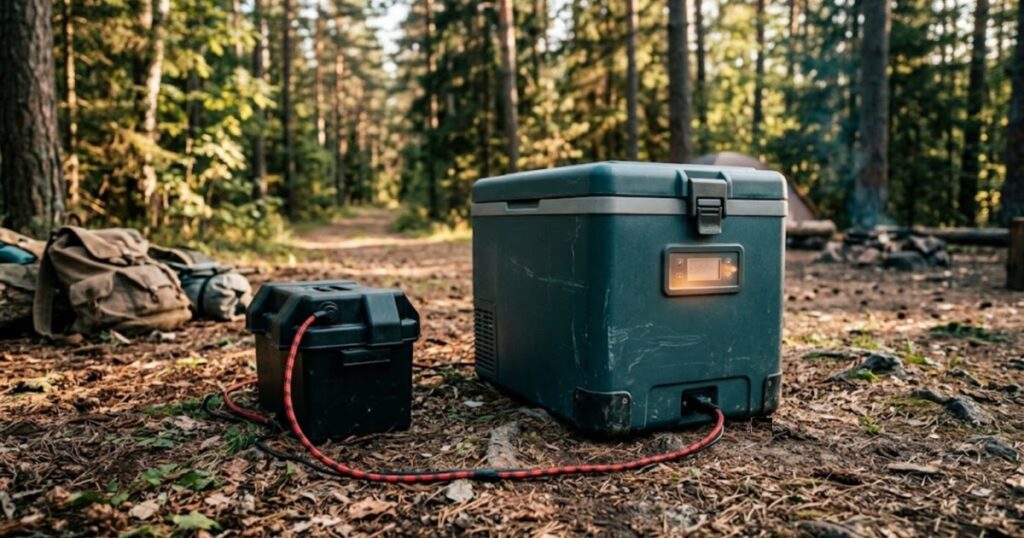
Short answer, for an ARB or a Dometic: High on a starter battery, Medium on a lead-acid or AGM second battery, Low on a LiFePO4 battery or a power station. The setting is the voltage at which the fridge switches itself off, and the right one depends on what the battery behind it can afford to lose.
Two things make it less tidy than that. The labels are not standard: High means 11.8 volts on an ARB or a Dometic and 11.1 on an ICECO, which is lower than ARB’s Medium. So on an ICECO or a BougeRV a second battery wants one step higher than the words suggest: High on lead-acid, Medium on LiFePO4. And the fridge reads voltage at its own end of the wiring with the compressor running, so the number it acts on is never quite the battery’s.
What does the low-voltage cutoff actually do?
ARB’s description is the plain one: “Once the fridge senses that the battery has dropped below a certain point it will automatically switch off.” And afterwards: “Once voltage has been restored, the fridge will restart.” So every setting is two numbers, a switch-off voltage and a higher restart voltage. The second is higher on every brand that prints both, so a fridge that has cut out does not start again the moment the voltage bounces.
Where it reads that voltage matters more than the number itself. Secop makes 12 volt fridge compressors and the controllers that run them, and its instruction sheet says the limits are measured on “the + and – terminals of the electronic unit”. That is inside the fridge. Dometic’s CFX3 goes one step better: “Voltage is measured at the internal electronics, then calculated to equate to the voltage at the DC Plug at the end of the DC lead.” So a CFX3 allows for its own lead and acts on the voltage at the plug. That is still the socket, not the battery. Nothing in the fridge knows what the battery is doing. It knows what arrived.
What voltage is High, Medium and Low on each brand?
| Fridge | Low: off / restart | Medium: off / restart | High: off / restart |
|---|---|---|---|
| ARB | 10.1 / 11.1 | 11.4 / 12.2 | 11.8 / 12.6 |
| Dometic CFX3 / CFX2 | 10.1 / 11.4 | 11.2 / 12.2 | 11.8 / 12.6 |
| Dometic CFX (older, CFX35W manual) | 10.1 / 11.1 | 11.4 / 12.2 | 11.8 / 12.6 |
| BougeRV 53 / 42 / 31 qt | 9.6 / 10.9 | 10.1 / 11.4 | 11.3 / 12.5 |
| ICECO VL45 / VL60 ProS | 9.6 / 10.9 | 10.1 / 11.4 | 11.1 / 12.4 |
| Engel MT-V45F | 10.5 (restart not listed) | no Medium step | 11.5 (restart not listed) |
Each cell is the switch-off voltage, then the restart voltage, on a 12 volt supply, from the maker’s manual or support page. Dometic changed two cells after the older CFX, so both generations are here. One caveat on that row: the CFX3 manual prints its six figures without saying which line is switch-off and which is restart, and the labelled version is Dometic’s support page for the CFX2, which carries the same 12 volt numbers. Engel’s MT-V has two steps and an off position, and the product card I could read gives only the switch-off figures. Goal Zero’s Alta 50 has the three modes and ships on High, but its guide prints no voltages at all.
Now read down the High column for the three-step fridges: 11.8, 11.8, 11.8, 11.3, 11.1. ICECO’s High lets the voltage fall 0.7 lower than ARB’s before it acts, and it sits below ARB’s Medium. An ICECO VL60 owner on Tacoma World found the 11.1 in his manual and started a thread about it. The first figure he got back: “On my dometic high is 11.8.” Same word on the panel, different protection.
The lower numbers will look familiar to anyone who has read a compressor maker’s sheet. Secop’s instructions print a table of optional cut-out settings for its controller, running from 9.6 to 11.3 volts, with 10.4 as the standard. ICECO’s three presets match three rows of that table, and so do BougeRV’s. Iceco names Secop as the compressor maker on its VL45 page. The 11.8 on an ARB or a Dometic is higher than anything in the table.
What do those voltages mean for the battery?
A lead-acid battery (starter or AGM)
Battery University publishes the BCI chart for a 12 volt starter battery at rest:
| State of charge | Resting voltage |
|---|---|
| 100% | 12.65 V |
| 75% | 12.45 V |
| 50% | 12.24 V |
| 25% | 12.06 V |
| 0% | 11.89 V |
Two cautions before you line that up against the fridge table. Those are resting figures, taken after the battery has sat with nothing connected, and Battery University’s own warning is that a charge or a discharge “distorts the voltage”. A fridge reads with its compressor pulling current, through a cable, so it sees less than the chart would. That means a High trip usually arrives before the battery is truly empty. How long before depends on the load and the wiring. Nobody publishes that conversion and I am not going to invent one.
What the chart does settle is the bottom end. Low is 10.1 volts on an ARB or a Dometic and 9.6 on an ICECO. A starter battery resting at 11.89 is already empty on that chart. By the time a fridge-sized load has pulled a lead-acid battery itself down to 10 volts there is nothing left in it worth protecting.
And the top end. Optima’s line for a long battery life is to keep it from dropping below 12.4 volts. No setting on any fridge in the table is close to that. The cutoff is there to save the morning start, or the last of a second battery. It is not there to make the battery last for years.
A LiFePO4 battery
Lithium iron phosphate holds its voltage nearly flat and then drops quickly at the end. Anker SOLIX’s chart for a 12 volt pack at rest:
| State of charge | Approximate resting voltage |
|---|---|
| 100% | 13.6 V |
| 50% | 13.0 V |
| 20% | 12.6 V |
| 10% | 12.0 V |
| 0% | 10.0 V |
The highest switch-off in the fridge table is 11.8 volts. At the battery’s terminals that is under the 10 percent line. So with a sound cable, every setting on every brand trips near the end of a LiFePO4 battery, and the choice between them is worth very little runtime. Through a thin cable the fridge can still trip far earlier, exactly as it does on lead-acid, and that is what the choice changes: Low leaves the most room for cable loss. It is a resting chart set against a reading under load, so treat it as a guide. Charts also differ a little between makers, and Anker says as much on the page.
The floor under all of it is the battery’s own management system. Battle Born says its BMS steps in when “the battery’s voltage falls below 10V” and disconnects the battery, which then has to be woken from another 12 volt source. That matters on two of the fridges above. Low on an ICECO or a BougeRV is 9.6 volts, under that line, so on paper the battery switches itself off before the fridge does and takes everything else wired to it down as well. Their Medium is 10.1, the same figure as Low on an ARB or a Dometic. Other battery brands set the disconnect elsewhere, so check yours. Putting those two numbers side by side is my inference, not something either maker prints.
A power station
Here the fridge is not reading a battery at all. It is reading a 12 volt port, and where the maker describes that port it is an electronic output held at one voltage whatever the charge level. Goal Zero’s guide for the Yeti 500 and 700 says “All DC outputs are regulated”. Anker says the C1000X socket is “designed to maintain a constant output of around 13.4V, even as the battery level decreases”. EcoFlow rates the River 3’s at 12.6 volts, and one reviewer read “a regulated 12.5 volts” off a Bluetti AC180.
So the cutoff has no battery to protect. The station looks after its own. All a high setting can do is trip on a loss in the plug, the socket or the lead when the compressor starts. And there is a second trap, which is arithmetic and not a test: High restarts at 12.6 volts on an ARB or a Dometic. A port that sits at 12.5 or 12.6 never gets clear of that, so a fridge that trips once can stay off.
One owner on Anker’s forum, in a thread that is mostly about the C1000’s socket timing out, reported: “I had my fridge set on the highest setting and the fridge would not run for long.” On the lowest it ran “for about 15 hours”. Treat that as one unconfirmed report: another owner in the same thread said the fridge setting had nothing to do with his shut-offs. The makers are a better guide. Goal Zero gives this advice for its own fridge in the Alta 50 guide: “If the fridge is powered by a Yeti 200X or 500X power station, we recommend setting it to Low protection mode.” iTechworld’s help page for its power stations says the lowest setting too.
It used to be worse. Goal Zero sold a regulated cable for its older Yeti Lithium stations, in its words “to regulate the HPP output of a Goal Zero Yeti Lithium to a consistent voltage”, and the same page says the later Yeti X line does not need it. If you are running a fridge from a station of that age, Low is not optional.
The port voltage, and the other settings that can switch a fridge off overnight, are different on every station. The model pages have them: Jackery Explorer 1000, EcoFlow River 3, Bluetti AC70 and AC180, Anker SOLIX C1000, Goal Zero Yeti.
So which setting for which battery?
| What the fridge runs from | ARB or Dometic | ICECO or BougeRV | Why |
|---|---|---|---|
| Starter battery | High (11.8 V) | High (11.1 / 11.3 V) | Every maker that gives advice says High. Dometic also allows Medium on its own fridges. |
| Lead-acid or AGM second battery | Medium (11.4 or 11.2 V) | High (11.1 / 11.3 V) | ARB’s advice for a conventional dual battery, matched by voltage. Low is under an empty battery’s resting voltage. |
| LiFePO4 second battery | Low (10.1 V) | Medium (10.1 V) | Even High is under the 10 percent resting line. Keep the fridge’s number above the BMS’s. |
| Power station | Low | Low | There is no battery for the fridge to read, only a port. |
The makers do not fully agree with each other, so here is where I have picked a side. For a second battery ARB says Medium, and keeps Low for a fridge on “its own dedicated power source”. Dometic’s CFX3 manual calls Low “ideal” on a supply battery, and BougeRV says medium or low on anything that is not the car battery. None of the three mentions lithium. On lead-acid I side with ARB, because of the resting chart above. On LiFePO4 I side with Dometic, because of the flat curve and the BMS. That split is my reading of the published numbers, not a rule any of them prints. The ICECO and BougeRV column is the same reasoning matched by voltage instead of by label, and it departs from BougeRV’s own manual, which is content with medium or low on a second battery. Its Medium is 10.1 volts, and by the resting chart I would not take a lead-acid battery there.
On the starter battery nobody argues against High. ARB: “High is best if the fridge is connected to the vehicle’s starting battery.” Its reason: “This will preserve enough voltage for the vehicle to start after the fridge has switched off.” Remember which High you have, though. On an ICECO or a BougeRV it is 11.1 or 11.3 volts, and that is thin cover for an engine start. Goal Zero’s Alta guide attaches a caution to switching down from High: “This will drain your vehicle’s battery and could prevent your vehicle from starting.” How much of a starter battery one night takes, and when trucks stop starting, is in can you run a 12V fridge off your car battery overnight.
One pair of owner reports for scale, both from that Tacoma World thread. The ICECO VL60 owner ran his fridge, already full and cold when he plugged it in, overnight on a single AGM, and about 13.5 hours later read 12.63 volts at the battery with the fridge unplugged. His cutoff never came into it. Another member, with a smaller battery, had the other kind of night: “I had issues with my Dometic 75 draining my Odyssey AGM overnight.”
Why does it cut out when the battery is fine?
The cable, more often than the battery. In that same thread: “Keep in mind the fridge will also see lower voltage than what’s actually in the battery”. The size of the gap is arithmetic. Copper wire has a published resistance per foot, and Dometic prints 8.2 amps as the CFX3 45’s rated current. At 8 amps, 20 feet of 16 AWG wire loses about 1.3 volts over the trip out and back, and the same run in 10 AWG loses about 0.3. On the thin wire an 11.8 volt cutoff at the fridge is a 13.1 volt cutoff at the battery at full draw, which is more than a parked lead-acid battery has. On the 10 AWG it is 12.1. Running draw is lower than rated (GNOMAD Home logged 33 to 55 watts on an ICECO, roughly 3 to 5 amps), so the real loss is smaller than both figures. The direction never changes. The table by gauge and length is in what gauge wire for a 12V fridge.
A JL Wrangler owner describes the usual discovery: “Along the way, I noticed that the fridge had shut itself off since the voltage was below the threshold I had set (medium).” Another member in the thread, who sometimes runs a fridge off the rear of his Jeep: “There is a ton of voltage drop to the rear.” He leaves his fridge on Low.
Dometic’s fix list is short. “Do not use splitters, pigtails or extensions.” And if the fridge still will not start on a recommended setting, “try setting the system to one level lower”. ICECO’s manual gives the same advice when protection errors show up on car power. Dropping a level is fine on a second battery or a power station. On a starter battery, fix the wire first, because one level lower is one level less between you and a jump start.
ARB fridge wiring kit
A dedicated feed from the battery, so the cutoff reads something close to the truth. ARB’s page lists it as 20 feet of 10 AWG with a built-in 15 amp fuse and a threaded socket that, in its words, “keeps the cord from coming loose when off-road” (the Amazon listing calls the same cable 8-gauge, 6mm). Check what plug your fridge’s lead ends in before you order.
Why will it not start again by itself?
Because the restart number is higher than the switch-off number, and a battery that has really been run down does not climb back to it by resting. High restarts at 12.6 volts on an ARB or a Dometic. A full starter battery at rest reads 12.65 on the chart above. So after a real High trip the fridge is waiting for a charger: the engine, a solar panel, a DC-DC charger. Dometic’s manual says it in two lines. “When switched off by the battery protection, the battery will no longer be fully charged.” And: “Avoid starting repeatedly. Ensure that the battery is recharged.”
A false trip from cable loss behaves differently. With the compressor off the loss disappears, the voltage at the fridge jumps back, and the fridge can start, trip and start again. A fridge that cycles like that on a charged battery is telling you about the wiring.
If you come back to a warm fridge and a truck that starts, the cutoff did its job. Drive, let the battery come up, and the fridge will pick up again without being asked.
What to skip
- Treating the cutoff as a battery gauge. It reads at the fridge, under load, and tells you one thing, once, by switching off. If you want to know what is left in a second battery, that is a shunt’s job.
- Low or Medium on the battery that starts the engine. Dometic’s manual allows Medium on its own fridges. I would still take High, and Medium on an ICECO is 10.1 volts. If the fridge shares the starter battery it goes on High, and something that can jump the truck goes in the door pocket.
- High on a power station. There is nothing for it to protect, and its restart voltage can be at or above what the port puts out.
- Turning the setting down to clear an error on a starter battery. It works, and it hides a cable problem behind a flat battery. Fix the feed.
- Copying a friend’s setting. Their High may be your Medium. Read the voltages in your own manual.
- Switching protection off. Engel’s monitor has an off position. Leave it alone on any battery you need for something else afterwards.
NOCO Boost GB40
For anyone running the fridge from the starter battery. The cutoff is plan A and this is plan B. NOCO rates it at 1,000 amps and up to 20 jump starts per charge, for gas engines up to 6.0 litres and diesels up to 3.0. It gets the engine running. It does not undo the wear on the battery.
Build the rest of the rig: running a fridge off the starter battery overnight · what gauge wire a 12V fridge needs · how long a power station runs a 12V fridge · how many amps a 12V fridge really draws · the dual-battery setup, sized right · best 12V fridge for overlanding
I have not metered any of these fridges or batteries. The cutoff voltages are from the makers’ manuals and support pages, the battery voltages are from published charts, and where two published numbers are set side by side the conclusion is mine.
The receipts: what I read
- ManufacturerFridge freezer tips and tricks ↗ – ARB USASwitch-off and restart voltages for Low, Medium and High, and which setting ARB advises for a starting battery, a dual battery and a dedicated source.
- ManufacturerCFX3 series operating manual ↗ – Dometic (PDF, Forest River copy)The voltage figure (printed without row labels), Medium or High on a starter battery, Low on a supply battery, the two lines about recharging after a cut-out, and 8.2 A rated current for the CFX3 45.
- ManufacturerHow to use the battery monitor (CFX2 coolers) ↗ – Dometic supportThe labelled table of switch-off and restart voltages; its 12V numbers are the ones in the CFX3 manual’s unlabelled figure.
- ManufacturerCFX3 says ALERT VOLTAGE LOW even though it is plugged in ↗ – Dometic supportWhere the voltage is measured, no splitters or extensions, and the advice to try one level lower.
- ManufacturerDometic CFX35W operating manual ↗ – Dometic (PDF)The older CFX voltage table, and High when supplied by the starter battery.
- ManufacturerVL45/60 ProS manual ↗ – ICECO (PDF, Lowe’s copy)Cut-out and cut-in voltages for Low, Medium and High, and the advice to lower the setting if protection errors appear on car power.
- Manufacturer53 / 42 / 31 quart fridge user manual ↗ – BougeRV (PDF)The voltage table, the High factory default, and High for a car battery, medium or low for other batteries.
- ManufacturerInstructions: electronic unit for BD compressors (BD35F, 12-24V DC) ↗ – Secop / Danfoss (PDF)Where the controller measures voltage, the standard 10.4 V cut-out, and the table of optional settings from 9.6 to 11.3 V.
- ManufacturerVL45 product page ↗ – IcecoNames Secop as the compressor maker.
- ManufacturerEngel MT-V45F product card ↗ – My Generator (retailer PDF)Battery monitor: Hi 11.5 V, Lo 10.5 V, or off.
- ManufacturerAlta 50 user guide ↗ – Goal Zero (PDF)Three modes, High by default, Low recommended on a Yeti 200X or 500X, and the caution about the vehicle battery.
- Hard numbersBU-903: How to measure state-of-charge ↗ – Battery UniversityThe BCI table of resting voltage by state of charge for a starter battery, and why a reading taken during charge or discharge is not comparable.
- Hard numbersWhat is normal for parasitic draw? ↗ – Optima BatteriesKeep battery voltage from dropping below 12.4 V for a long life.
- Hard numbersLiFePO4 voltage chart ↗ – Anker SOLIXApproximate resting voltage by state of charge for a 12V LiFePO4 pack, and the note that readings vary by maker.
- ManufacturerAll about low-voltage disconnect ↗ – Battle Born BatteriesThe BMS disconnects the battery below 10 V, and it then has to be woken from another 12V source.
- ManufacturerYeti 300 / 500 / 700 user guide ↗ – Goal Zero (PDF)All DC outputs are regulated.
- ManufacturerThe C1000X car socket is regulated to about 13.4 V as the battery level falls.
- ManufacturerRIVER 3 user manual ↗ – EcoFlow (PDF)Car port output rated 12.6 V, 10 A.
- Expert reviewBluetti AC180 in-depth review and testing ↗ – Geek World (Medium)A reading of a regulated 12.5 V at the AC180’s 12V port.
- ManufacturerYeti Lithium 12V regulated cable ↗ – Goal ZeroAn accessory to regulate the older Yeti Lithium’s 12V output; not needed on the Yeti X line.
- ManufacturerMy power station does not run my fridge as long as I expected ↗ – iTechworld help centreSet the fridge’s low-voltage cut-off to its lowest setting on a power station.
- Owner reportsSOLIX C1000 DC plug shuts off automatically ↗ – Anker community forumOne owner’s report of a fridge that would not run for long on its highest setting and ran about 15 hours on its lowest; another owner there says the setting was not his problem.
- Owner reportsSingle AGM, fridge, and battery protection ↗ – Tacoma WorldAn ICECO High of 11.1 V against a Dometic High of 11.8 V, an overnight run on one AGM, and a smaller battery drained overnight.
- Owner reportsBattery not keeping up with fridge – while running ↗ – JL Wrangler ForumsA fridge shutting off on Medium, and voltage drop to the rear outlet.
- Hard numbersAmerican wire gauge: table of AWG wire sizes ↗ – WikipediaCopper resistance per foot, the input to the cable-loss arithmetic.
- ManufacturerSmartShunt ↗ – Victron EnergyA battery monitor reporting state of charge, time remaining, voltage and current to the VictronConnect app.
- Expert reviewTrail tested: CFX3 power consumption ↗ – Trail4RunnerA Dometic fridge test metered with Victron SmartShunts.
- Expert reviewIceco VL35 ProS review ↗ – GNOMAD HomeCompressor draw of about 55W in Max and 33W in Eco.
- ManufacturerBoost GB40 ↗ – NOCOMaker’s ratings: 1,000 amps, up to 20 jump starts, gas to 6.0L and diesel to 3.0L.
FAQ
What should the battery protection be set to on a 12V fridge?
On an ARB or a Dometic: High if the fridge runs from the battery that starts the engine, Medium on a lead-acid or AGM second battery, Low on a LiFePO4 battery or a power station. ICECO and BougeRV use the same labels for lower voltages, so on those a lead-acid second battery wants High and a LiFePO4 one wants Medium. Check the voltages in your own manual.
Is High always 11.8 volts?
No. ARB and Dometic switch off at 11.8 volts on High. BougeRV’s manual gives 11.3 and ICECO’s VL45/60 ProS manual gives 11.1, which is lower than ARB’s Medium of 11.4. Engel’s MT-V45F card lists 11.5.
What setting for a LiFePO4 battery?
Low on an ARB or a Dometic, which is 10.1 volts. On an ICECO or a BougeRV, Low is 9.6 volts, under the 10 volts at which Battle Born says its BMS disconnects, so Medium at 10.1 is the closer match. That last step is my inference from the two published numbers. No fridge maker read for this page gives lithium advice.
What setting on a Jackery, EcoFlow, Bluetti or Anker power station?
Low. The fridge is reading a port, not a battery, so there is nothing for a higher setting to protect. Goal Zero and Anker describe their 12 volt outputs as regulated, EcoFlow rates the River 3’s at a fixed 12.6 volts, and High’s 12.6 volt restart can sit at or above what a port delivers. Goal Zero recommends Low for its own fridge on its 200X and 500X stations.
Why does my fridge cut out when the battery is full?
It reads voltage at its own end of the wiring with the compressor running. Thin wire, a long run, a loose plug or an extension each take a slice. Dometic’s advice is no splitters, pigtails or extensions. If it runs when cabled straight to the battery, the wiring was the fault.
Will the cutoff stop the fridge flattening my car battery?
On High it is meant to leave enough to start the engine, and ARB says so. It is a backstop, not a guarantee: High is only 11.1 volts on an ICECO, and no setting keeps the battery above the 12.4 volts Optima recommends for a long life.
Are these numbers from a test?
No. The fridge voltages are copied from the makers’ manuals and support pages, and the battery voltages from published charts. The cable loss is arithmetic from the resistance of copper. Nothing on this page was measured by me.