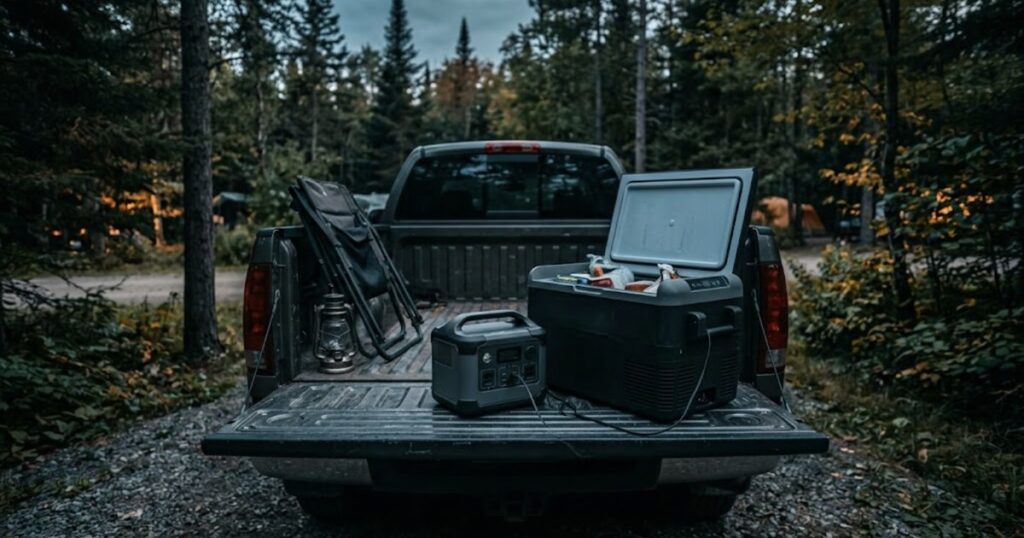
Yes, for one night. An EcoFlow River 3 should run a 40-55L 12V compressor fridge for roughly 13 to 18 hours on its 12V car port, and a River 3 Plus for 15 to 21. That is arithmetic, not a test: nobody has published a run of either unit on a compressor fridge, so every hour on this page is worked out from the battery size, one measured capacity test and what owners meter at the fridge. The battery is the problem. A fridge like that uses 300 to 500Wh a day and these hold 245 and 286Wh. Without a drive or a solar panel every day, the fridge is warm by the second evening.
How long will an EcoFlow River 3 or River 3 Plus run a 12V fridge?
The formula is usable watt-hours divided by what the fridge averages over a day, compressor cycling included. For the fridge side we use the figures from our 12V fridge amp-draw guide: 25 to 40Ah a day for a mid-size compressor fridge in mild weather, which is 300 to 480Wh, and about 500Wh on a warm day. For the battery side there is one real measurement. StorageReview ran a River 3 flat through its AC outlet and got 210Wh, 86% of the label; The Solar Lab’s run came out at about 83%. Nobody has metered the 12V port on either unit, so the 12V rows assume 90% of the label, the same factor Bluetti publishes for its own DC outputs. The AC rows add 10W for the inverter running all night, which is also an assumption.
| Unit and port | Usable Wh | Mild day, 300Wh | Typical, 400Wh | Warm, 500Wh |
|---|---|---|---|---|
| River 3, 12V port | 220 (245 x 0.90) | 18 h | 13 h | 11 h |
| River 3, AC outlet | 210 (measured) | 9 h | 8 h | 7 h |
| River 3 Plus, 12V port | 257 (286 x 0.90) | 21 h | 15 h | 12 h |
| River 3 Plus, AC outlet | 243 (286 x 0.85) | 11 h | 9 h | 8 h |
| Plus + 286Wh extra battery, 12V | 515 (572 x 0.90) | 41 h | 31 h | 25 h |
| Plus + 572Wh extra battery, 12V | 772 (858 x 0.90) | 62 h | 46 h | 37 h |
Read it as hours from a full battery to a dead one. A River 3 on the 12V port gets a sealed, pre-chilled fridge from dinner to breakfast on a mild night and not much further. The Plus buys two or three more hours. Neither covers a full 24 hours even in the mild column, and both are in trouble by early morning in the warm one. In real heat, or with the fridge set as a freezer, the average can reach 70W and a River 3 is done in about three hours.
If the 12V port turns out closer to the 87% that reviewers measured on Bluetti’s car ports, take about 3% off those rows. It does not change the answer.
Should the fridge go on the 12V port or the AC outlet?
The 12V port. On a battery this small the inverter’s overhead is not a rounding error. The table’s AC rows are about half the 12V rows, and the one like-for-like owner report on a small EcoFlow points the same way: a reef-tank owner ran the same 8W pump controller from a River 2, about 14 hours through the AC outlet and about 60 from the car port. That is the older River 2, not a River 3, and a pump, not a fridge. It is still the clearest picture of what an idling inverter does to 250Wh.
There is a second reason on the base River 3. Its inverter is 300W, and when The Solar Lab tried a full-size household fridge on it, the start-up surge tripped the overload straight away. A 12V compressor fridge on its mains adapter is a far gentler load, but the 12V port avoids the question.
Both units have the same car socket: 12.6V, 10A, 126W. A Dometic CFX3 45 pulls about 8A when the compressor starts, so the fridge gets the socket to itself, on its own lead, with no splitter. Neither River 3 has the small barrel-type DC ports some stations carry. Phones and lights go on USB.
Why would the fridge shut off overnight on an EcoFlow?
Three settings. Two are in the EcoFlow app and one is on the fridge.
The AC timeout. Both manuals say the AC output switches itself off after it has sat idle for a set time, and they name “intermittent loads like refrigerators” as the thing that triggers it. A compressor that rests for an hour on a cool night looks like nothing plugged in. The manuals also say an output that timed out stays off until you press the button again, so the fridge does not come back by itself. If you must use AC, set the AC timeout to Never in the app. Better, use the 12V port.
The unit timeout. EcoFlow stations also have a device timeout that powers the whole unit down when it thinks nothing is happening. Neither River 3 manual prints the default. EcoFlow’s DELTA 2 Max manual, for one, lists two hours for the unit and twelve for AC. The River 3 manuals mention no separate timeout for the 12V port, and we could not confirm from the app whether one exists. So do the boring thing before the first night: open the app’s settings and set every timeout you find to Never, then leave the fridge on it in the driveway overnight.
While you are in there, check the discharge limit and the backup reserve. Either one set above 0% takes that slice out of a battery that has nothing to spare.
The fridge’s own battery protection. Every compressor fridge has a low-voltage cutoff meant to protect a car’s starter battery. Dometic’s High setting cuts out at 11.8V and will not restart until it sees 12.6V. The River’s port is rated at exactly 12.6V before any drop in the cable, so a fridge on High that trips once may never restart. Set it to Low. The station has its own battery management; the fridge does not need to guard it.
River 3 or River 3 Plus: which one for a fridge?
The Plus, and capacity is the smallest reason. It has 41Wh more, which is two to three hours of fridge. The bigger differences are on the way in. The River 3 accepts 110W of solar; the Plus accepts 220W. The River 3 has no expansion; the Plus takes one extra battery, 286Wh or 572Wh, for 572 or 858Wh in total. And the Plus has a 600W inverter against 300W, which matters for everything else you will plug into it.
What you pay is weight: 10.4 lb against 7.7. The River 3 is a fine box for phones, a laptop, camera batteries and camp lights, and it will get a fridge through one mild night at a push. If a fridge is in the plan at all, it is the wrong one of the two. One thing to check on the box either way: EcoFlow also sells a 230Wh River 3 and a 268Wh River 3 Plus under the same names. The numbers here are for the 245Wh and 286Wh versions.
How do you keep it going past the first night?
Something has to refill it every day. There are two honest options.
Drive. A car charging cable is in both boxes. EcoFlow quotes 2.8 hours to fill the River 3 from a car socket and 3.3 hours for the Plus, which works out at about 87W going in on either one. The Plus’s 220W label is the port’s ceiling at higher voltage; a 12V socket cannot supply it. Against a fridge averaging 15 to 22W that nets 65 to 72W, so a full refill is about four hours of driving with the fridge running. A day of trail driving covers it. A ten-minute run to the camp store does not. EcoFlow’s alternator charger changes that for the Plus: EcoFlow Australia bundles the two and quotes 1.3 hours of driving for a full battery, which is the Plus’s full 220W. For the base River 3 the same charger is listed at 2.3 hours, barely quicker than the socket, so it is not worth fitting. The car-charging guide has the wiring trade-offs.
Solar. Bob Vila’s reviewer refilled a River 3 from a 110W panel in a little over three sunny hours, and PhoneArena filled a Plus from a 160W panel in three to four hours in winter. One 110W panel in good sun makes about 400Wh a day, more than a mild fridge day. The catch is that the battery cannot bank the surplus. The number that binds is the night: 14 hours of dark at a 15W average is 210Wh, and at 22W it is 308Wh. A River 3 has about 220Wh to give and the Plus about 257Wh. A mild night fits. A warm one does not, however much sun you had. Panel sizing is in the solar sizing guide.
When should you skip the River 3 and buy bigger?
When you want the fridge to survive a day you did not drive and the sun did not show. Our rule of thumb from the fridge runtime guide is about 500Wh per fridge-day and 1,000Wh for a two-day weekend. A River 3 is half of the first number. If you already own a Plus, the 572Wh extra battery gets you to roughly two mild days on the 12V port, though The Solar Lab did not rate the extra battery on value and it is worth comparing against simply buying a bigger station. If you are buying new for a fridge, start at 1kWh. The sizing guide walks through the sum for your own kit.
The same working for units in that class, with measured numbers instead of assumed ones: the Jackery Explorer 1000, the Bluetti AC70 and AC180 and the Anker SOLIX C1000.
And if the real question is whether you need a second battery at all for one night, that is its own page: can you run a 12V fridge off your car battery overnight?
The picks
EcoFlow RIVER 3 Plus
The River to buy if a fridge will ever sit on it. 286Wh LiFePO4, 12.6V / 10A car port, 220W solar input, 600W inverter, room for one extra battery. One mild night of fridge by itself; a workable loop with a panel or a daily drive.
EcoFlow RIVER 3
Phones, laptop, lights, and one mild night of fridge at a push. 245Wh on the label, 210Wh measured out of the AC outlet by StorageReview. Not the one to buy for a fridge: the 110W solar ceiling limits how fast it comes back.
EcoFlow RIVER 3 Plus extra battery (572Wh)
For people who already own a Plus. Takes it to 858Wh, which the math puts at about two mild fridge days on the 12V port. It only fits the Plus. Compare it against a bigger station before you buy; that is often the better money.
EcoFlow 110W portable solar panel
What turns either River into a fridge loop at a sunny camp. Bob Vila’s reviewer refilled a River 3 with one in a little over three bright hours. A bigger panel is wasted on the base River 3, which stops at 110W. No use in a shaded site.
EcoFlow DELTA 3 Plus
The step up if you are buying for a fridge and want to stay with EcoFlow. About 1,024Wh, which is the two-day weekend number without a panel. Heavier and dearer, and the first size where the fridge stops being the thing you plan the day around.
What to skip
The AC outlet for the fridge; it halves a battery that was already small. X-Boost as a reason to buy; it is an AC-side trick for kettles and heaters and does nothing for a 12V fridge. A 200W panel for the base River 3; it takes 110W and no more. A 12V splitter so the fridge can share the socket; the 10A limit is real. A thermoelectric cooler in place of a compressor fridge; it draws 40-60W without cycling and would flatten a River 3 in about four hours. And the idea that a River 3 is a weekend fridge battery because the product page lists a refrigerator among the things it runs. It is a one-night battery with a charging job attached.
The receipts: what I read and watched
- ManufacturerEcoFlow RIVER 3 user manual ↗ – EcoFlow (PDF, Solar Power Supply mirror)245Wh LiFePO4, 300W AC, car port 12.6V / 10A / 126W, solar 11-30V 110W, car input 100W, 7.72 lb; the AC output times out when idle and the manual names refrigerators as a trigger.
- ManufacturerEcoFlow RIVER 3 Plus user manual ↗ – EcoFlow (PDF, SanTan Solar mirror)286Wh LiFePO4, 600W AC, the same 12.6V / 10A car port, solar 11-55V 220W, one extra battery supported; same AC timeout wording; an output that timed out is not restored automatically.
- ManufacturerEcoFlow RIVER 3 Plus portable power station ↗ – us.ecoflow.comExtra batteries of 286Wh and 572Wh, 858Wh maximum; car charging 0-100% in 3.3 hours; 10.4 lb.
- Expert reviewEcoFlow RIVER 3 review ↗ – StorageReview210Wh delivered to a 300W load before shutdown, 270Wh from the wall to recharge; relays EcoFlow’s 2.8-hour car-charge figure.
- Expert reviewEcoFlow River 3 review ↗ – The Solar Lab273W load ran 45 minutes, about 83% efficiency; a full-size refrigerator’s start-up caused an immediate overload; 110W solar took over three hours; unimpressed by X-Boost.
- Expert reviewEcoFlow River 3 Plus review ↗ – The Solar LabWorks as advertised; does not recommend the extra battery on value.
- Expert reviewEcoFlow River 3 review ↗ – Bob VilaA 110W panel on a bright day recharged the River 3 in a little more than three hours.
- Expert reviewEcoFlow River 3 Plus review ↗ – PhoneArenaA 160W panel in winter filled the Plus in about three to four hours.
- ManufacturerRIVER 3 Plus + 500W Alternator Charger bundle ↗ – EcoFlow AustraliaEcoFlow sells the two together and quotes 1.3 hours of driving for a full charge.
- ManufacturerEcoFlow 500W Alternator Charger ↗ – us.ecoflow.comCharge-time list includes the RIVER 3 at 2.3 hours, about the same rate as a car socket.
- ManufacturerEcoFlow DELTA 2 Max user manual (app settings) ↗ – EcoFlow (PDF)A different EcoFlow model, for reference: unit timeout defaults to 2 hours, AC and 12V DC timeouts to 12 hours. The River 3 defaults are not published.
- Owner reportsEcoFlow River 2 issues with DC output ↗ – Reef2Reef forumRiver 2, not River 3: the same 8W controller ran about 14 hours from the AC outlet and about 60 from the car port.
- Owner reportsEcoflow+Dometic issues ↗ – Go Fast Campers forumDometic CFX3 55 on an older River Pro’s AC outlet, flat overnight; replies say use the DC outlet. Dometic later replaced the fridge as faulty.
- Expert reviewJackery power station for vanlife ↗ – FarOutRideCompressor start current: about 7A for a small Dometic, 8.2A for a CFX3 45. Why a 10A port runs one fridge.
- ManufacturerDometic CFX series manual: battery monitor ↗ – ManualsLib12V cutoff and restart: Low 10.1/11.1V, Med 11.4/12.2V, High 11.8/12.6V.
- ManufacturerHow long can a Bluetti run a 12V portable fridge? ↗ – Bluetti AustraliaThe capacity x 0.9 formula for DC outputs that the 12V rows borrow.
- Field testDirt Cheap EcoFlow River 3 – Best Beginner Power Station? ↗ – The Solar Lab (YouTube)The River 3 test on camera.
- Field testEcoFlow River 3 Plus – They FINALLY Did it! ↗ – The Solar Lab (YouTube)The River 3 Plus test on camera.
FAQ
Will an EcoFlow River 3 run a 12V fridge overnight?
On a mild night, from a full charge, on the 12V port: yes. The math gives a sealed, pre-chilled 40-55L fridge about 13 to 18 hours. On a warm night it is closer to 11, and a fridge that starts warm or gets opened all evening will take it lower. No published fridge test exists for the River 3, so treat that as a calculation and try it at home first.
How long will a River 3 Plus run a Dometic CFX3 or an ICECO?
About 15 to 21 hours on the 12V port in mild weather, by the same sum. Owners meter a CFX3 45 at 13-14W average at 70F and an ICECO VL35 at about 21W across warmer days, and 257 usable watt-hours divided by those gives roughly 19 and 12 hours.
Can a River 3 charge from solar and run the fridge at the same time?
Probably, and it is the whole plan, so check it. A 110W panel in good sun makes several times what a fridge averages, so the battery should climb through the day with the fridge running. We could not find it in writing that the 12V port stays live while the solar input is charging on a River 3, so run it that way in the driveway before you rely on it.
Does X-Boost help run a fridge?
No. X-Boost is an AC-outlet feature for running some appliances rated above the inverter’s limit at reduced power. A 12V fridge on the car port never touches the inverter.
Is the River 3 Plus worth it over the River 3 for a fridge?
Yes, if those are the two choices. It is two or three more hours of fridge, double the solar input and the option of an extra battery. If the fridge is the main reason you are buying a power station, neither is the right size; look at 1kWh units.