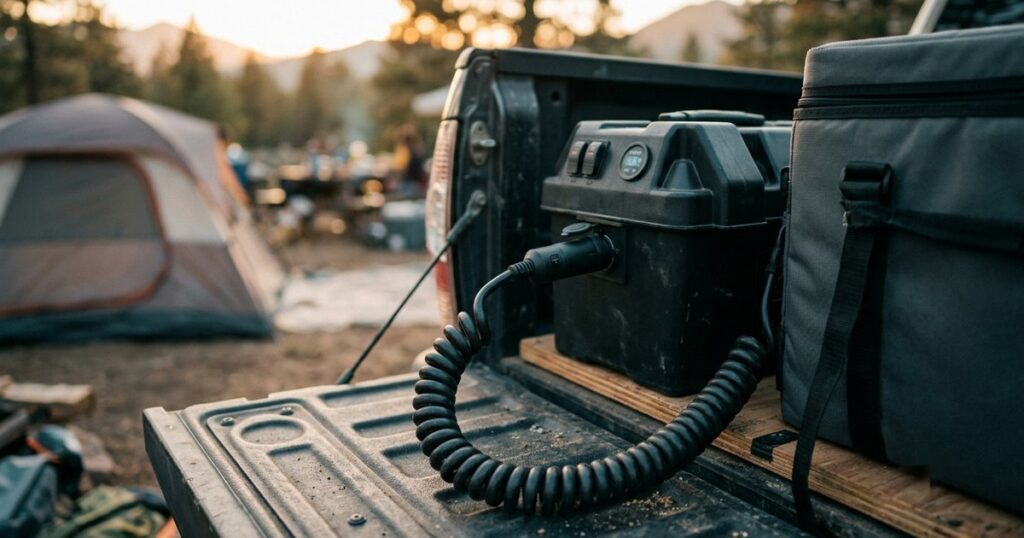
Yes. A Bluetti AC70 runs a 40-55L 12V compressor fridge for roughly 30 to 45 hours on its 12V car port, and the AC180 for 45 to 66, at the draw owners actually meter. Put the same fridge on the AC outlet and the inverter takes about a third of that. One setting matters more on a Bluetti than on any other brand: ECO mode. The AC70’s manual says it is on out of the box, and it switches the 12V output off when the load stays low for a few hours, which is exactly what a shut fridge does on a cool night. Turn ECO off, set the fridge’s battery protection to Low, and the numbers below hold.
How long will a Bluetti AC70 or AC180 run a 12V fridge?
This table is built from measurements, not from the label. The Technology Man ran an electronic load on each unit’s 12V car outlet until it shut down: 672Wh from the AC70 and 997Wh from the AC180, about 87% of the rated capacity in both cases. For the AC outlet, Trusted Reviews got 663Wh from the AC70 at a 200W load and PCWorld got 1,007Wh from the AC180 at 200W. The AC rows also carry the inverter’s own idle draw, which the same bench tests put at about 1.5% of the AC70 per hour and 5% of the AC180 per four hours, roughly 11W and 14W. Divide usable watt-hours by what the fridge averages over a day, compressor cycling included, and you get hours.
| Unit and port | Usable Wh | Mild, 35W avg | Warm, 45W avg | Hot or freezer, 70W avg |
|---|---|---|---|---|
| AC70, 12V port | 672 (measured) | 19 h | 15 h | 10 h |
| AC70, AC outlet | 663 (measured) | 14 h | 12 h | 8 h |
| AC70P, 12V port | ~756 (scaled, no test) | 22 h | 17 h | 11 h |
| AC180, 12V port | 997 (measured) | 28 h | 22 h | 14 h |
| AC180, AC outlet | 1,007 (measured) | 20 h | 17 h | 12 h |
Those fridge averages are pessimistic on purpose. They are what you plan around. What owners meter is lower: a Dometic CFX3 45 averaged 13-14W in real use at 70F, an ICECO VL35 averaged 21W over five days that ran from the low 60s to the mid 80s, and a dual-zone SetPower on a small Bluetti averaged about 20W over four days with one side frozen. At 15W mild or 22W warm on the 12V port, the AC70 lands at 45 or 31 hours and the AC180 at 66 or 45.
Two published runs agree with that. A Wrangler owner logged an ICECO VL45 on an AC70P at 72-74F: 25% of the battery per twelve hours on the 12V port, which projects to 48 hours from full. And New Atlas, reviewing the AC180, noted that Bluetti’s own figure for a 40W fridge is 17 hours, which is only true if the fridge draws 40W without ever cycling off; in use they saw closer to 50. Heat is what moves it. One AC180 owner on the Bronco forums got most of a week out of an ICECO APL35 when days stayed under 80F and watched the battery work far harder once they hit 90. Our 12V fridge amp-draw guide has the metered numbers by fridge model.
Should the fridge go on the 12V port or the AC outlet?
The 12V port. The same Wrangler owner ran the same fridge both ways on the same AC70P: 25% per twelve hours on DC, 37% on AC. Worked back from the AC70P’s 864Wh, that is about 18W against about 27W, so the AC route cost roughly half as much energy again for the same cold. Mike Sokol measured the same thing on a different station and fridge: 28W average on 12V, 45W through the inverter. Bluetti’s own fridge guide puts the AC penalty at 10-15%. The people who metered it got three times that.
The reason is idle draw. With the AC output on and nothing plugged in, the AC70 lost about 1.5% an hour on The Technology Man’s bench, and the DC outputs lost next to nothing. An inverter that idles at 11-14W is burning about what a fridge averages on a mild night. You are running two fridges and cooling one.
Both units have one 12V car socket rated at 10A, and neither has the small barrel-type DC ports some stations carry. A Dometic CFX3 45 pulls about 8A when the compressor starts, so the fridge gets the socket to itself, on its own lead, with no splitter. Phones and lights go on USB.
Why does the fridge shut off overnight on a Bluetti?
Two settings, and the first one is specific to Bluetti.
ECO mode. The AC70 manual describes it as a power-saving mode that is enabled by default: the AC or DC output turns itself off when the load is low or absent for a while. The thresholds are adjustable, 10-30W on the AC side and 5-10W on the DC side, for one to four hours. The AC180 manual gives the same DC range and does not say whether it ships on or off, so assume on. A compressor fridge idles at about 1W between cycles and can average under 10W on a cool night with the lid shut. New Atlas hit this on the AC180: a small fridge in an insulating cover on an autumn night never needed to start its compressor, and the station shut the output down. The insulated cover that saves you power is the thing that trips it.
Turn it off before the first night. On the unit: screen on, AC output off, hold the AC and DC buttons together for about two seconds until the frequency indicator flashes, then press the DC button to toggle ECO; the ECO icon leaves the screen. Or switch it off in the Bluetti app, which is also where the thresholds and hours live. Neither manual says whether one compressor cycle resets the timer, so do not rely on that.
The fridge’s own battery protection. Every compressor fridge has a low-voltage cutoff meant to protect a car’s starter battery. Dometic’s High setting cuts out at 11.8V and will not restart until it sees 12.6V. Bluetti calls both car ports regulated, and the one published reading for the AC180 is 12.5V. A fridge on High that trips once on a 12.5V supply has no way back. Set it to Low, which is what Dometic recommends for anything that is not a starter battery. The station has its own battery management; the fridge does not need to guard it.
AC70, AC70P or AC180: which one for a fridge?
The AC70 if the fridge is the job and you recharge most days. It is 768Wh and 22.5 lb, it refills from the wall in about an hour and a half, and one mild day and night of fridge is comfortable. Two is the limit. The AC70P is the same box at the same weight with 864Wh and a wireless charging pad on top; if you find one, take it over the AC70, but it is not worth a hunt. Note that it is 864Wh, not 1,000: the 1000 in the name is the inverter’s watts.
The AC180 if you want two or three days without plugging in, or a laptop or a CPAP alongside the fridge. It is 1,152Wh, 1,800W and 35 lb. Off Grid Benchmark ran one near Moab with an ARB fridge, a CPAP, lights and devices: 58% left after the first day and night, 19% after the second. That is a two-night unit with company, and a three-night unit for a fridge alone in mild weather.
How do you keep it charged on a trip?
Not from the cigarette socket. The AC70 takes 7-9 hours that way by Bluetti’s own figure and The Technology Man measured about 110W; the AC180 takes 10-12 hours. A hundred watts covers a mild-weather fridge while you drive and puts almost nothing back. The two things that refill it are an alternator charger and a panel. Bluetti’s Charger 1 pushes up to 560W while the engine runs and Bluetti lists the AC70 full in 1.8 hours and the AC180 in 2.5; it wires to the vehicle battery, so it is an afternoon’s install, not a plug. Both stations accept 500W of solar, and reviewers got about 165W from a single 200W panel in good sun, which over five decent hours is more than a full AC70. The trade-offs are in the car-charging guide and the solar sizing guide.
Weighing this against a Jackery? The same working, for the Explorer 1000 v2 and 1000 Plus, is in Will a Jackery Explorer 1000 run a 12V fridge?.
The picks
Bluetti AC70
The weekend fridge unit. 768Wh LiFePO4, 672Wh measured out of the 12V port, regulated 10A car socket, 500W solar input, 22.5 lb. Switch ECO off before the first night.
Bluetti AC180
The multi-day unit. 1,152Wh LiFePO4, 997Wh measured out of the 12V port, 1,800W inverter for the kettle you promised not to bring. 35 lb, so it lives in the truck.
Bluetti Charger 1 (560W alternator charger)
What makes either station keep up with a fridge on a driving trip. Bluetti lists the AC70 full in 1.8 hours of driving and the AC180 in 2.5, against 7-12 hours from the socket. Needs a cable run to the vehicle battery. Not for EVs.
Bluetti PV200 200W solar panel
One panel is enough to carry a fridge through a sunny day and refill an AC70. Reviewers measured about 160-170W from it in good sun. Useless in a shaded camp; a 120W panel managed 5% of an AC70 in a winter afternoon.
ICECO VL45
Its ProS version is the fridge in the best owner test on this page: 25% of an AC70P per twelve hours on the 12V port at 72-74F. Dometic-class compressor for less money.
What to skip
Running the fridge on the AC outlet “to be safe”; it is the expensive way. Leaving ECO on because the fridge worked fine in the driveway at noon; it will work fine until the first cool night. A 12V splitter so the fridge can share the socket with something else; the 10A limit is real and Dometic blames splitters and extensions for most of its low-voltage alerts. A thermoelectric cooler in place of a compressor fridge; it draws 40-60W without cycling and will flatten an AC70 in well under a day. And counting on the drive home to refill the station from the cigarette socket.
The receipts: what I read and watched
- ManufacturerBluetti AC70 portable power station ↗ – bluettipower.com768Wh LiFePO4, 1,000W AC, car outlet 12V/10A regulated, 500W DC input, 22.5 lb, charges at 0-40C.
- ManufacturerBluetti AC70 user manual ↗ – Bluetti (PDF)ECO mode is enabled by default; thresholds AC 10-30W / DC 5-10W for 1-4 hours; button sequence to toggle it; car charging about 7-9 h on 12V.
- ManufacturerBluetti AC70P portable power station ↗ – bluettipower.com864Wh in the AC70 chassis at the same weight, plus a 15W wireless pad.
- ManufacturerBluetti AC180 portable power station ↗ – bluettipower.com1,152Wh LiFePO4, 1,800W AC, car outlet 12V/10A regulated, 500W DC input, 35.27 lb; runtime formula with about 15W self-consumption.
- ManufacturerBluetti AC180 user manual ↗ – Inverters R Us (PDF)ECO thresholds AC 15-30W / DC 5-10W for 1-4 hours; charge 0-40C, discharge -20 to 40C.
- Expert reviewBluetti AC70 review: 1000W portable power station ↗ – The Technology Man672Wh from the 12V car outlet at 10A (88%), 669Wh on AC, about 1.5% per hour AC idle, negligible DC idle, about 110W from a car socket.
- Expert reviewBluetti AC180 review ↗ – The Technology Man997Wh from the 12V car outlet at 8A (87%), 983Wh on AC, 5% per four hours AC idle, about 165W from one PV200.
- Expert reviewBluetti AC70 review ↗ – Trusted Reviews663Wh at a 200W load, 697Wh at 500W, 643Wh at 1kW; 120W maximum from a car socket.
- Expert reviewBluetti AC180 power station review ↗ – PCWorld1,007Wh at a 200W load (87%) and 970Wh at 800W.
- Expert reviewBluetti AC180 review ↗ – OutdoorGearLab950Wh measured output (82%), 1.3 h to full, 36 lb on the scale.
- Expert reviewBluetti AC180 portable power station review ↗ – New AtlasECO mode shut down a small insulated fridge on an autumn night; about 50 hours of fridge in use against Bluetti’s 17-hour figure for a constant 40W.
- Expert reviewBluetti AC70 portable power station review ↗ – TechRadarConfirms the unit ships set to its power-saving ECO mode.
- Owner reportsFridge power consumption: AC vs DC vs insulated ↗ – JL Wrangler ForumsICECO VL45 ProS on a Bluetti AC70P at 72-74F: 37% per 12 h on AC, 25% on DC, 24% with an insulated jacket.
- Expert reviewBluetti AC180 review ↗ – Off Grid BenchmarkThree nights near Moab with an ARB fridge, CPAP and devices: 58% after day one, 19% after night two; 160-170W from a 200W panel.
- Owner reportsFridge opinions and feedback ↗ – Bronco6G forumICECO APL35 on an AC180: most of a week under 80F, much heavier use once days hit 90F.
- Owner reports12V fridge and power bank: calculating consumption ↗ – Bronco6G forumSetPower 45 dual zone on a Bluetti’s 12V plug averaged about 20W over four days with zones at 16F and 32F.
- Hard numbersInverter loss: 12-volt vs 120-volt energy usage ↗ – RVelectricity (Mike Sokol)Same fridge, same station: about 28W average on 12V DC against 45W through the AC inverter.
- ManufacturerHow long can a Bluetti run a 12V portable fridge? ↗ – Bluetti AustraliaBluetti’s own advice to use the 12V socket, its capacity x 0.9 formula for DC, and its 10-15% estimate of the AC penalty.
- Expert reviewBluetti AC180 in-depth review and testing ↗ – Geek World (Medium)The AC180’s car port held a regulated 12.5V and sustained the full 10A. The only published voltage reading.
- Expert reviewJackery power station for vanlife ↗ – FarOutRideCompressor start current: about 7A for a small Dometic, 8.2A for a CFX3 45. Why a 10A port runs one fridge.
- ManufacturerDometic CFX series manual: battery monitor ↗ – ManualsLibOlder CFX line (CFX28 to CFX65DZ), 12V cutoff and restart: Low 10.1/11.1V, Med 11.4/12.2V, High 11.8/12.6V. The CFX3 and CFX2 differ on two figures: Low restarts at 11.4V and Medium cuts out at 11.2V (Dometic’s battery monitor page). High is the same.
- ManufacturerRecommended battery protection settings (CFX3) ↗ – Dometic supportHigh or Medium from a starter battery; Low from an accessory or dual battery.
- ManufacturerCFX says ALERT VOLTAGE LOW even though it is plugged in ↗ – Dometic supportDo not use splitters, pigtails or extensions on the 12V lead.
- ManufacturerBluetti Charger 1 alternator charger ↗ – bluettipower.comUp to 560W while the engine runs; wires to the vehicle battery; not for EVs.
- ManufacturerGuide to alternator chargers ↗ – bluettipower.comBluetti’s charge times with the Charger 1: AC70 1.8 hours, AC180 2.5 hours.
- Expert reviewBluetti AC70 review ↗ – Expedition AustraliaA 120W panel added about 5% in two mid-winter hours; 400-500W in from a vehicle inverter while driving.
- Field testBluetti AC70 Review 1000W Portable Power Station | Best Budget Option? ↗ – The Technology Man (YouTube)The AC70 bench test on camera.
- Field testBluetti AC180 Review | Best 1800W Power Station Solar Generator? ↗ – The Technology Man (YouTube)The AC180 bench test on camera.
FAQ
How long will a Bluetti AC70 run a 12V fridge overnight?
A 45L compressor fridge on the 12V port uses roughly 10-20% of an AC70 over an eight-hour mild night and a quarter or more on a warm one. The one owner log on its 864Wh sibling shows 25% per twelve hours at 72-74F with the fridge working in its Max mode. One night is easy. The second night is where the AC70 needs sun or a drive.
How do I turn off ECO mode on a Bluetti AC70 or AC180?
With the screen on and the AC output off, hold the AC and DC buttons together for about two seconds to enter the settings mode, then press the DC button to toggle ECO. The ECO icon disappears when it is off. The Bluetti app has the same switch plus the threshold and timer settings.
Can a Bluetti AC70 run a fridge and charge from solar at the same time?
Yes. It takes up to 500W on its DC input while the outputs are live. One 200W panel in good sun delivers about 165W, which is several times what a fridge averages, so the battery climbs through the day with the fridge running.
Is the AC180 worth it over the AC70 for a fridge?
If you want a second night without recharging, yes. It has half as much capacity again and delivers it: 997Wh from the 12V port against 672. If you drive or get sun every day, the AC70 does the same job at almost 13 lb less.
Will a Bluetti run a 12V fridge in freezing weather?
It will discharge down to -4F. It will not charge below 32F; the battery waits until it warms up. Keep the station inside the vehicle or tent overnight. In that cold the fridge barely runs, which is one more reason to have ECO switched off.