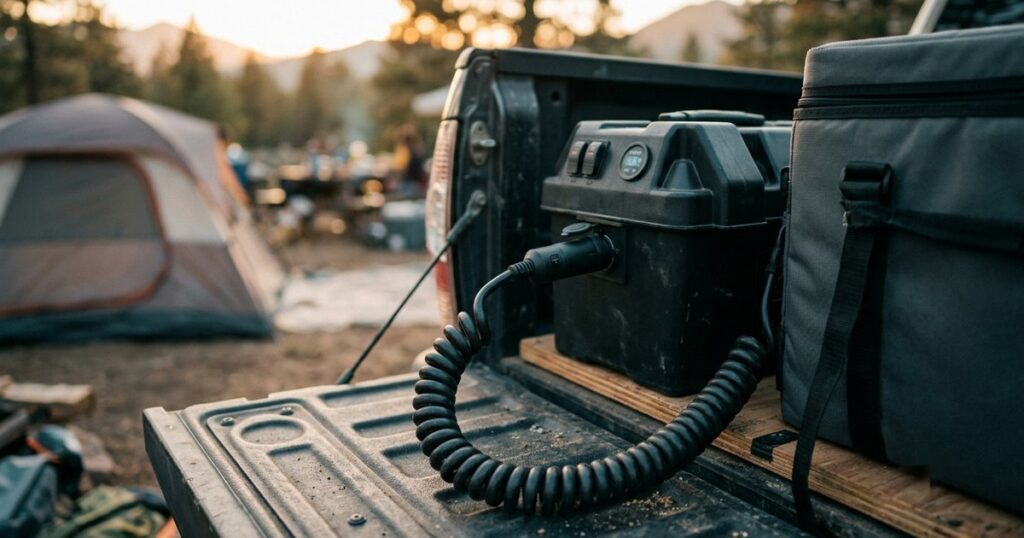
Let’s save you some money up front: if you own a power station, you almost certainly don’t need a separate inverter. The inverter is already inside the box, it’s already pure sine, and it’s already sized to the battery. The question “what size inverter do I need for camping” usually means one of two other things – either you’re wiring AC into a dual-battery van build and feeding it off a leisure battery, or you’re trying to run one specific appliance off a bare 12V battery. Those are the only times a standalone inverter earns its keep.
So this is really two questions stacked together: do you need one at all, and if you do, how big? I’ll settle the first in a paragraph, then give you the actual sizing math – continuous versus surge watts, a worked camp-load tally, the pure-versus-modified-sine call, and the bit nobody warns you about: past 2000W an inverter stops being a plug-in gadget and becomes a battery-cable job.
First: do you even need a separate inverter?
A power station is a battery, an inverter and a charger in one case. The inverter inside a modern EcoFlow, Anker or Bluetti is pure sine and rated to the unit’s output, so plugging a laptop or a CPAP into the AC socket is exactly what it’s built for. Buying a second inverter to sit next to it is paying twice for the same part. If you’re still deciding what to carry, the power-station sizing guide is the post you actually want.
A standalone inverter makes sense in exactly two setups:
- A dual-battery or van build. You’ve got a leisure or auxiliary battery wired in (usually charged by a DC-DC charger off the alternator) and you want mains sockets fed straight from it. Here the inverter is a permanent, hardwired part of the electrical system.
- One appliance off a bare battery. You have a 12V battery and one thing you need to run from it – a CPAP, a laptop, a small TV – and no power station. A small inverter is the cheap, sane way to do that.
If neither is you, stop reading and buy a power station instead. If one is you, here’s how to size it.
Continuous vs surge: the two numbers on every inverter
Every inverter is sold with two wattage figures and people buy on the wrong one. Continuous (or rated) watts is what it can deliver all day – that’s the number that matters. Surge (or peak) watts is a brief spike it can tolerate for a second or two, and it’s usually quoted at roughly double the continuous rating.
Surge matters because anything with a motor or compressor – a fridge, a pump, a power drill – pulls a big gulp of power at the instant it starts, typically two to three times its running watts, before settling down. A 45W fridge compressor can spike past 120W on start-up. Size only for the running number and the inverter trips the moment the compressor kicks in. So the rule is simple: continuous rating covers the sum of what’s running, surge rating covers the worst single start-up.
Add up your real camp load (the worked example)
People get this backwards – they picture a huge load and buy a huge inverter. Tally an honest car-camp setup and the running total is tiny. These are realistic figures, not nameplate maximums:
| Device | Running watts | Surge (start-up) | Sine needed |
|---|---|---|---|
| 12V compressor fridge (on AC) | 40 to 60W | 100 to 150W | Pure sine |
| Laptop charger | 45 to 90W | negligible | Pure sine |
| Phone / tablet charging | 10 to 20W | negligible | Either |
| LED camp + string lights | 5 to 20W | negligible | Either |
| 12V fan | 10 to 25W | negligible | Either |
| CPAP (humidifier OFF) | 30 to 60W | negligible | Pure sine |
| Microwave (700W cook rating) | 1000 to 1300W | 1500W+ | Pure sine |
| Electric kettle | 1200 to 1500W | 1500W | Either (but see below) |
| Low-watt induction burner | 1200 to 1800W | 1800W | Pure sine |
Run the everyday stuff together – fridge, laptop, lights, a fan, charging a couple of phones – and you’re at roughly 150 to 200W continuous. Add 30% headroom and you want about 250W; the fridge compressor’s start-up surge is the only spike, and any 300W inverter swallows a 150W surge without blinking. So a 300 to 600W pure-sine inverter covers a complete camp as long as you’re not cooking with electricity.
The number only explodes when you add one high-draw appliance. Drop a 700W microwave into that mix and your peak demand jumps to 1200 to 1300W, so you’d size to a 2000W inverter to start and run it with headroom. That single decision – do I want to microwave or boil water off this thing – is what moves you from a small inverter to a big one. Almost nothing else does.
A laptop-and-Starlink workday sits at the small end of all this. The full power budget for that setup is in the work-from-camp guide.
The size tiers, and what each one really runs
| Inverter size (continuous) | Comfortably runs | Don’t expect it to | Who it’s for |
|---|---|---|---|
| None – use the power station | Fridge, laptop, CPAP, lights, Starlink, charging | Long resistive cooking | ~95% of car campers |
| 300 to 600W pure sine | Laptop, CPAP, router, small TV, charging | Anything with a heating element | One device off a leisure battery |
| 1000 to 1500W pure sine | Microwave in bursts, blender, small power tools | Sustained 1500W cooking | A modest van build |
| 2000W+ pure sine | Microwave plus other loads, a single induction burner, big tools | A 2000W kettle all day on a small battery | A full van build (a wiring job) |
Why the kettle is the enemy (resistive heating loads)
Notice the kettle, the induction burner and a hair dryer all sit up at 1200 to 1800W. That’s because resistive heating turns watts straight into heat with no efficiency to hide behind – and it holds that full draw the entire time it runs, not just at start-up. An electric kettle hits 1500W the instant you flick it on and stays there until the water boils.
Two things follow. First, heating loads blow past most inverters: a 1000W inverter cannot run a 1500W kettle, full stop. Second, and more important, this is a battery problem, not an inverter problem. Even if your inverter is big enough, 1500W of kettle drains a 1000Wh battery in well under an hour. The honest move for hot food and drink off-grid is gas – a cheap stove boils water for nothing while your battery does the jobs only electricity can. If you genuinely must cook on electrons, you’re in 2000W+ inverter territory and a big battery and serious solar, not a clever inverter choice.
Pure sine vs modified sine: just buy pure sine
Cheap inverters output modified sine – a blocky, stepped approximation of mains power. Pure sine is the smooth wave you get from the grid. The price gap has shrunk to almost nothing, and modified sine causes enough real problems that it’s not worth saving on.
What actually misbehaves on modified sine: CPAP machines (manufacturers specify pure sine, and the humidifier/heater especially dislikes the stepped wave), anything with a motor (fridges, pumps and fans run hotter and less efficiently, and some buzz), certain battery chargers and power supplies, and microwaves (they run weaker and slower). Sensitive electronics can overheat or shorten their life on it. For a camp where the whole point is a fridge, a CPAP and charging laptops, modified sine is exactly the wrong tool.
The catch at 2000W+: it becomes a battery-cable job
Here’s what the listings don’t shout about. Power on the AC side has to come from somewhere on the DC side, and at 12V the current gets brutal. A 2000W inverter at full tilt pulls roughly 185 amps from a 12V battery (2000W plus inverter losses, divided by 12V). That is not a cigarette-lighter plug – it’s a short run of very thick cable bolted to the battery terminals.
Cross-checked across the install guides, a 2000W 12V inverter wants roughly 2/0 AWG cable for a short run (4/0 for longer), and a 200 to 250A fuse – ideally a Class T – mounted right at the battery so a short can’t set the cable alight. That’s why a 2000W+ inverter belongs in a planned dual-battery build, not clipped onto a battery for the weekend. If you’re not comfortable sizing cable and fitting a fuse, that’s your sign you want a power station, which does all of this internally and safely.
One more number that shapes the choice: idle draw. An inverter burns power just being switched on with nothing plugged in. Cheap units sit at 20 to 30W idle, which quietly murders a battery overnight; good ones are far lower (a Victron Phoenix idles around 8W, or near 1W in its ECO standby mode). For an always-on van setup, low idle and a standby mode matter more than the headline wattage.
The picks (if you’re in the standalone-inverter camp)
Only two scenarios buy one, so two picks: a do-everything quality unit for a build you’ll keep, and a value workhorse for occasional bigger loads. Both pure sine. No prices here – check current pricing on Amazon.
Victron Energy Phoenix 1200VA (12V pure sine)
The one to buy if it’s wired into a van or a battery system you’ll keep for years. Victron is the reliability benchmark in off-grid electronics, and the Phoenix earns it: clean pure-sine output, a very low idle draw (around 8W, near 1W in ECO standby so it isn’t bleeding the battery overnight), VE.Direct monitoring and a five-year warranty. This 12V unit is 1200VA continuous (2200W peak), which comfortably covers a fridge, laptops, a CPAP and charging. Want to start a microwave or power tools? That’s the Giandel below, or a larger Phoenix (the line jumps to 1600 and 3000VA). It costs more than the no-name boxes, and reviewers across the off-grid forums consistently say it’s the one still working when the cheap ones have died.
Giandel 2200W Pure Sine Wave Inverter (12V)
The value pick when you genuinely need to start and run a microwave or power tools off a battery. It’s the budget unit the DIY-solar crowd keeps landing on: 2200W continuous (4400W surge), real pure sine at about 3% THD, hardwire blocks plus heavy copper cables in the box, and a wired remote. It’s not Victron-quiet on idle and it isn’t a forever unit, but for occasional high-draw use it’s a lot of clean watts for the money. Mind the cable and fuse the install properly – at 2200W it pulls around 185A.
What to skip
- A second inverter when you own a power station. The most common waste of money on this whole topic. The power station’s built-in pure-sine inverter already does the job.
- Modified sine to save a few quid. It buzzes motors, upsets chargers and is a no for CPAP. The pure-sine premium is tiny now.
- A 3000W monster “to be safe.” Bigger inverters idle higher and demand fatter, pricier cable. Size to your real load plus headroom, not to a fantasy.
- Running a kettle or induction off a small battery. The inverter might cope for a minute; the battery won’t. Boil water on gas and keep the battery for the jobs only it can do.
- Clipping a 2000W inverter to a battery with thin leads. At ~185A that’s a fire risk. Heavy cable and a fuse at the battery, or buy a power station instead.
Pair it right: what size power station you need · charging it while driving (DC-DC) · how much solar you need · running a fridge off it · how many amps a 12V fridge draws.
The receipts: what I read and watched
- Field testRenogy 2000W Inverter Review: Efficiency Test + Real-World Results ↗ – YouTube field testMeters a 2000W inverter’s real efficiency and idle draw and benchmarks it against a Victron unit under load.
- Expert reviewGiandel 1200W Pure Sine Wave Inverter – detailed bench test ↗ – The Musing GregMeasured ~1.05A (about 13W) no-load draw and a clean pure-sine waveform with only minor crossover distortion – the idle-draw reality.
- Hard numbersWhat Size Wire for a 2000W Inverter? ↗ – EcoFlowDocuments the ~185A draw at 12V and the 2/0-4/0 AWG cable + 200-250A fuse sizing used here.
- Hard numbersSpells out what runs badly on modified sine (motors, medical, sensitive electronics) versus pure sine.
- Hard numbersReal-world idle / no-load power consumption (Phoenix & Multiplus) ↗ – Victron CommunityOwner and Victron figures for the ~8W idle / near-1W ECO standby behind the idle-draw point.
- Expert reviewWhy resistive cooking loads (1200-1800W, held continuously) are a battery-and-solar problem, not an inverter choice.
FAQ
Do I need an inverter if I have a power station?
No. A power station already contains a pure-sine inverter sized to its battery, so plugging gear into its AC sockets is exactly what it’s for. A separate inverter is only useful when you’re running mains gear off a bare or auxiliary 12V battery, such as in a dual-battery van build.
What size inverter do I need for camping?
Add up the running watts of everything you’ll use at once and add 20-30% headroom. A normal camp – fridge, laptop, lights, charging – runs around 150-200W, so a 300-600W pure-sine inverter is plenty. You only need 2000W or more if you want to run a microwave or power tools, and the surge rating should be at least double your biggest motor load.
Can a 1000W inverter run a kettle or microwave?
A kettle, no – most pull 1200-1500W and hold it, which is above a 1000W inverter’s continuous rating. A small 700W-rated microwave actually draws around 1000-1300W to cook, so it needs a 1500-2000W inverter to start and run with headroom. And remember the battery: heating loads drain it fast regardless of inverter size.
Is pure sine wave worth it for camping?
Yes. The price gap is now small, and modified sine causes real trouble for CPAP machines, motors (fridges, fans, pumps), some chargers and microwaves. For a typical camp setup built around a fridge and charging sensitive electronics, buy pure sine.
How big a battery cable does a 2000W inverter need?
A 2000W 12V inverter pulls roughly 185A at full load, so it needs heavy cable – about 2/0 AWG for a short run – and a 200-250A fuse mounted at the battery. That’s why a high-watt inverter is a planned wiring job, not a clip-on accessory; a power station handles the same loads without you touching a cable.