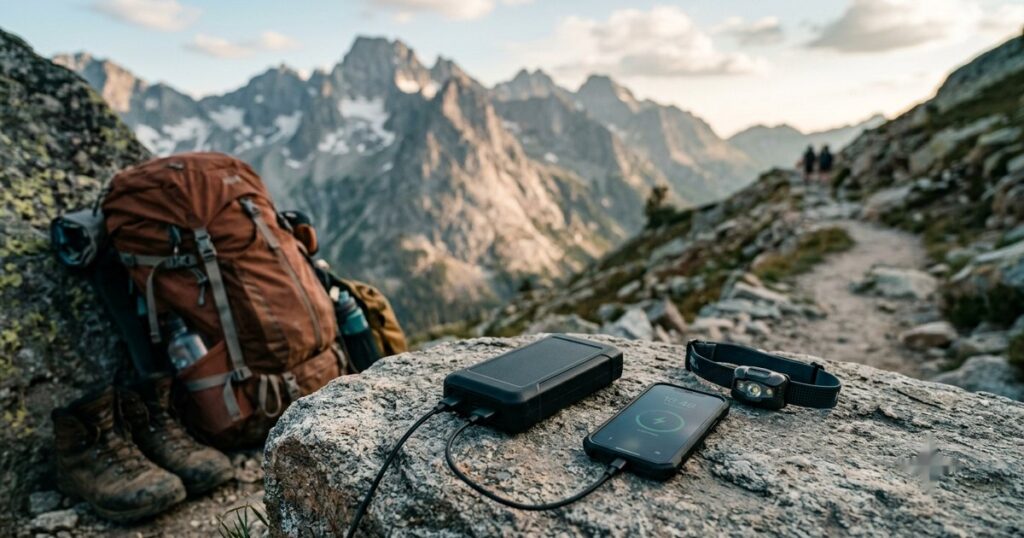
Two things nobody tells you when you buy a power bank for camping. First, you never get the mAh printed on the box – a 10,000mAh bank delivers more like 6,500mAh to your phone, every time, by design. Second, the number that actually matters for flying with it isn’t mAh at all, it’s watt-hours, and there’s a hard 100Wh airline limit. Get those two straight and choosing one is easy.
A power bank is the right tool for the small end – phone, headlamp, GPS watch, earbuds – where dragging out a power station is overkill. Here’s the math that tells you what size you really need, the one spec (USB-C PD) that decides how fast it charges, three picks from ultralight to laptop-capable, and the cold-weather catch that bites people in the mountains.
Why you never get the mAh on the box
The rated mAh is measured at the battery’s internal voltage (3.7V). Your phone charges at 5V (or higher over USB-C), and converting between the two loses energy to heat and circuitry. Add the bank’s own electronics and you land at roughly 60 to 70% of the rated mAh in real use. So a 10,000mAh bank gives your phone about 6,500mAh, a 20,000mAh bank about 13,000. It’s not a scam, it’s physics – but plan on the real number, not the sticker.
What size you actually need
Work in real charges, not sticker mAh. A modern phone battery is roughly 4,000-5,000mAh, so a 10,000mAh bank (real ~6,500) is about 1.5 phone charges, a 20,000mAh bank (real ~13,000) about three. Rough guide:
| Bank (rated) | Real output | Roughly | Best for |
|---|---|---|---|
| 10,000mAh (~37Wh) | ~6,500mAh | 1-2 phone charges | Ultralight, a weekend, one device |
| 20,000mAh (~74Wh) | ~13,000mAh | ~3 phone charges | Most campers, a few gadgets |
| 27,000mAh (~100Wh) | ~17,500mAh | 4+ charges, tops a laptop | Heavy use, still airline-legal |
| Power station (250Wh+) | see the power guide | Days of everything | Fridge, Starlink, AC gear |
For a weekend with a phone and a headlamp, 10,000mAh is plenty and barely weighs anything. For most people juggling a phone, a GPS watch, earbuds and a camera over several days, 20,000mAh is the sweet spot. Past 27,000mAh you’re over the airline limit and into power-station territory – at which point you should size it properly with the watt-hour math.
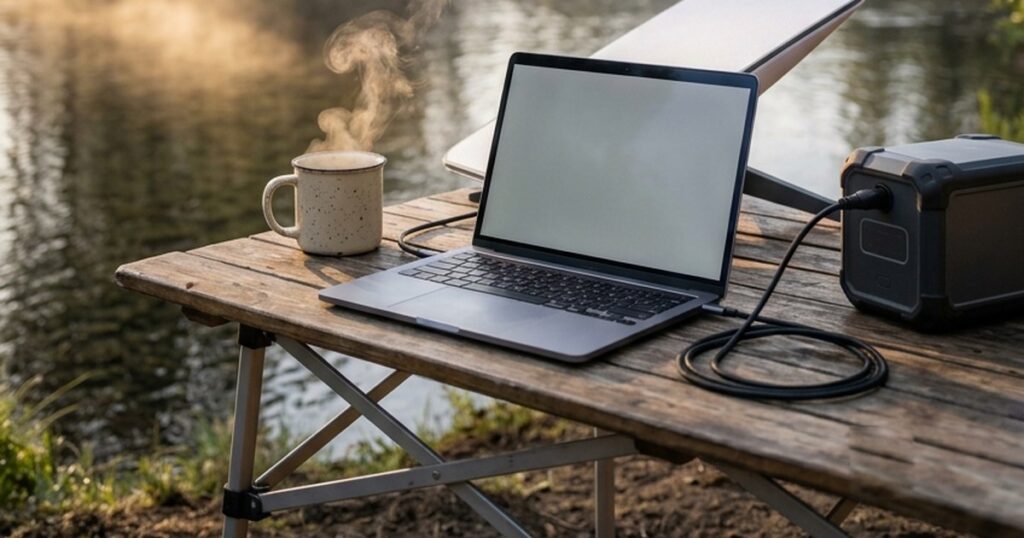
If a laptop is coming because you plan to work from the campsite, a power bank is the wrong tool for a full day. The work-from-camp setup does the workday math for the laptop and the internet together.
The spec that decides charging speed: USB-C PD
Capacity is how much; USB-C Power Delivery (PD) is how fast. Look at the wattage of the bank’s main USB-C port. For phones, 30W is the sweet spot – full speed for any phone with headroom to spare. For charging a laptop or a Starlink, you want 65W or more; the newest PD 3.1 banks push up to 140W from a single port, enough for a big laptop. Ignore banks that only do old slow USB-A; a single good USB-C PD port is worth more than three weak ones.
The picks
Nitecore NB10000 Gen 2
The ultralight benchmark. At around 5 ounces it has the best watt-hours-per-gram in its class, refills a phone a couple of times, and disappears in a pack. No screen, no gimmicks, just the most capacity for the least weight – exactly what a backpacker wants. The one catch is cold (see below). For warm-to-mild trips where every gram counts, it’s the default.
Nestout 15,000mAh Outdoor Battery
The rugged pick for actual abuse. Built waterproof, dustproof and shockproof for the outdoors, with all three ports doubling as inputs, so it survives the trips that kill normal banks. Heavier than the Nitecore and worth it if you canoe, climb or camp in the wet. The one to hand to someone who’s hard on gear.
Anker Prime 27,650mAh
The do-everything high-capacity bank that’s still airline-legal (just under 100Wh). It packs a lot into a compact metal body and pushes serious power – up to 250W total across its ports and 140W from a single USB-C with PD 3.1, enough to fast-charge a 16-inch laptop. Heavier and pricier, but if one bank has to cover phones, a tablet and a laptop for days, this is it. The most capacity you can still take on a plane.
What to look for
- Real capacity, not sticker mAh. Plan on ~65% of the rated number reaching your device. Size up accordingly.
- USB-C PD wattage. 30W for phones, 65W+ for laptops/Starlink. One strong USB-C port beats a fistful of slow USB-A ones.
- Pass-through and recharge. Can it charge your phone while itself charging? And how fast does it refill from the wall or a solar panel? A bank you can’t top up between days is half useful.
- Weight vs capacity. Backpacking rewards Wh-per-gram (Nitecore); car camping can carry the big Anker without a thought. Match it to how you travel.
- The 100Wh airline line. Staying at or under ~27,000mAh keeps it carry-on legal with no paperwork. Go bigger and you’re into power-station rules.
The cold-weather catch
Lithium batteries lose capacity in the cold, and power banks are not equal here. Testers find some models (Goal Zero Flip, certain UGREEN and Miady banks) hold up better in the cold, while some ultralight favourites – the Nitecore included – drop off more in freezing temperatures. The fix is simple and free: keep the bank warm. Stash it in an inside jacket pocket or your sleeping bag overnight, not in the tent vestibule. A warm bank gives most of its capacity back. If you camp in genuine cold a lot, weight the cold-tolerant models higher.
Related: best power stations for car camping · what size power station you need · how much solar you need · powering Starlink Mini.
The receipts: what I read and watched
- Expert reviewBest Power Banks for Backpacking 2026, Tested ↗ – CleverHikerField testing behind the Nitecore NB10000 ultralight pick and real-charge counts.
- Expert reviewThe Best Power Banks of 2026, Tested ↗ – GearJunkieIndependent testing across capacity tiers incl. the rugged and high-capacity picks.
- Hard numbersThe mAh-to-Wh conversion, ~65% real capacity, and the 100Wh airline rule used here.
- Expert reviewBest Power Banks for Backpacking (cold-weather testing) ↗ – OutdoorTechLabCold-weather performance differences (which banks hold capacity, which fade).
FAQ
What size power bank do I need for camping?
For a weekend with a phone and a headlamp, 10,000mAh (about 1.5 real phone charges) is plenty. For several days with multiple gadgets, 20,000mAh (about three charges) is the sweet spot. Need to top up a laptop too? Go to ~27,000mAh, which is still airline-legal. Remember you get roughly 65% of the rated mAh in real use.
Why does my power bank only charge my phone once?
Because you get about 60-70% of the rated mAh after voltage conversion and heat loss, and a modern phone battery is 4,000-5,000mAh. So a 10,000mAh bank (real ~6,500) is only about 1.5 phone charges. Size up if you want more – a 20,000mAh bank gives around three.
How big a power bank can I take on a plane?
Up to 100 watt-hours in carry-on, no approval needed, and never in checked luggage. That’s roughly 27,000mAh at 3.7V. Use Wh = mAh times 3.7 divided by 1000 to check yours. You can carry several banks as long as each is under 100Wh.
Do power banks work in cold weather?
They lose capacity in the cold, some more than others. Keep the bank warm – an inside pocket or your sleeping bag overnight – and it gives most of its capacity back. If you camp in genuine cold often, favour models testers rate well in the cold over the lightest ultralight options.