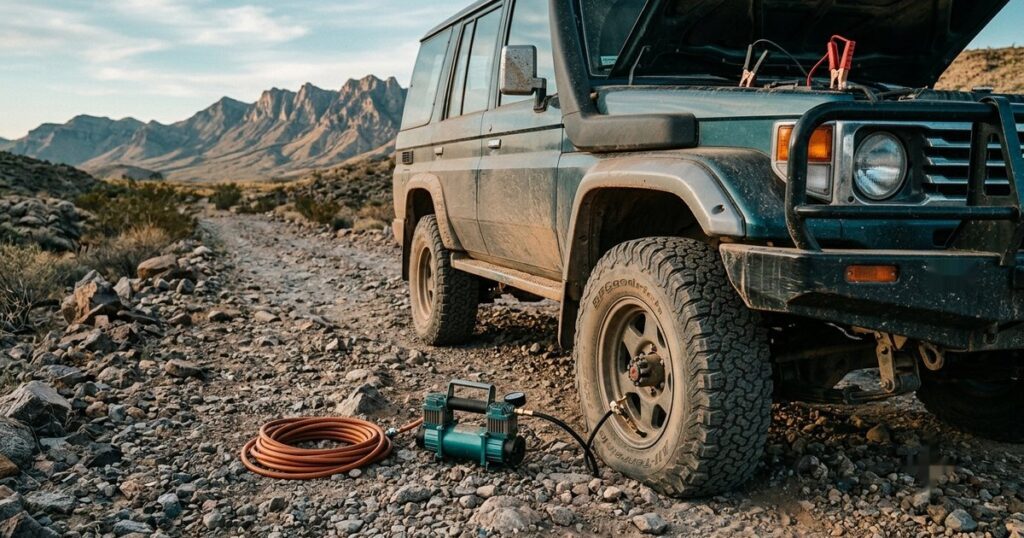
Airing down your tyres for the trail and back up for the road is the most basic overlanding ritual there is, and the compressor you choose decides whether airing up takes five minutes or twenty-five of standing around watching a cheap pump cook itself. Two specs settle it: CFM (how fast it moves air) and duty cycle (how long it runs before it has to stop and cool down). Get those right for your tyre size and you’ll never think about it again.
I haven’t run these in the desert myself – I’ve read the head-to-head tests and the long-haul owner threads, and the pecking order is clear. Here’s how to choose, the picks worth owning from value to bombproof, what you actually need for 35s versus 37s, and the cheap inflators that’ll let you down.
Why you need one (and can’t fake it)
Off-road, you drop tyre pressure to put more rubber on the ground – more traction, a softer ride over rocks and corrugations, less chance of getting stuck in sand. Then you have to put it all back before you hit tarmac, or you’ll ruin the tyres and handle like a boat. There’s no manual way to shift that much air, so a 12V compressor is non-negotiable kit. The only question is how long you want to stand there doing it.
The two specs that decide it
- CFM (cubic feet per minute) = speed. More CFM, faster fills. For airing up big off-road tyres you want real CFM, not a peak number measured against no resistance. Around 2.4 CFM handles tyres up to 35 inches at a sensible pace; bigger or faster wants more.
- Duty cycle = stamina. This is how long it runs before it overheats and needs to cool. A 100% duty cycle means it’ll air up all four big tyres in one go without stopping. Cheap single-cylinder units have low duty cycles and force a cool-down break halfway through – which is exactly when you don’t want one. Twin-cylinder compressors get the 100% figure and the speed.
The multi-tyre hose kit trick
Here’s the upgrade people sleep on: a four-tyre inflation kit runs hoses to all four tyres at once. It makes the most of your compressor’s CFM, cuts total airing-up time hugely, and actually reduces back-pressure and heat on the pump, so it runs cooler and lasts longer. If your compressor pushes more than ~5 CFM you can air all four together; with less, it still speeds things up working in pairs. For a rig with 35s, this is the difference between a coffee break and a chore.
| Compressor | Airflow | Duty cycle | Good for | Best for |
|---|---|---|---|---|
| MORRFlate PSI Pro | High | 100% | Up to 37 in | Set-and-forget, fastest |
| ARB Twin | ~2.65 CFM | 100% | Up to 37 in | Bombproof premium |
| VIAIR 400P | ~2.4 CFM | Limited | Up to 35 in | Value workhorse |
| VIAIR 440P | Higher | Better | Up to 37 in | Bigger tyres on a budget |
The picks
MORRFlate PSI Pro
The smartest compressor going and the new benchmark. You set the target pressure on its screen and it does the rest – fills every tyre to the same PSI and shuts off by itself, no gauge-watching. In head-to-head testing it beat both the ARB twin and the VIAIR 400P on speed, taking 33-inch tyres from 10 to 40 psi in about 5 minutes 51 seconds, with a 100% duty cycle. Pair it with its multi-tyre hose kit and airing up four tyres becomes genuinely quick. The one to buy if you air up often.
ARB Twin Portable Compressor
The bombproof choice. ARB builds for abuse, and the twin-cylinder portable delivers ~2.65 CFM with a 100% duty cycle in a rugged carry case that survives years of trail life. It’s not the cheapest and it doesn’t have the MORRFlate’s auto-PSI cleverness, but if you want the unit you’ll never have to think about or replace, this is it. The default for people who buy once and beat it up.
VIAIR 400P
The reliable value workhorse, and plenty for most rigs. Around 2.4 CFM airs up off-road tyres to 35 inches at a fair clip, it’s been the trusted budget-to-mid pick for years, and it won’t break the bank. The trade is a lower duty cycle than the twins, so on a full set of big tyres from very low pressure you may hit a cool-down pause. For 33s, occasional use, or a tighter budget, it’s the sensible buy.
VIAIR 440P
The 400P’s bigger brother, for bigger tyres on a sensible budget. It steps up the airflow and duty cycle enough to handle tyres up to 37 inches without the premium price of the twins. If you’re on 37s but don’t want to spend ARB or MORRFlate money, this is the value bridge. Still a single-tank design, so a multi-tyre kit helps it along.
What to look for
- 100% duty cycle for big or multiple tyres. Anything less and you’re waiting for it to cool mid-job. Twins get you there.
- Direct battery clamps, not the cigarette socket. Serious compressors draw too much for a 12V accessory plug – they connect straight to the battery terminals. A unit that only plugs into the lighter socket is a small-tyre toy.
- Real airflow, stated honestly. Ignore the headline ‘max PSI’ number; a 150-psi rating means nothing if the CFM is tiny. Speed comes from CFM at working pressure.
- Good hose and fittings. The compressor is only as good as the chuck and hose. Cheap kits leak and pop off. A locking air chuck and a long, decent hose make the whole job nicer.
- Auto shutoff (if you can get it). Setting a target PSI and walking away, like the MORRFlate, removes the gauge-watching and the risk of over- or under-inflating.
What to skip
- Cheap cigarette-plug inflators for big off-road tyres. Fine for topping up a car tyre in the driveway, hopeless for airing up four 33s from trail pressure – they’re painfully slow and overheat fast. Wrong tool.
- No-name ‘150 PSI!’ pumps. Max pressure is marketing. Without real CFM and a proper duty cycle, they crawl and cook. Buy on airflow and duty cycle, not the big PSI sticker.
- A single-cylinder unit for four 35s, often. It’ll do it, with a cool-down break in the middle. If you air up big tyres regularly, the twin pays for itself in time and patience.
- Forgetting the hose kit. A great compressor with a four-tyre kit beats a great compressor without one. It’s the cheapest speed upgrade you can make.
Kitting out the rig? Keep the fridge and devices running off the right power station, sized with our power math. More overlanding guides are on the way.
The receipts: what I read and watched
- Expert reviewTimed the PSI Pro beating the ARB twin and VIAIR 400P (~5:51 for 33-inch tyres, 10-40 psi).
- Expert reviewThe Overland Journal Air Compressor Test ↗ – Expedition PortalHead-to-head bench testing of the major overlanding compressors on speed and duty cycle.
- Expert reviewCFM/duty-cycle explainer and the VIAIR 400P/440P tyre-size guidance used here.
- Owner reportsAir compressor for 35 inch tyres (owner thread) ↗ – Overland Bound communityOwners stress 100% duty cycle and multi-tyre kits for big tyres.
- Expert reviewOff-Road Air Compressor Guide 2026 ↗ – OrdealistMulti-tyre kit benefits (less back-pressure, lower heat, faster) behind that section.
The compressor is the most-used piece of recovery gear you will own, because airing down and back up happens every trip and getting stuck does not. What else belongs in the box, and why the winch can wait a season, is in the recovery kit checklist.
FAQ
What size air compressor do I need for overlanding?
For tyres up to 35 inches, a single like the VIAIR 400P (~2.4 CFM) is plenty. For 35-37 inch tyres, or to air up all four without a cool-down break, get a twin-cylinder 100%-duty unit (MORRFlate PSI Pro, ARB Twin, VIAIR 440P). Match it to your tyre size and how often you air up.
What is a good CFM for an off-road air compressor?
Around 2.4 CFM airs up tyres to 35 inches at a fair pace; more is faster and needed for bigger tyres or to run a four-tyre kit efficiently (over ~5 CFM lets you inflate all four at once). Judge on real CFM at working pressure, not the headline max-PSI number.
What does duty cycle mean on an air compressor?
It’s how long the compressor can run before it has to stop and cool down. A 100% duty cycle runs continuously – ideal for airing up all four big tyres in one go. Low-duty single-cylinder units force a mid-job pause, which is why twins are worth it for big or multiple tyres.
Can I just use a cheap tyre inflator for off-roading?
For topping up a car tyre, sure. For airing up four big off-road tyres from low trail pressure, no – cheap cigarette-plug inflators are painfully slow and overheat quickly. You want a unit that clamps to the battery with real CFM and a high duty cycle.