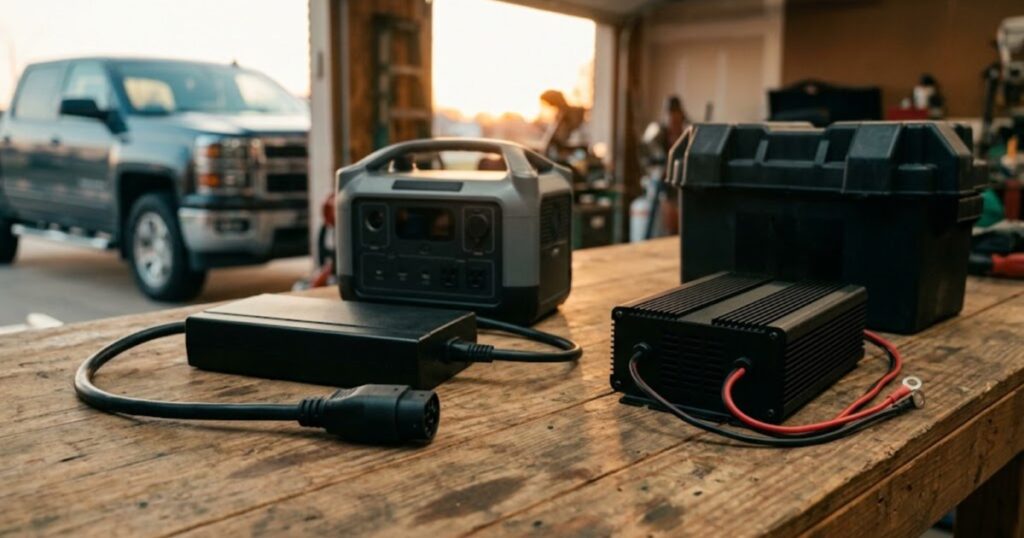
Short answer: they are the same job done for two different batteries. An EcoFlow 800W Alternator Charger and a 50 amp DC-DC charger both pull 50 to 76 amps off the starter battery through 6 AWG cable, and both put two days of fridge back in an hour or two of driving. The alternator charger feeds a power station through its high-voltage input. The DC-DC charger feeds a 12 volt lithium battery. Neither does the other one’s job well.
So the question is not which is faster. It is what sits at the far end of the wire. If you already own a power station, buy the alternator charger. If your fridge and lights live on a wired 12 volt bank in the truck, buy the DC-DC charger and a battery. If you own neither, the choice is really the one in our dual battery vs power station, and the charger follows from it.
What is the difference between an alternator charger and a DC-DC charger?
Both are DC-DC converters bolted between the starter battery and something you want charged while the engine runs. The difference is the output. EcoFlow’s charger puts out 40 to 60 volts, which is what a power station’s own high-current input wants, and it talks to the station over the XT150 or XT60 lead. A Redarc, Victron or Renogy DC-DC charger puts out about 14.4 volts with a proper lithium charge profile, which is what a bare LiFePO4 battery wants. Here they are side by side, from the makers’ own sheets.
| EcoFlow 800W Alternator Charger | Victron Orion XS 12/12-50 | Redarc BCDC1240D | |
|---|---|---|---|
| Charges | a power station (EcoFlow, most others via XT60) | a 12V battery | a 12V battery |
| Output | 40-60V, 800W max | 50A, 700W | 40A, 600W |
| Input draw | up to 76A (maker’s max) | about 51-55A (calculated) | about 46A before losses (calculated) |
| Fuse | 125A, in the box | 70A starter side, 60A house side (dealer) | 60A, not supplied |
| Cable | 5 m input lead in the box; the fused lead is 6 AWG | 6 AWG, 4 AWG on long runs | 6 AWG to 16 ft, 4 AWG to 30 ft |
| Engine sensing | voltage only: charges above 13V | engine shutdown detection built in | blue ignition wire for smart alternators |
| Solar input | none | none | MPPT, 9-32V |
| Draw when parked | not published | under 1.5 mA | under 8 mA |
| Reverse charge | yes, 800W into the starter battery | no | no |
| App | EcoFlow app, CarPlay | not checked | not checked |
| Weight | 5.1 lb | 0.73 lb | 2.2 lb |
Two things stand out. The EcoFlow’s fuse is twice the size of the DC-DC chargers’ on the same gauge of cable; I can only tell you that is what EcoFlow prints, not why. And the EcoFlow does not have an ignition wire. It watches voltage and starts above 13 volts, which is fine on a conventional alternator and the thing to check on a smart one. One Jeep owner on the JL forum found his “does not engage until it hits about 13.5-13.6” volts, whatever he set in the app.
How much does each one put back per hour of driving?
This is where people expect a gap, and there is not much of one. Each row is the driving time to put back 800Wh, two days of fridge at the 400Wh a day our runtime table plans on.
| Route | Rate | Driving time for 800Wh | Whose figure |
|---|---|---|---|
| EcoFlow 800W into a power station | about 769W | about 1 hour | EcoFlow: 1kWh in 1.3 hours |
| Bluetti Charger 2 into a power station | 640W measured | about 1.25 hours | GoRV, in a LandCruiser 200 |
| Bluetti Charger 1 into a power station | up to 560W | about 1.4 hours | Bluetti’s rating |
| Jackery 600W into an Explorer 1000 v2 | about 400W | about 2.0 hours | Jackery’s own table (the station’s input caps it) |
| Victron Orion XS 50A into a 100Ah LiFePO4 | about 582Wh an hour | about 1.4 hours | arithmetic: 50A x 12.8V, divided by 1.1 for losses |
| Redarc BCDC1240D 40A into a 100Ah LiFePO4 | about 465Wh an hour | about 1.7 hours | arithmetic, the same way |
| Power station on the dash socket | about 89W | about 9 hours | Jackery: 12 hours for a full charge |
The alternator charger wins on paper by half an hour to forty minutes, and that is before you ask what the alternator can spare. The Solar Lab saw the EcoFlow “hit 800W almost instantly” on a Wrangler and hold it with the headlights and air conditioning on. An RV Living reviewer put a 2kWh DELTA 2 Max back to full in “about 2.5 hours maximum” on an F-350. The DC-DC rows are sums, not measurements, and real chargers run under their rating on a hot day or at idle: the Orion XS owner in our dual-battery guide sees 40 amps at idle, 35 to 38 on one highway drive and 45 to 48 on a longer trip. Nothing on this page was measured by me.
Notice the Jackery row. Its charger is rated 600 watts, but a Jackery Explorer 1000 v2 accepts 400 watts on its DC input, so Jackery’s own table shows “Around 400W” and three hours. The station’s input sets the rate, not the charger. That matters for the next section.
Can a DC-DC charger charge a power station?
Slowly. A DC-DC charger’s output is 12 volt battery voltage, and a power station takes 12 to 16 volts in through its solar or car port at a hard amp limit. Here is what that limit works out to at 14.4 volts, from each station’s printed input spec.
| Station | 12-16V input limit (maker) | Watts from a DC-DC charger | Driving time for 800Wh |
|---|---|---|---|
| Jackery Explorer 1000 v2 | 8A | about 115W (calculated) | about 6.9 hours |
| EcoFlow RIVER 3 | 8A, 110W max | about 110W (calculated) | about 7.3 hours |
| Bluetti AC180 | 10A | about 144W (calculated) | about 5.6 hours |
| EcoFlow DELTA 2 | 15A | about 216W (calculated) | about 3.7 hours |
So a 700 watt DC-DC charger into a DELTA 2 is a 216 watt charger, about 3.7 times slower than the alternator charger, and into a Jackery 1000 v2 it is a 115 watt one, seven times slower. Faster than the dash socket, which is why EcoFlow’s own blog says campers do it, but it is not what you bought a 50 amp charger for. The one exception EcoFlow names is the DELTA 3 Ultra’s “dedicated high-current input port”, and it gives no figure for it, so I will not either.
The reverse is worse. The EcoFlow’s charge-mode output starts at 40 volts, so it cannot charge a bare 12 volt LiFePO4 at all. Its only 13.8 volt outputs are the reverse-charge mode (800W) and the maintenance mode (100W), and both run the other way: from the station into the starter battery. This is my inference from the spec sheets, not a test, and it is the whole reason the two products exist side by side.
Will my alternator take it?
Both routes ask the same question of the alternator, so neither gets a pass here. EcoFlow prints 76 amps as the input maximum; by arithmetic that is the worst case near the bottom of its 11 volt input range, and at a normal 14 volts the draw is about 57 amps before losses, which one JL owner put as “800w / 12. 5v = 64 extra amps”. A Victron Orion XS at full output is about 51 to 55 amps by the same sum, a Renogy 40A about 48, and owners report DC-DC chargers drawing more at the input than their output rating: one Victron 18A owner sees 22 to 25 amps, and Renogy’s manual, quoted on a forum, puts a 40A unit at up to 60 amps.
EcoFlow’s own sizing blog says to budget around 20% to 40% of the alternator’s rated output and to size against the hot continuous rating, not the cold peak. At the top of that range, 76 amps wants a 190 amp alternator and 57 amps wants about 143. A UK dealer lists the EcoFlow for alternators “above 150A”. The same rule puts a 40 amp DC-DC charger, 46 to 48 amps in, on a 115 to 120 amp alternator, or about 140 on the one-third rule some owners use, which is the sizing our DC-DC sizing post lands too.
The alternator charger has one answer the DC-DC charger mostly does not: a slider. Owners on three forums run the EcoFlow at 300, 500 or 650 watts from the app. One Land Cruiser owner keeps his at 300 because “as long as we drive 3 hours or so, we can hit camp with everything charged”. A Bronco owner “dropped the charge speed to around 650W to bring the wire temps down”. A JKU owner found his stock 140 amp alternator “can handle 500w charging without a voltage dip but wouldn’t do 800w” and swapped the alternator. Victron’s Orion XS can be set from 1 to 50 amps too; the Redarc and Renogy pages I read list no such setting.
What does each one do when the engine is off?
A DC-DC charger goes to sleep: Victron prints under 1.5 mA standby, Redarc under 8 mA, Renogy under 15 mA, and each has an engine or ignition input so a smart alternator’s low parked voltage does not fool it. EcoFlow prints no standby figure for the 800W unit on any page I could find. Two Bronco owners disagree about it: “There is a small current draw to being on standby” against “No battery drain that I can tell as its configured to stop charging once source falls under 13v”. The Solar Lab’s reviewer says “This unit always remains on, unless you manually turn it off in the app” and recommends an inline switch. If the truck sits for weeks between trips, that switch is cheap insurance, and I would want it.
The EcoFlow earns some of that back with the reverse modes. From the app it can push 800 watts from the station back into a flat starter battery, or trickle 100 watts to keep one up. One Bronco owner on his third starter battery says “having this thing around has given me more than enough juice back into the starter battery to get home”. No DC-DC charger on this page runs backwards.
Which one, by what you own?
| You have | Buy | Why |
|---|---|---|
| An EcoFlow DELTA or RIVER | EcoFlow 800W Alternator Charger | XT150 lead in the box for a DELTA; the XT60 lead is a separate part for a RIVER. |
| A Bluetti station | Bluetti Charger 1 or Charger 2 | 560W or 800W into the solar input over MC4; the Charger 2 adds 600W of solar. |
| A Jackery or Anker station | That brand’s own alternator charger | Both are locked to their own stations; check the station’s input cap first (Jackery’s 1000 v2 takes 400W). |
| Another brand of station | EcoFlow 800W with the XT60 lead, or a Bluetti | EcoFlow lists “most third-party power stations”; Bluetti lists most that charge over MC4. |
| A 12V LiFePO4 house battery | A DC-DC charger: Orion XS, BCDC1240D or Renogy 40A | Proper lithium profile, ignition sensing, milliamps when parked; the Redarc adds solar. |
| Neither yet | Decide the battery first | The charger follows from the battery. A station if you want AC and portability; a wired bank if the fridge lives in the truck. |
| A hybrid with a built-in 120V inverter | Maybe nothing | 4Runner hybrid owners charge from the truck’s outlet at about 500W; its inverter fan gets loud above about 400 to 500W. |
The last row is a third route that nobody sells a bracket for. A hybrid 4Runner already has a 120 volt outlet in the back, and one owner on the 4Runner forum relays other threads charging a DELTA from it in “2hrs on the plug” at 500 watts with the input turned down so the truck’s fan stays quiet. If you have that outlet, try it before you buy either charger.
What do owners say after living with each?
The EcoFlow crowd bought it to skip the dual battery, and most of them say so in those words. A Bronco owner picked it “in lieu of a more permanent and involved dual battery setup” and found the “hardest part was figuring out where to mount it cleanly”. A JL owner: “Easy install and much better than dual setup.” Two Bronco owners burned out dash sockets first: one “burned out five 12-volt sockets since getting a power station” before wiring a Bluetti in, the other fried one before the EcoFlow. A hybrid 4Runner owner routed the cable under the sill covers and says it “can be unplugged and removed from the vehicle in 30 seconds when not needed”.
The DC-DC side answers with the station’s limits, not the charger’s. The clearest version is on IH8MUD, from a member arguing against an EcoFlow in a Land Cruiser: power stations “lack a lot of 12v ports and the ports have low amp limits”, “have rather limited operating temps”, and “you spend alot of money and space on the 110v features in these boxes that don’t get used a lot out camping”. His answer is “a diy battery box with a LiFePo4 battery and decided dc to dc charger around 25-30amps”. The Gladiator owner with a Renogy 40A and a 100Ah lithium put it shorter: “I do not have any need for 115V so I have no need for a power station.” Our car-battery post and the dual-battery guide are the wired side of that argument.
The one worry both camps share is the alternator. A Land Cruiser owner who replaced his at 168,000 miles after years of feeding 360 to 600 watts of accessories: “Low and slow is the name of the game and 100W-250W is really all that it takes.” Another “open[s] the hood whenever idling w/ the charger just to help some of that heat escape”. Neither product fixes that. The slider on the EcoFlow at least lets you choose.
EcoFlow 800W Alternator Charger
The alternator charger in the table: 800 watts into a power station, 76 amps maximum draw, a 125 amp fuse on a 6 AWG fuse lead plus a 5 metre input cable, and the XT150 cable for a DELTA in the box. Three modes from the app, including 800 watts back into the starter battery. Starts above 13 volts on its own; no ignition wire. EcoFlow prints no standby draw, so fit a switch if the truck sits.
Bluetti Charger 1
The smaller alternator charger: 560 watts over MC4 into the solar input of a Bluetti or, per Bluetti, most other stations, pulling about 50 amps at 12 volts through a 16 foot 6 AWG lead with a 60 amp breaker. It stops drawing 3 to 6 seconds after the engine shuts off and has a fan. One owner runs a DELTA 2 Max from it at its full rating.
Victron Orion XS 12/12-50
The DC-DC charger in the table: 50 amps and 700 watts into a 12 volt lithium battery at 98.5% peak efficiency, which is why it runs cool and weighs under a pound. Under 1.5 mA when parked, engine detection built in, output set from 1 to 50 amps in the app. No solar input; pair it with a separate controller. The Oliver forum owner sees 40 amps at idle on a 180 amp alternator.
Redarc BCDC1240D
The DC-DC charger with a solar input: 40 amps and 600 watts from the alternator or an MPPT-regulated panel, so camp days top the bank up without the engine. Blue ignition wire for smart alternators, under 8 mA standby, rated to 80C. Redarc’s manual wants a 60 amp fuse you buy separately, 6 AWG to 16 feet and 4 AWG beyond. The full parts list is in the dual-battery guide.
What to skip
- A DC-DC charger to feed a power station. The station’s 12 to 16 volt input caps it at 8 to 15 amps. That is 115 to 216 watts from a 700 watt charger.
- An alternator charger to feed a bare lithium battery. Its output starts at 40 volts. It is not a battery charger and does not pretend to be.
- Either one on a small alternator at full output. Both draw 50 to 76 amps. Budget 20 to 40 percent of the alternator’s hot rating, and turn the EcoFlow down in the app.
- Trusting the 13 volt start on a smart alternator. One owner’s unit waits for 13.5. Watch it on the first drive before you rely on it.
- Leaving the EcoFlow wired with no switch on a parked truck. EcoFlow prints no standby draw and owners report both ways. A switch settles it.
- A Jackery or Anker charger for another brand of station. Both list only their own stations.
- Chaining extension leads. EcoFlow sells a 2 metre extension and prints no maximum length. A long run on 6 AWG at 60 amps drops voltage; the DC-DC makers step up to 4 AWG past about 16 feet, and so would I.
- Buying the charger before the battery. The battery decides the charger, never the other way round.
Build the rest of the rig: the dual-battery setup, sized and wired · what size DC-DC charger for a 100Ah LiFePO4 · dual battery vs power station · charging a power station while driving · how long a power station runs a 12V fridge · what gauge wire a 12V fridge needs · will an EcoFlow River 3 run a 12V fridge · will a Bluetti AC70 run a 12V fridge
I have not wired either charger or metered one. The ratings, fuses, cable sizes and input limits are the makers’ printed figures, the driving times are arithmetic from them, the measured watts are the reviewers’ own, and the owner reports are quoted from the forum threads listed below. Where two published numbers are set side by side, the conclusion is mine.
The receipts: what I read
- Manufacturer800W Alternator Charger ↗ – EcoFlowInput 11-31V up to 76A, output 40-60V 800W, 125A fuse, three modes (charge, reverse charge at 13.8V/800W, maintenance at 100W), charges above 13V, 1kWh in 1.3 hours, XT150 included and XT60 separate, -4 to 140F, 5.1 lb.
- ManufacturerAlternator Charger Fuse Cable ↗ – EcoFlow (EU)The replacement fused lead for the 800W charger: 125A rated, 6 AWG.
- Hard numbersDC-to-DC charger wiring and sizing for a camper ↗ – EcoFlow blogBudget 20 to 40 percent of the alternator’s rated output, sized against its hot continuous rating; match the fuse to the wire; campers do use a DC-DC charger to keep a station charged, and the DELTA 3 Ultra has a dedicated high-current input.
- Expert reviewEcoFlow 800W Alternator Charger review ↗ – The Solar LabHit 800W almost instantly on a Wrangler and held it with headlights and air conditioning on; the alternator dipped from 14.4 to about 13.8V momentarily; reverse charge ran at about 200W; the unit always remains on unless turned off in the app, and the reviewer recommends an inline switch.
- Expert reviewEcoFlow Alternator Charger on an F-350 ↗ – RV Living (Lucinda Belden)A full 800 watts into a DELTA 2 Max, back to 100 percent in about 2.5 hours maximum; the charger goes to standby once the station is full.
- Expert reviewDC-DC Charger Test: Bluetti Charger 2 ↗ – GoRV (Marty Ledwich)A maximum of 640W of alternator charging in a LandCruiser 200 with other loads running; a load of around 60A at full output; a 75A main fuse in the kit; the Charger 1 could refill a 1,024Wh station in about two hours.
- ManufacturerCharger 1 ↗ – Bluetti, via Outbound Power’s spec table12-14V in, 50A at 12V, 560W max, output 15 to 56V adjustable in the app, 16 ft 6 AWG lead with a 60A breaker, MC4 output, fan cooled, stops 3 to 6 seconds after the engine is off.
- ManufacturerCharger 2 ↗ – Bluetti (EU FAQ)Up to 66.6A from a 12V vehicle, 800W from the alternator plus 600W of solar, 1,200W total; works with Bluetti and most third-party stations that charge over MC4.
- ManufacturerDC-DC Alternator Charger ↗ – Jackery11.8-32V in at 60A, 600W max, 50V out, ACC signal wire, no fan; Jackery’s own table shows the Explorer 1000 v2 taking around 400W and about three hours.
- ManufacturerSOLIX Alternator Charger ↗ – Anker (EU)Up to 800W, a 7 m battery lead with a 100A fuse, XT60i output, listed for Anker SOLIX stations.
- ManufacturerOrion XS 12/12-50A technical data ↗ – Victron EnergyStandby under 1.5 mA, no-load under 100 mA, 1 to 50A settable, 98.5 percent maximum efficiency, 0.33 kg, derates above 40C; engine shutdown detection is on the datasheet.
- ManufacturerOrion XS cable and fuse sizing ↗ – Solar4RVs6 B&S cable, 4 B&S for longer runs, a 70A fuse at the starter battery and 60A at the house battery.
- Manufacturer40A, 600W, MPPT solar input 9-32V, standby under 8 mA, 6 AWG to 16 ft and 4 AWG to 30 ft, operating to 80C.
- Manufacturer60A fuse recommended, not supplied; the support article says the blue wire goes to ignition only on a smart-alternator vehicle and draws about a microamp.
- Manufacturer12V 40A DC to DC Battery Charger ↗ – Renogy584W, 94 percent efficiency, 60A input and 50A output fuses, idle under 15 mA, 3 m ignition wire, no solar input on this model.
- ManufacturerExplorer 1000 v2, DELTA 2, RIVER 3 and AC180 DC inputs ↗ – Jackery, EcoFlow, BluettiThe 12 to 16 volt input tiers: Jackery 1000 v2 8A, EcoFlow RIVER 3 8A and 110W max, Bluetti AC180 10A, EcoFlow DELTA 2 15A. The watt figures in the table are those amps at 14.4V.
- Owner reportsEcoFlow Alternator Charger ↗ – Bronco6G forumBought in lieu of a dual battery; one owner reports a small standby draw and another none; one turned it down to 650W for wire temperature; one burned out five dash sockets before wiring a Bluetti in; the reverse mode got one owner home.
- Owner reportsEcoFlow 800w Alternator Charger Question ↗ – JL Wrangler ForumsStarts at about 13.5 to 13.6V whatever the app setting on one Jeep; the leads are thick; 800W at 12.5V is 64 amps by one owner’s sum; five months with a DELTA 2 Max and a fridge on an eTorque 3.6L.
- Owner reportsThe two camps in one thread: the EcoFlow as a minimalist, movable system against the case for a LiFePO4 box with a 25 to 30 amp DC-DC charger because stations lack 12V ports, have low amp limits and narrow operating temperatures.
- Owner reportsOverland Power, page 2 ↗ – IH8MUDAn alternator replaced at 168k after years of 360 to 600W of accessories; low and slow; one owner opens the hood when idling with a 40A charger; another runs the EcoFlow at 300W and reaches camp charged after three hours.
- Owner reportsDual-battery setup for the Hybrid 4Runner ↗ – 4Runner6GA DELTA 3 Plus and the 800W charger on a hybrid’s DC-DC converter; cable under the sill covers; removable in 30 seconds; the truck’s inverter fan is loud above 400W; others charge from the 120V outlet at 500W.
- Owner reportsTacoma high-output alternator and Bluetti Charger 1 ↗ – Overland BoundA stock 140A JKU alternator handled 500W without a dip but not 800W; a Charger 1 runs a DELTA 2 Max at 57V and 10A; 150A called the minimum for dual batteries.
- Owner reportsBattery setup for overlanding ↗ – Jeep Gladiator ForumA Renogy 40A and 100Ah lithium owner with no need for 115V; a Bluetti AC180 owner getting up to 600W from a Charger 2 who wired front to back himself.
FAQ
Is the EcoFlow alternator charger a DC-DC charger?
Technically yes: it converts the vehicle’s 12 or 24 volts to a higher DC voltage. But its output is 40 to 60 volts for a power station’s input, not the 14.4 volts a lithium battery charges at, so it is not a battery charger in the Redarc or Victron sense and cannot replace one.
Can I use a Redarc or Victron DC-DC charger to charge my EcoFlow?
Through the solar or car input, at that input’s amp limit: 15 amps on a DELTA 2, 8 on a RIVER 3. At 14.4 volts that is about 216 and 110 watts. Faster than the dash socket, a fraction of the alternator charger. All of it is arithmetic from published figures, not a test.
How many amps does the EcoFlow 800W alternator charger draw?
EcoFlow prints 76 amps maximum. At a normal 14 volt alternator voltage, 800 watts is about 57 amps before losses; the 76 is the worst case at the bottom of its input range. You can turn it down in the app.
Does the EcoFlow alternator charger drain the starter battery when parked?
At its default it stops charging below 13 volts, so it will not pull the starter battery down through the station; set the threshold lower in the app and one owner found it runs with the engine off. Its own standby draw is not published, and owners report both a small draw and none. An inline switch on the input lead takes the question away.
Which is better for a 12V fridge?
Whichever battery the fridge runs on. A fridge on a power station gets the alternator charger; a fridge on a wired house battery gets the DC-DC charger. Our runtime table covers the station side and the dual-battery guide the wired side.
Do I need a bigger alternator?
Both routes draw 50 to 76 amps flat out. EcoFlow’s own blog budgets 20 to 40 percent of the alternator’s hot rating, which puts 800 watts on a 150 to 190 amp alternator. On a smaller one, turn the EcoFlow down, pick a 25 or 30 amp DC-DC charger, or accept a slower refill.
Are these numbers from a test?
No. Nothing on this page was measured by me. The 800 watts is EcoFlow’s rating and two reviewers’ readings; the DC-DC rates and the station input figures are arithmetic from the makers’ sheets. Where a figure is unpublished, the page says so.