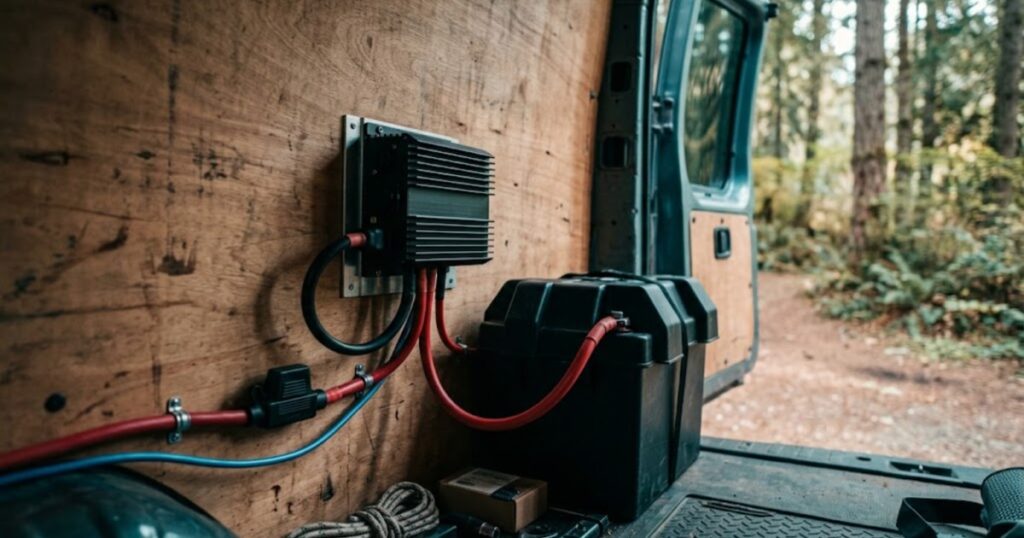
Short answer: for one 100Ah lithium battery, a 25 to 30 amp charger is the right size for most trucks, and 40 amps is the ceiling worth paying for. The battery is not what limits you. LiTime allows 100 amps into its 100Ah and recommends 20. Battle Born allows 50. What limits you is the alternator feeding the charger and the cable between them, and a 40 amp charger pulls nearer 50 to 60 from the alternator, not 40.
The hours are simple arithmetic. From a fifth left, a 25 amp charger refills 100Ah in about three hours of driving, a 40 amp in two, a 50 amp in one and a half. One day of a 12V fridge is about 31 amp-hours, which a 25 amp charger puts back in about an hour and twenty minutes of driving, a 40 amp in under an hour. If you drive between camps most days, the smaller charger keeps up and asks less of the alternator. The bigger one earns its place when the drives are short, the alternator is big, or the bank will grow past 100Ah.
Will a 100Ah LiFePO4 take 50 amps?
Yes, and more. This is the first thing to settle, because it is where most people start and it is not the limit. Three makers’ sheets for a 100Ah battery:
| 100Ah LiFePO4 | Recommended charge current | Maximum charge current | Absorption |
|---|---|---|---|
| LiTime 12V 100Ah Mini | 20A | 100A continuous | not stated |
| Battle Born BB10012 | not stated | 50A per 100Ah | 20 to 30 minutes per 100Ah |
| Renogy 12V 100Ah Smart | not stated | 50A continuous | not stated |
Every charger in this article sits under every one of those ceilings. LiTime’s 20 amp recommendation is the only line that argues for a small charger, and LiTime itself prints the charge time for a bigger one on the same page, “a 40A DC-DC charger (2.5 hours)”, and, for a 50 amp charger of any kind, “50A (0.5C): Up to 100% charge in ~2 hours”. So the battery will take whatever you give it from this range. The question moves to the truck.
Redarc’s advice runs the other way from most buyers’ instinct. Its support article says a bank of 75 to 200Ah has “a recommended charge rate of less than 40 amps, so a BCDC1225D would be the better choice”, and the BCDC1240D’s own page says it “is typically used for lead acid battery banks over 200Ah and lithium batteries over 100Ah”. The 50 amp unit is “used for battery bank sizes over 200AH”. Read plainly: for one 100Ah battery, Redarc sells you the 25.
How long does each size take to charge 100Ah?
Amp-hours divided by amps. The first column is from flat, which you should not do to a lithium battery every day. The second is from a fifth left, which is a normal morning after a fridge night. Neither includes the absorption step at the end, which Battle Born puts at 20 to 30 minutes per 100Ah, or the slowdown as the charger warms up.
| Charger | 100Ah from flat | 80Ah (from a fifth left) | One fridge day, 34Ah with losses |
|---|---|---|---|
| 20A | 5.0 h | 4.0 h | 1.7 h of driving |
| 25A | 4.0 h | 3.2 h | 1.4 h |
| 30A | 3.3 h | 2.7 h | 1.1 h |
| 40A | 2.5 h | 2.0 h | 0.9 h (about 52 minutes) |
| 50A | 2.0 h | 1.6 h | 0.7 h |
All of it is arithmetic from published figures, not a test. The fridge day is the 400Wh our runtime table is built on, which is 31 amp-hours at 12.8 volts, plus the ten percent for losses that our dual-battery guide adds to its own charge-time table. Two published figures land on the same line: Mike Sokol, writing on RV electricity, says “a 25-amp DC-DC charger could fully recharge a 100 amp-hr Lithium trailer battery in about 4 hours of driving time”, and a Go Fast Campers forum member with a 25 amp Redarc on a 100Ah lithium reckons about four hours from drained to full.
What the table says about the choice: if you drive between camps, a 25 amp charger puts a whole fridge day back before the second coffee stop. The 40 amp saves you about half an hour a day. The 50 amp saves you ten minutes more than that. Where the 40 wins outright is a short hop, an hour of driving after two nights parked, where it puts back twice what the 20 does.
What does the alternator actually see?
More than the number on the box. A DC-DC charger steps the voltage up to charge the lithium battery, and the losses come out of the input side, so a 40 amp charger draws more than 40 amps from the alternator. The makers publish output watts and efficiency; divide one by the other, and by the alternator’s voltage, and you have the draw.
| Charger | Output | Efficiency (maker) | Input at 13V (calculated) | Waste heat at full output |
|---|---|---|---|---|
| Victron Orion-Tr Smart 12/12-30 | 30A, 360W | 87% | about 32A | about 54W |
| Renogy 40A DC-DC | 40A, 584W | 94% | about 48A | about 37W |
| Victron Orion XS 12/12-50 | 50A, 700W | 98.5% | about 55A | about 11W |
Those are best cases at a steady voltage. Owners see more. A Land Cruiser owner on IH8MUD: “my Victron 18A can draw 22-25A on the input.” A Class B Forum member quoting the Renogy manual: “the amperage consumption will be 50% greater on the input side”, so “The 40A might put as much as a 60A load on the system”. That is the number to size the alternator and the cable for, not the 40.
Two rules of thumb circulate for how much of the alternator a charger may take. Spheral Solar’s sizing guide: “your DC to DC charger’s input current should not exceed 50% of your alternator’s rated output current.” The IH8MUD member above, answering whether a 40 amp charger is safe on a 180 amp Land Cruiser alternator: “no more than 50% charger to alternator size, but probably safer to limit to 33%.” Here is what the two rules allow, as input amps, for the alternators common under overland trucks.
| Alternator | Half rule | Third rule | What fits |
|---|---|---|---|
| 110A (an older or smaller engine) | 55A | 37A | 20 or 25A on either rule; 40A only on the half rule |
| 130 to 140A (a 4Runner-class Toyota, per an owner’s figure) | 65A | 43A | 25 or 30A on either; 40A on the half rule |
| 180A (Land Cruiser 200; the smallest JL option) | 90A | 60A | 40A on either; 50A on either, just |
| 220 or 240A (JL options) | 120A | 80A | any size here |
The alternator figures are the thinnest part of this page, and I say so. The Jeep ones are Mopar part listings (180, 220 or 240 amps for the 3.6 litre JL and JT). The Land Cruiser’s 180 is an owner’s statement on IH8MUD. The Toyota body-on-frame figure is one forum member’s recollection, “usually around 130-140”, and the aftermarket page I found for the Tacoma contradicts itself. Read the rating off your own alternator or the dealer’s parts list before you size against it.
Idle is the other half. A charger that is fine at highway revs can drag the system down in a car park. The Class B member with the 40 amp Renogy on a 160 amp Chevy alternator: it “charges at a full 40 amps”, but, idling in traffic with the air conditioning running, “I ocassionally noticed a voltage drop to low 12’s or even high 11’s voltage unless I add gas.” On the other side, a 2018 Land Cruiser owner with a 50 amp charger and 200Ah of lithium: “I get an honest 50 amps out of our 2018 LC @ idle.” Another member’s estimate is that “modern alternators can easily put out over 50% of maximum amps at idle”, and one aftermarket maker’s figures for its own 270 amp Tacoma unit show the shape: 200 amps at idle cold, 180 at idle hot. No maker I found publishes an idle curve for a stock alternator.
What cable and fuse does each size need?
This is where the 40 and 50 amp units cost more than their price tag. Redarc’s wiring-kit manual has one cable size for the 25 amp charger and a heavier one for the 40 and 50, by run length:
| Run from starter battery to charger | 25A (Redarc BCDC1225D kits) | 40A and 50A (BCDC1240D / 1250D kits) |
|---|---|---|
| Under 0.6 m (engine bay) | 8 AWG | 6 AWG |
| 0.6 to 3.5 m | 6 AWG | 4 AWG |
| Up to 8.5 m (a rear install) | 6 AWG | 4 AWG |
| Fuse, both ends | 40A | 60A |
An etrailer expert gives the same line for the BCDC1240D in feet: under 16 feet, 6 gauge; “between 18 and 20 feet you’d want to use 4 gauge wire.” Victron’s dealer page for the Orion XS 50 amp says “6 B&S is recommended, with 4 B&S recommended for longer runs”, with a 70 amp fuse at the starter battery and 60 at the house battery, and Victron’s own sheet caps the terminal at 4 AWG. The target behind all of it, from the IH8MUD thread: “Keep the voltage drop under 3% at full load.” The gauge table by amps and feet, and why a long thin run quietly turns a 40 amp charger into a 30, is in our dual-battery guide, and the same arithmetic for the fridge’s own cable is in what gauge wire a 12V fridge needs.
Heat is the quieter cost. The older Victron Orion-Tr Smart 30 amp runs at 87 percent, so at full output it sheds about 54 watts into wherever it is mounted, and Victron derates it 3 percent per degree above 40C. The Orion XS at 98.5 percent sheds about 11 and derates 1.5 percent per degree. Redarc’s BCDC1240D is rated to 80C and potted for the engine bay. Renogy’s advice for its 40 amp unit is to mount it flat for venting and near the house battery. Put the charger where air moves, and remember that a lithium battery in the same box has its own limits: a JL owner’s rule of thumb is that “LiFePO4 (Lithium Phosphate) batteries don’t like it hotter than about 112F.”
Which size, by truck and by trip?
| Your situation | Pick | Why |
|---|---|---|
| Alternator under 130A, one 100Ah battery | 20 or 25A | Inside the third rule. A whole fridge day back in under two hours. |
| 130 to 180A alternator, you drive most days | 25 or 30A | 3.2 hours from a fifth left; the cable is a size lighter and the fuse is 40A. |
| 180A or more, short drives between camps | 40A | Two hours from a fifth left, 52 minutes a day for the fridge. Budget 4 AWG and 60A fuses. |
| A second 100Ah is coming, or a bank over 200Ah | 40 or 50A | Redarc’s own line for the 40 is lithium over 100Ah; the 50 is for banks over 200Ah. |
| You idle to charge (work truck, camp host) | 25A | The 40 amp Renogy pulled a 160A alternator down to the low 12s at idle, with the air conditioning on. |
| A smart alternator (JL, most new vehicles) | any size, with the ignition wire connected | The charger needs to be told the engine is running. See below. |
| AGM instead of lithium | 25A | An AGM wants a slower charge; the IH8MUD buyer notes the 25 is the pick for AGM. |
I would draw the line at the alternator, not at the battery. Two owners who bought big say the same. A Go Fast Campers member who installed a 40 amp unit for a single lithium battery says in hindsight 20 amps would have done, and “The key is making sure you leave some headroom on the alternator.” On MotorhomeFun, a van owner asking whether a 40 amp charger suits a 110 amp alternator got this: “A lithium will gobble up as many amps as you can throw at it” and “110amp is a pretty small alternator these days.” He kept the 20.
One Ram 1500 owner on Overland Bound, with 150Ah of lithium and a fridge, weighed the 40 against the 50 and landed on the 40: “I don’t think that what I gain from the 1250 is worth it.” Another member’s reading of Redarc’s range matches the table above: the 25 is the usual pick for batteries up to 100Ah, and the 40 “packs more value in terms of price/output” once the bank is bigger.
Why does a smart alternator change the install?
Older alternators hold a steady voltage, around 14 volts, whenever the engine runs. A smart alternator does not. Victron’s engine-detection note says they “generate a variable output voltage which can range from 12.5V to 15V”, and can sit at under 12.5 for a while, especially with regenerative braking. Redarc puts it bluntly: “This lower voltage (often as low as 12.3V) was too low to charge deep cycle batteries at all.” A charger that decides the engine is running by watching the voltage will switch itself off.
The fix is a wire. Redarc’s blue wire “only needs to be connected to ignition when the BCDC* is installed in a "smart" alternator system”, draws about a microamp, and must go to a point that shows battery voltage with the ignition on. Renogy ships a three metre ignition wire with its 40 amp unit and lists a separate input range for “Smart Alternator (Euro 6)”. Victron’s Orion-Tr Smart has a remote on/off connector for the same job, and the Orion XS detects the engine on its own. On a JL, an owner’s advice is unambiguous: “the JL most definitely has a smart alternator” and “You should definitely have a wire to the DCC30S/50S telling it that your engine is on.” Renogy’s phone support told the same thread’s starter the opposite. Wire it.
Redarc BCDC1225D
The size Redarc itself names for one 100Ah battery: 25 amps, a solar input on the same unit, 40 amp fuses and 6 AWG cable even to the back of a long wheelbase. From a fifth left it refills 100Ah in about 3.2 hours of driving and a fridge day in about 82 minutes.
Redarc BCDC1240D
The 40 amp unit from the dual-battery guide: 600 watts, a solar regulator in the same case, rated to 80C and potted for the engine bay. Redarc’s page puts it at lithium banks over 100Ah. It needs 4 AWG past the first 0.6 metres and 60 amp fuses, and it asks the alternator for nearer 50 amps than 40 (600 watts at 13 volts is 46 amps before losses).
Victron Orion XS 12/12-50
The one that makes the size question go away: the output is set anywhere from 1 to 50 amps (Victron lists the setting range as 1 to 50), so it can run as a 25 on a small alternator and a 50 later. At 98.5 percent efficiency it sheds about 11 watts at full output and weighs under a pound. No solar input; a separate controller does that.
Renogy 12V 40A DC-DC
The budget 40: 584 watts at 94 percent, a 60 amp input fuse, a three metre ignition wire in the box and a separate input range for smart alternators. Its own manual, per an owner quoting it, has the input running “50% greater”, so plan for a 60 amp load. The owner with one on a 160 amp alternator saw the voltage sag at idle.
What to skip
- Sizing the charger to the battery’s maximum. LiTime’s 100 amps is a ceiling, not a target. No DC-DC charger in this class can feed it, and it would take half of even the biggest alternator here.
- A 50 amp charger on an alternator under 150 amps. It draws about 55 from the alternator at full output, which is a third of a 165 amp unit and more than that of anything smaller.
- Buying the 40 and keeping the 25’s cable. The run past the engine bay goes from 6 AWG to 4, and the fuses from 40 to 60. Thin cable gives you a slower charger that runs hot.
- Charging at idle in a car park and expecting the label. One 40 amp unit pulled a 160 amp alternator into the low 12 volts at idle. Drive, or set the charger lower.
- Leaving the ignition wire off on a smart alternator. The charger will stop when the alternator rests, which is often. Connect it.
- Sharing a fuse with the winch. The Go Fast Campers member’s warning: the winch “draws alot”. Its own circuit, its own fuse.
- Trusting a phone rep over the forum. Renogy’s support told one JL owner the Jeep has no smart alternator. It does.
Build the rest of the rig: the dual-battery setup, sized and wired · how long a power station runs a 12V fridge · what gauge wire a 12V fridge needs · charging a power station while driving · running a fridge off the starter battery overnight · how many amps a 12V fridge really draws · best 12V fridge for overlanding · which fridge battery-protection setting to use
I have not installed any of these chargers or metered one on an alternator. The charge currents, efficiencies, cable sizes and fuse ratings are the makers’ published figures, the hours and the input amps are arithmetic from them, and the owner reports are quoted from the forum threads listed below. Where two published numbers are set side by side, the conclusion is mine.
The receipts: what I read
- Manufacturer12V 100Ah Mini LiFePO4 battery ↗ – LiTimeRecommended charge current 20A, max continuous 100A, 1,280Wh; the page’s own charge times of 2.5 hours on a 40A DC-DC charger and about 2 hours at 50A.
- ManufacturerBB10012 cut sheet ↗ – Battle Born (PDF)50 amps of charge per 100Ah; absorption 20 to 30 minutes per 100Ah; 100A continuous discharge.
- ManufacturerMaximum continuous charging current 50A.
- ManufacturerHow to use a BCDC to charge a secondary battery in any vehicle ↗ – Redarc support75 to 200Ah banks: a recommended charge rate under 40A, so the BCDC1225D; the blue ignition wire for smart alternators; stay within the battery maker’s recommended maximum.
- Manufacturer40A, 600W, 60A fuses (FK60, not supplied), 1 kg, -20C to +80C, engine-bay install; typically used for lithium batteries over 100Ah.
- ManufacturerBCDC1225D and BCDC1250D listings ↗ – Home of 12 Volt (Redarc dealer)BCDC1225D: 25A, 40A fuses, for 75 to 200Ah banks. BCDC1250D: 50A, 60A fuses, for banks over 200Ah.
- ManufacturerBCDC wiring kit instruction manual ↗ – Redarc (PDF)25A kits: 8 AWG under 0.6 m, 6 AWG to 8.5 m, 40A fuses. 40A and 50A kits: 6 AWG under 0.6 m, 4 AWG to 8.5 m, 60A fuses. 20 AWG ignition wire with a 2A fuse.
- ManufacturerOrion XS 12/12-50A technical data and datasheet ↗ – Victron Energy1 to 50A, 700W, 98.5 percent maximum efficiency, derating 1.5 percent per degree above 40C, 4 AWG maximum cable, 0.33 kg, engine shutdown detection.
- ManufacturerOrion XS 12/12-50 listing ↗ – Solar4RVs (Victron dealer)6 B&S cable, 4 B&S for longer runs; 70A fuse at the starter battery, 60A at the house battery.
- ManufacturerOrion-Tr Smart 12/12-30 listing ↗ – Navstore (Victron dealer)30A, 360W, 87 percent efficiency, 6 AWG maximum cable, 1.8 kg, derate 3 percent per degree above 40C, remote on/off connector.
- ManufacturerEngine detection note (Orion-Tr Smart) ↗ – Victron Energy (PDF)Regular alternators hold a fixed voltage; smart alternators range from 12.5V to 15V and can sit below 12.5V; default start 13.3V, stop 13.1V.
- Manufacturer12V 40A DC to DC battery charger ↗ – Renogy40A, 584W, 94 percent efficiency, 60A input and 50A output fuses, smart alternator input 12 to 16V, 3 m ignition wire included, mount flat and near the house battery.
- ManufacturerAlternator, JL / JT 3.6L ↗ – Quadratec (Mopar parts)Mopar alternator options of 180, 220 or 240 amps.
- Hard numbersDC to DC charger sizing guide ↗ – Spheral SolarInput current at most 50 percent of the alternator’s rated output; output at most the battery’s recommended maximum.
- Hard numbersCharging while driving ↗ – RV Electricity (Mike Sokol)A 25A DC-DC charger recharges a 100Ah lithium in about 4 hours of driving; a 7-way trailer plug gives about 5A.
- Hard numbersBCDC1240D cable questions ↗ – etrailer (expert answers)Under 16 feet, 6 gauge; 18 to 20 feet, 4 gauge.
- Owner reportsAlternator output at idle? ↗ – IH8MUD forumA Victron 18A drawing 22 to 25A on the input; an honest 50A at idle from a 2018 Land Cruiser; the 180A stock alternator; the over-50-percent-at-idle estimate.
- Owner reportsIs it OK to run a 40 amp DC to DC charger on a 180 amp OEM Land Cruiser alternator? ↗ – IH8MUD forumThe 50 percent rule, safer at 33; voltage drop under 3 percent at full load; the 25 as the pick for AGM.
- Owner reportsRenogy DC-DC 20/40/60A notes ↗ – Class B ForumA 40A Renogy on a 160A alternator charging at a full 40A and sagging to the low 12s at idle; the manual’s input 50 percent greater, as much as a 60A load.
- Owner reportsRedarc BCDC sizing ↗ – Overland Bound forumA Ram 1500 owner with 150Ah choosing the 40 over the 50; the 25 as the usual pick up to 100Ah.
- Owner reportsDC to DC chargers? ↗ – Go Fast Campers forumA 40A owner who would buy 20A in hindsight and the headroom advice; a 25A Redarc on 100Ah at about four hours; the winch fuse warning.
- Owner reportsHelp sizing Renogy DC to DC charger for 110amp alternator ↗ – MotorhomeFunA 110A alternator called small; a lithium will gobble up as many amps as you can throw at it; the owner kept the 20A.
- Owner reportsRenogy DC to DC charger with MPPT ↗ – JL Wrangler ForumsThe JL has a smart alternator and the charger needs the ignition wire; Renogy support said otherwise; the 112F rule of thumb for LiFePO4.
- Owner reportsHybrid alternator amperage ↗ – 4Runner6G forumAn owner’s recollection that Toyota body-on-frame alternators ran about 130 to 140A before the hybrids.
- Hard numbers270 amp XP high output alternator, 2016+ Tacoma 3.5L ↗ – SDHQ OffroadThe aftermarket unit’s own figures: 200A at idle, 180A at hot idle, 270A maximum, 250A hot.
FAQ
Is a 20 amp DC-DC charger enough for a 100Ah lithium battery?
For one battery and a fridge, yes, if you drive. It is LiTime’s recommended charge current for its 100Ah, and it puts back a 400Wh fridge day in about 1.7 hours of driving, or 100Ah from flat in 5. It is the right size for an alternator of 110 amps or so. Where it falls short is a short hop after two nights parked.
Can I run a 50 amp DC-DC charger on a stock alternator?
On a 180 amp alternator, owners do. A 2018 Land Cruiser with a 50 amp charger reports an honest 50 amps at idle. The charger draws about 55 amps from the alternator at full output, which is under a third of 180. On a 130 or 140 amp alternator it is over a third and near the half rule, and I would not.
How long does a 40 amp DC-DC charger take to charge a 100Ah battery?
About 2.5 hours from flat and 2 from a fifth left, before absorption. LiTime prints the same 2.5 hours for its 100Ah on a 40 amp charger. One fridge day is back in about 50 minutes.
Does a bigger charger need thicker cable?
Yes, and heavier fuses. Redarc’s kits go from 6 AWG and 40 amp fuses for the 25 amp charger to 4 AWG and 60 amp fuses for the 40 and 50, on any run past the engine bay. The input draw of a 40 amp charger is nearer 50 to 60 amps, which is what the cable has to carry.
Why does my DC-DC charger keep switching off while I drive?
Most likely a smart alternator. It lets the voltage fall when the battery is full or the car is coasting, and a charger that watches the voltage to decide whether the engine is running turns off. Connect the ignition wire (Redarc’s blue wire, Renogy’s IGN wire, Victron’s remote connector) to a point that shows battery voltage with the ignition on.
Are these numbers from a test?
No. The charge currents, efficiencies, cable sizes and fuses are copied from the makers’ pages and manuals. The hours and the input amps are sums from those figures. The owner reports are quotes from forum threads. Nothing on this page was measured by me.