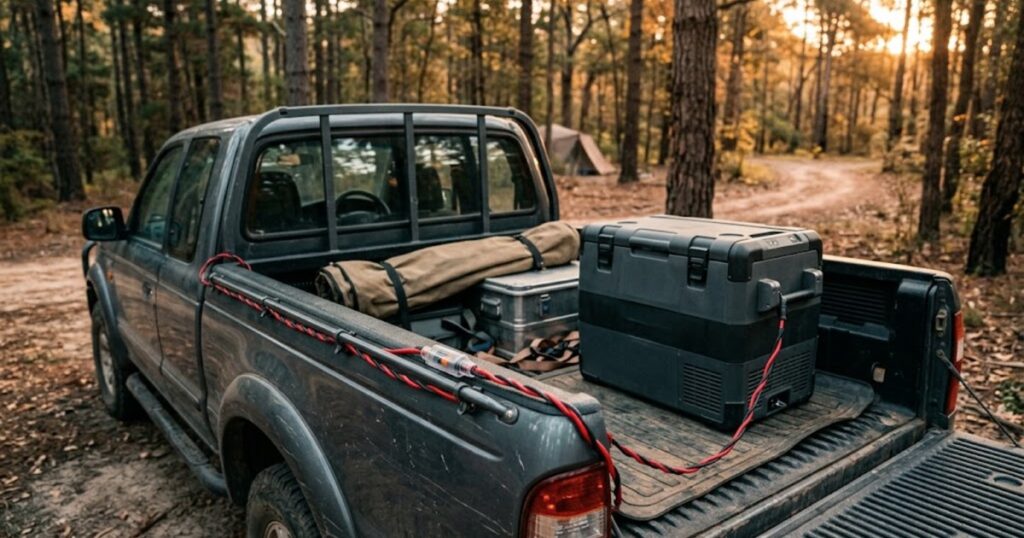
Short answer: 10 AWG for a run of up to about 20 feet from the battery to the fridge, 8 AWG if it is longer, and 12 AWG only if it is under about 13 feet. Both wires go back to the battery, with a 15 amp fuse on the positive at the battery end. That is not a forum opinion. It is the wire table a fridge-compressor maker prints for exactly this job, and the arithmetic agrees with it.
The reason it matters is not heat or fire. A fridge pulls a few amps, and almost any wire will carry that. It matters because the fridge decides when to shut off by reading voltage at its own end of the cable. Every tenth of a volt the wire loses is read as a flatter battery. Thin wire on a long run, and the fridge quits at 2 a.m. with a battery that is fine.
Why does wire gauge matter to a fridge that only draws a few amps?
Because of the low-voltage cutoff. Every one of these fridges has a battery protection setting that stops the compressor when voltage falls to a set point. On an ARB, High switches off at 11.8 volts, Medium at 11.4 and Low at 10.1. The catch is where that voltage is read. Dometic’s support page says the CFX3 measures it at the fridge’s internal electronics and reports it as the voltage at the plug. Either way that is the fridge’s end of the cable, not the battery’s. So the fridge sees battery voltage minus whatever the cable, the plug and the socket lost on the way.
Secop makes 12 volt fridge compressors and the controllers that run them (Iceco names Secop on the VL45’s product page), and its installation sheet says it in one line: “Avoid extra junctions in the power supply system to prevent voltage drop from affecting the battery protection setting.” The same sheet says the wire dimensions in its table “must be observed”. Here is that table.
What gauge does the compressor maker call for?
| Wire (as Secop labels it) | Max length at 12V, battery to fridge | At 24V |
|---|---|---|
| 2.5 mm² (12 AWG) | 2.5 m / 8 ft | 5 m / 16 ft |
| 4 mm² (12 AWG) | 4 m / 13 ft | 8 m / 26 ft |
| 6 mm² (10 AWG) | 6 m / 20 ft | 12 m / 39 ft |
| 10 mm² (8 AWG) | 10 m / 33 ft | 20 m / 66 ft |
That is from Secop’s instructions for the BD35F, one of its 12 and 24 volt fridge compressors. Two things to notice. The rule is one square millimetre of copper per metre of run, so the wire gets thicker exactly as fast as the run gets longer. And the table is a little generous with its gauge labels: it prints 12 AWG beside both of the first two rows, and calls 6 mm² a 10 AWG, when a 10 AWG wire is 5.26 mm² on the standard chart. Treat 20 feet as the far end of what 10 AWG should be asked to do, not the middle.
A Bushman fridge manual quoted on ExplorOz carries the same first three rows: 2.5, 4 and 6 square millimetres for 2.5, 4 and 6 metres. Different badge, same rule.
How much voltage does each gauge lose?
This table is arithmetic, not a test. Copper wire has a published resistance per foot. Multiply by the length there and back, then by the current, and you have the volts that never reach the fridge. The sum uses 8 amps, because that is about what the makers print as rated current (Dometic lists 8.2 amps for the CFX3 45 and 7.0 for the older CFX35W). Measured running draw is lower: GNOMAD Home logged 33 to 55 watts on an Iceco, roughly 3 to 5 amps, so halve the numbers for the easy hours. The cutoff does not trip in the easy hours.
| Wire | 6 ft run | 10 ft run | 15 ft run | 20 ft run | 25 ft run |
|---|---|---|---|---|---|
| 16 AWG | 0.39 V | 0.64 V | 0.96 V | 1.29 V | 1.61 V |
| 14 AWG | 0.24 V | 0.40 V | 0.61 V | 0.81 V | 1.01 V |
| 12 AWG | 0.15 V | 0.25 V | 0.38 V | 0.51 V | 0.64 V |
| 10 AWG | 0.10 V | 0.16 V | 0.24 V | 0.32 V | 0.40 V |
| 8 AWG | 0.06 V | 0.10 V | 0.15 V | 0.20 V | 0.25 V |
Run length is one way, battery to fridge; the sum already counts the trip back. Bold is anything over 0.36 volts, which is 3 percent of 12. Blue Sea Systems’ wire-sizing guide uses 3 percent for critical circuits and 10 for the rest, and measures every circuit as the round trip. By its own list a fridge would sit with general appliances at 10. I held it to 3 anyway, because this circuit has a voltage cutoff at the far end and a cabin light does not.
Read across the 20 foot column. A 16 AWG wire loses 1.29 V. A 12 AWG loses 0.51 V. A 10 AWG loses 0.32 V, which is inside the line, and at 25 feet it is 0.40 V, which is not. Worked the other way, 3 percent at 8 amps allows a little under 6 feet of 16 AWG, about 9 of 14, 14 of 12, 23 of 10 and 36 of 8. Put that beside Secop’s 8, 13, 20 and 33 feet. Two different routes, one from a compressor factory and one from a boat-wiring chart, and they land in the same place.
Which gauge for which run?
Measure the route the wire will take, not the truck. Along the firewall, down the frame rail or under the sill trim, up into the bed or the cargo area. It is always longer than the straight line. ARB sells its kit at 20 feet, which tells you what ARB thinks a vehicle needs.
- Under about 13 feet (a short SUV cargo run, or a battery that already lives in the back): 12 AWG meets the table. 10 AWG costs little more and leaves room.
- 13 to 20 feet (most pickups, battery to bed): 10 AWG. This is the answer the owner threads keep arriving at on their own.
- Over 20 feet (long-bed crew cabs, a route that wanders, a fridge on a trailer): 8 AWG.
Going thicker than the table costs a little more copper and nothing else. Going thinner costs you the job twice. A Tacoma World regular gave the same advice to an owner wiring his bed: “16 minimum, 12 is better, 10 is even better. I’d put in 10 just to not have to re-run it in the future”.
What about the socket that is already in the truck?
ARB’s tips page is blunt about it: “Most vehicle cigarette lighters are designed to power no more than a cell phone. Many are also designed to shut off when the key is in the off position.” The owner’s manual gives you a fuse rating or a watt limit for the outlet (15 amps on a Silverado, 120 watts on a Forester). It never gives you the wire gauge behind it.
The owner reports read like the table with names attached:
- A 4Runner and an ARB 50-quart. AdventureTaco’s write-up: “the battery was doing great, but the fridge was in error mode – low voltage!” Cabled straight to the battery, “everything worked just fine! Sure enough, the wiring to the 12v cigarette lighter was the culprit.”
- A Waeco on factory wiring. An Expedition Portal owner: once the battery was below about 12.4 volts, the compressor’s start-up draw pulled that circuit under 11 and tripped the cutoff. His advice to the next owner with the same fault: “Upgrade to 10ga wire and it will work as designed.”
- A van with thin converter wiring. A T6 Forum owner measured it: battery at about 12.5 volts, fridge starting and cutting out ten seconds later, and “a 2volt drop” in the feed, one volt in each wire. Heavier wire took the loss to about half a volt.
- A Bushman on a fridge slide. An ExplorOz owner had 12.41 volts at the battery poles just before the fridge stopped. The wire was “about 3.5 long” (metres; it is an Australian forum) and measured only about 2 mm across the outside. The manual wanted 4 mm² for that length.
- A truck bed, from a Tacoma World thread. “I tried using 12g for my Edgestar fridge(in truck bed) but there was noticeable voltage drop so I switched to 10g.”
The Waeco owner adds a catch worth keeping. With the wire fixed, he says, the fridge “will then effectively drain the vehicle battery below starting voltage”. Good wire makes the cutoff honest. It does not make the cutoff setting right, and on a battery that also starts the engine ARB says High and Dometic says High or Medium.
Extension leads belong on the same list. Dometic’s fix list for its low-voltage alert says “Do not use splitters, pigtails or extensions”, because each one adds line loss. One 12 foot plug-in fridge extension on sale is listed as 16 AWG. By the arithmetic above that lead alone gives up 0.77 V at 8 amps, before the socket it is plugged into has lost anything.
How do you wire it?
- Two wires, both to the battery. Secop: “The electronic unit must always be connected directly to the battery poles.” The return wire carries the same current as the feed and loses the same voltage, which is why the tables count the round trip.
- Fuse the positive at the battery end. Secop again: a fuse “on the + cable as close to the battery as possible”, 15 amps for a 12V system. ARB builds a 15 amp fuse into its kit. The fuse is there for the wire, so it goes where the wire starts.
- As few joints as you can manage. Every plug, splice and adapter is one of the “extra junctions” Secop warns about. One good connector at the fridge end is enough.
- A connector that stays put. ARB’s kit uses a threaded socket, in its words one that “keeps the cord from coming loose when off-road”, which tells you what the ordinary push-in plug does. On Expedition Portal, one regular who has made up many 12V leads says he always sticks to Anderson connectors. Check what your fridge’s lead ends in before you buy either.
- Then measure it. Compressor running, multimeter on the battery posts, then on the fridge end of the cable. The difference is your drop. Under about a third of a volt and the wiring is no longer the problem.
Ancor 10/2 duplex cable (tinned copper)
Two 10 AWG conductors, black and red, in one flat jacket, so the feed and the return go in together. Ancor’s listing describes individually tinned copper strands, which is the marine-grade kind and the one to have under a truck. It is sold by the spool: the 50 foot option is the shortest on the listing and leaves spare for the next job.
Inline blade fuse holder, 10 AWG leads
Look for a sealed holder whose leads are as heavy as the wire it protects, and put a 15 amp blade fuse in it. It goes on the positive, as close to the battery as you can mount it. A holder with thin leads puts the weak link right back in.
Anderson SB50 connector pair
Anderson is the connector that Expedition Portal regular sticks to. The SB50 is the 50 amp size, several times what a fridge pulls. The contacts come in more than one size, so order the ones that match your wire gauge.
Ancor 8/2 duplex cable, 50 ft
The same cable one size up, for anything past 20 feet. Thicker cable is harder to route and needs lugs and a fuse holder to match, but it is what the table asks for at that length.
When do you not need to run wire at all?
The fridge runs off a power station. Then the station sits next to the fridge and the only cable is the fridge’s own lead. No run, no drop worth counting. How long that lasts is in how long a power station runs a 12V fridge.
A second battery already lives in the back. Wire the fridge to that, a few feet away, and the long cable in the truck is the charger’s cable, not the fridge’s. That one is sized differently and the dual-battery guide covers it.
You only drive with the fridge on. With the engine running the alternator holds the system well above battery voltage, and even a poor socket usually has enough headroom. The Waeco owner above only hit the cutoff once his battery was below about 12.4 volts. It is the parked night that finds thin wire out.
What to skip
- Turning the cutoff down to make the error go away. It works, and it hides the problem. Low on an ARB is 10.1 volts at the fridge. If the wire is the thing losing the volts, fix the wire. What that setting costs a starter battery is in can you run a 12V fridge off your car battery overnight.
- A plug-in extension lead. More length, thinner wire and two more junctions, which is all three things the makers tell you to avoid.
- A splitter so the fridge can share a socket. Same problem, plus a second load on a circuit that was marginal with one.
- 4 AWG for a fridge on its own. You will see builds with welding cable to the back. Those feed a fuse block, a solar controller and whatever comes next. For one fridge the table stops at 8 AWG.
- Copper-clad aluminium sold by gauge. The gauge number describes the size, not the metal. The resistance figures here are for copper.
Build the rest of the rig: how many amps a 12V fridge really draws · running a fridge off the starter battery overnight · the dual-battery setup, sized right · how long a power station runs a 12V fridge · best 12V fridge for overlanding
I have not run or metered these cables myself. The voltage-drop table is arithmetic from published copper resistance, and everything else comes from the instructions, support pages and owner reports listed here.
The receipts: what I read
- ManufacturerInstructions: electronic unit for BD compressors (BD35F, 12-24V DC) ↗ – Secop / Danfoss (PDF)The wire dimension table by length, the 15 amp fuse close to the battery, direct connection to the battery poles, and the line about extra junctions and battery protection.
- Hard numbersPart 1: Choosing the correct wire size for a DC circuit ↗ – Blue Sea Systems3 percent drop for critical circuits, 10 percent for non-critical, and circuit length measured as the round trip.
- Hard numbersAmerican wire gauge: table of AWG wire sizes ↗ – WikipediaCross-section and copper resistance per foot for each gauge, the inputs to the voltage-drop table.
- ManufacturerCFX says ALERT VOLTAGE LOW even though it is plugged in ↗ – Dometic supportVoltage is measured at the fridge’s electronics; no splitters, pigtails or extensions.
- ManufacturerCFX3 45 specifications ↗ – DometicRated DC input current 8.2 A.
- ManufacturerDometic CFX35W operating manual ↗ – Dometic (PDF)Rated current 7.0 A at 12V; 15 amp fuse in the plug.
- ManufacturerFridge freezer tips and tricks ↗ – ARB USAWhat factory sockets are built for, the wiring kit spec, and the cutoff voltages for Low, Medium and High.
- Hard numbers12 ft extension DC cable for portable refrigerators ↗ – Nomadic Supply (retailer listing)Listed as 12 feet of 16 AWG.
- ManufacturerChevrolet Silverado owner’s manual, power outlets ↗ – chsilverado.com15 amp limit on the outlets.
- Manufacturer120 watt limit on the outlets.
- Owner reportsAdding electrical to the 4Runner storage area ↗ – AdventureTacoAn ARB fridge in low-voltage error on the factory socket wiring, fine when cabled to the battery.
- Owner reportsLow voltage cutoff problems – is this a solution? ↗ – Expedition PortalA Waeco tripping its cutoff at compressor start on factory wiring; the owner’s advice is 10 gauge, with a warning about the starting battery.
- Owner reportsFridge cutting out – how I fixed it ↗ – T6 ForumA measured 2 volt drop on thin wiring, about half a volt after heavier wire.
- Owner reportsPower drop to 12V fridge ↗ – ExplorOzA fridge stopping with 12.41 V at the battery on undersized wire; the manual’s cable table quoted.
- Owner reportsWhat gauge wire do I need…for fridge ↗ – Tacoma World12 gauge to a truck bed showed noticeable drop; the thread settles on 10.
- Owner reports12V extension cord for fridge? ↗ – Expedition PortalHeavier wire and Anderson connectors recommended over a plug-in extension.
- Owner reportsWhy is my ARB fridge cutting out all the time? ↗ – Stranger In A Strange Van (YouTube)On an ARB fridge that keeps cutting out (cited from its description).
- Expert reviewIceco VL35 ProS review ↗ – GNOMAD HomeCompressor draw of about 55W in Max and 33W in Eco.
- ManufacturerVL45 product page ↗ – IcecoNames Secop as the compressor maker.
FAQ
What size wire do I need for a 12V fridge?
10 AWG copper covers a run of up to about 20 feet from the battery, which is most trucks. Use 8 AWG beyond 20 feet. 12 AWG is enough only when the run is about 13 feet or less. Those lengths come from the wire table Secop prints for its fridge compressors.
Is 12 gauge wire OK for a 12V fridge?
For a short run, yes. By the arithmetic, 12 AWG loses 0.25 V over 10 feet at 8 amps and 0.51 V over 20. The first is fine and the second is past the 3 percent line. One Tacoma World member ran 12 gauge to his truck bed, saw the drop and replaced it with 10.
Why does my fridge show low voltage when the battery is fine?
Because it reads voltage at its own end of the cable, with the compressor pulling current. Thin wire, a long run, a loose plug or an extension lead each take a slice. If the fridge runs normally when it is cabled straight to the battery, the wiring was the fault.
What size fuse for a 12V fridge?
Secop recommends 15 amps on a 12V system, on the positive wire as close to the battery as possible. ARB’s wiring kit has a 15 amp fuse built in, and Dometic’s CFX35W manual lists a 15 amp fuse in the plug.
Can I just use the 12V socket in the truck bed or cargo area?
You can try it. Some work, especially while driving. ARB’s own advice is that most factory sockets were designed for a phone and many switch off with the key. If the fridge throws a low-voltage error parked overnight, that socket is the first suspect.
Is the voltage-drop table from a test?
No. It is calculated from the standard resistance of copper wire at 8 amps, and it leaves out the plug, the socket and the fuse holder, which all add a little. Nobody seems to have published the same fridge measured on three gauges, so the owner reports above are the real-world check.