Most first recovery kits are bought in the wrong order. The winch goes on first because it looks like the serious purchase, and the rope, the boards and the compressor get whatever is left. Then the truck gets stuck in mud on a Saturday with a friend’s pickup twenty feet away, and the winch does nothing because there’s no tree, no rated point on the front of the friend’s truck, and nobody in the group has done a closed-system pull. A kinetic rope would have had you out in four minutes.
So this is the kit in the order it actually gets used, sized from one number on your door jamb, with the two items that show up in the accident reports named plainly so you don’t buy them by mistake. It is written for a stock-ish 4×4, SUV or pickup, no winch, usually travelling with at least one other vehicle. If you go solo into sand or snow, read to the end, the answer changes.
First: the one number every rating comes from
Open the driver’s door and read the sticker. The figure you want is GVWR, gross vehicle weight rating: the truck, the fuel, the people, the fridge, the roof tent and the four cases of water, all of it. Not curb weight. A 5th-gen 4Runner is 4,750 lb at the curb and 6,300 lb GVWR, and Trail4Runner’s worked example of a typical overland build lands about 485 lb over that. Size from curb weight and every rating below is 30% too small before you’ve packed.
| Vehicle | Typical GVWR | 3x GVWR (rope target) |
|---|---|---|
| Wrangler / Bronco class | ~5,000-5,500 lb | 15,000-16,500 lb |
| Tacoma | 5,600 lb | 16,800 lb |
| 5th-gen 4Runner | 6,300 lb | 18,900 lb |
| Half-ton pickup (F-150 with the GVWR package) | ~7,050 lb | ~21,000 lb |
| HD 2500 class | ~9,900 lb | ~29,700 lb |
Two vehicles are involved in every rope recovery and the sources disagree about which one to size for: Practical Motoring says the heavier, Yankum says the one doing the pulling, Factor 55 says the lighter. The rule that satisfies all of them except Factor 55’s upper bound is simple: pick the rope that clears three times the heavier vehicle’s GVWR. If your buddy drives a 3/4-ton, you size for the 3/4-ton.
Kinetic rope, not a tow strap
A kinetic rope is double-braided nylon that stretches 20-30% under load and gives the energy back, which is what pulls a bogged truck out with a rolling start instead of a jolt. A tow strap or a tree saver is polyester and stretches under 7%. It is for winching and flat towing on a road. Snatch with it and there is nowhere for the energy to go except into the recovery points, the hitch, and whatever is bolted to them. Both of the fatality reports in the sources below involve a non-stretch strap, a hitch ball, or both.
How much force are we talking about? 4WDing Australia’s engineering-style estimate for a vehicle bogged in mud on level ground is roughly 0.7-0.8 times its weight to get it moving: about 1,350 kg for a 2,000 kg vehicle, about 4,050 kg for a 5,000 kg one. That is why a rope rated at three times GVWR is a comfortable margin, two times is the floor, and a hardware-store strap with metal hooks is neither.
Sizing the rope: 3/4 in or 7/8 in
The rule of thumb varies by who’s selling: Practical Motoring, Rhino USA and 4WDing Australia say 2-3x vehicle weight, Bubba Rope says 3-4x, Factor 55 says 4-6x for light vehicles. Use 3x as the floor and the diameter table sorts itself out:
| Rope | Breaking strength (MBS) | Clears 3x GVWR up to | Who it’s for |
|---|---|---|---|
| 3/4 in kinetic | 18,000-19,000 lb | ~6,000 lb | Wrangler, Bronco, Tacoma; a 4Runner at the floor |
| 7/8 in kinetic | 28,600 lb | ~9,500 lb | 4Runner, half-ton pickups, the buy-once answer |
| 1 in kinetic | ~34,000 lb | ~11,000 lb | HD 2500 and loaded full-size |
Length: 20 ft for wooded and rocky trails where you can’t get a run-up anyway; 30 ft for open desert and dunes where the pulling vehicle needs room to roll. Kinetic ropes have no official working load limit (Bubba Rope says so outright; Yankum derives one by dividing MBS by 3 to 5), so compare on MBS. One more from the manufacturer data: wet nylon loses up to 10% of its strength, which is the argument for a coated rope and for drying it before it goes back in the bag.
Yankum Ropes Python 7/8 in x 20 ft Kinetic Recovery Rope
Two independent makers land on the same 28,600 lb breaking strength for 7/8 in, and it clears 3x GVWR for a 4Runner, a Tacoma and a half-ton with a roof tent. Double-braided nylon with a polymer coating, made in the USA, sized by Yankum for 5,000-7,199 lb recovery vehicles. A 30 ft version exists for open desert. Too stiff for a Subaru-class tow vehicle; go 3/4 in there.
Bubba Rope Renegade 3/4 in x 20 ft Kinetic Rope
The established name-brand rope for Wranglers and mid-size SUVs, Gator-ized coating, made in the USA. 19,000 lb MBS is right at 3x a 6,300 lb 4Runner, so for that truck it is the floor rather than the ceiling. Fine if everyone in your group drives something similar; the moment a 3/4-ton joins the trip, it’s the wrong rope.
Two soft shackles, rated above the rope
The rope should be the designed weak link, because a rope that lets go flops on the ground and a steel shackle that lets go goes through a windshield. A 3/4 in steel bow shackle is rated 4.75 t working load at a 6:1 design factor, roughly 57,000 lb to break, which sounds like a good thing until you realise that whatever it is bolted to will break first and the shackle becomes the missile. Quadratec and 4WDing Australia both make the same point. So for a first kit: 7/16 in soft shackles, one for each end of the rope, 32,000-39,000 lb MBS, which out-rates any 7/8 in rope.
The one place soft shackles lose: sharp edges. A Tacoma World owner cites a test where a soft shackle failed at about 8 t on a sharp edge against about 34 t for a steel D-ring. That’s a single owner-cited number, so take the direction and not the digits, but the direction is well supported. Soft shackles ride on rounded, burr-free recovery points only. A slotted aftermarket bumper with a square-cut edge gets a steel shackle or a rounded mount.
Factor 55 Standard Duty Soft Shackle 7/16 in x 10 in (00069)
39,000 lb breaking strength, 7,800 lb working load, 12-strand UHMWPE, 6.3 oz, serialised lots, rated by Factor 55 for vehicles up to 7,500 lb GVW. Out-rates every 7/8 in kinetic rope by a margin, which is the whole point. Buy two.
Bubba Rope Gator-Jaw PRO 7/16 in Soft Shackle
Same job at 32,000 lb MBS, which still clears a 7/8 in rope, with a protective sleeve and made in the USA. The natural partner for the Renegade. Not for HD trucks; a 9,900 lb GVWR class needs 1/2 in or bigger.
Recovery points: the receiver, never the ball
Most weekend rigs have a stock tow hook or loop at the front and a 2 in receiver at the back. The front hook is a rated point; check the bolts, use it. The back is where people die. A tow ball is rated for a steady trailer load of around 3,500 kg (7,700 lb), not a shock load, and a drop hitch multiplies the leverage on top of that. Exploring Overland documented a 2022 fatality where a drop-hitch ball assembly failed during a kinetic pull done with a non-stretch polyester strap and came through the windshield of the other vehicle. Jonathan Hanson’s line on it: don’t use hitch balls for recovery purposes. Any recovery purposes.
The fix costs less than the rope. A rated shackle mount slides into the receiver, takes a 3/4 in screw-pin shackle or a 7/16 in soft shackle, and pulls in line with the frame. Two rules from Factor 55’s own page: never exceed the receiver’s own rating, and never side-load it. Use a 5/8 in alloy hitch pin, not the soft steel one that came with the bike rack.
Factor 55 HitchLink 2.0 (2 in receiver)
9,500 lb working load, 51,000 lb ultimate, CNC-machined 6000-series aluminium, takes a 3/4 in screw-pin or a 7/16 in soft shackle. Turns the receiver into a real recovery point and gets the hitch ball out of the equation, which is the single biggest safety upgrade on this page. Needs a 5/8 in alloy pin. Crossovers with a 1.25 in receiver: check the receiver rating first and never exceed it.
The kit that gets used before the rope ever comes out
Here is the part the winch-first crowd skips. The most common off-pavement “recovery” by a wide margin is a puncture. The second most common is a wheel spinning in sand or mud that a pair of boards and a shovel would have fixed without anyone else’s truck. Overland Bound’s member consensus starter list puts the rope, the boards, the shovel and the compressor together for a reason, and adds the line that matters: it doesn’t matter what you carry if you don’t know how to use it.
Boards and a shovel
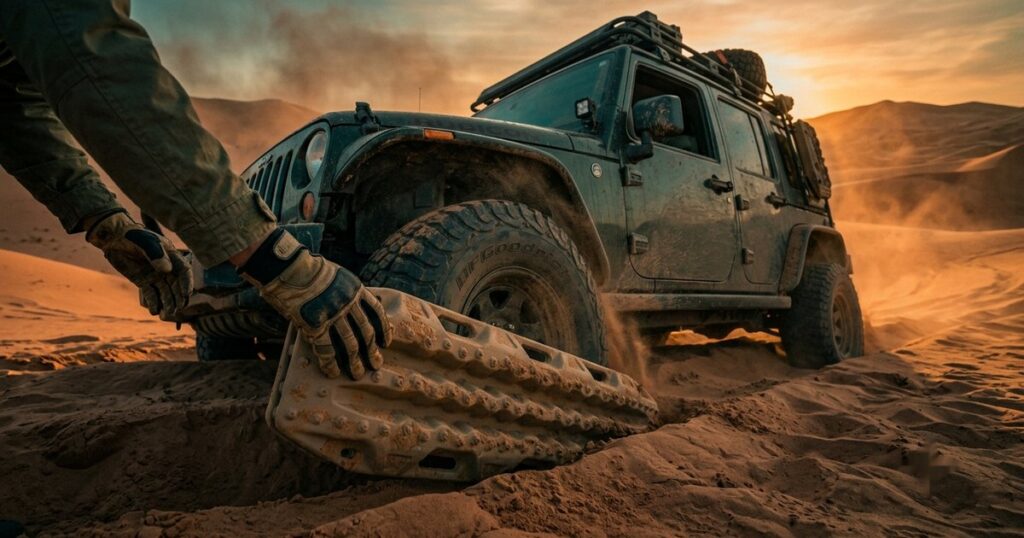
Boards are the only piece of kit that lets a solo vehicle self-recover from sand and mud without a winch. Dig the wheels clear, wedge the boards, drive out gently, done. Our MAXTRAX-versus-cheap guide covers whether the brand-name premium is worth it; the short version is that the moulded teeth and the UV-stable nylon are what you’re paying for. For the shovel, a full-length fibreglass-handle one from the hardware store digs faster than anything that folds. If cargo space is the constraint, the DMOS Delta is the pack-flat shovel that reviewers actually keep: 3.5 lb, 24 in collapsed, 51 in extended, and GearJunkie’s abuse test had it prying rocks without folding. The objections are the coating chipping and the price, and both are fair.
MAXTRAX MKII Recovery Boards (pair)
UV-stabilised nylon, moulded teeth, doubles as a shovel in a pinch. Boards plus a shovel solve most weekend stucks before a rope is needed, and for a solo traveller heading into sand or snow they are the first purchase, not the rope. Rarely deploy on rock-only trails.
DMOS Delta Shovel (aluminium)
3 mm 6061 aluminium blade on a telescoping shaft, 3.5 lb, 24 in collapsed and 51 in extended. Survived GearJunkie’s prying and rock-strike abuse. The one for SUV builds where the shovel has to live flat under the drawers. Budget kits: buy the hardware-store shovel instead.
The plug kit
Rope plugs fix tread punctures without taking the wheel off, and on gravel roads with all-terrains you will use them. The cheap kits are the ones where the T-handle bends inside a 10-ply tire. The ARB Speedy Seal II is the kit every reviewer defaults to for that reason: cast-handle spring-steel insertion needle, hardened reamer, pliers, blade, valve cores and a pencil gauge, 40 cords (ARB’s own spec; the Amazon listing title says 50, go with ARB). Sidewall cuts are a different problem: carry a spare, and Expedition Portal’s tire-repair list adds a GlueTread-type patch kit for the sidewall and a jack rated for the loaded vehicle.
ARB Speedy Seal II Tire Repair Kit (10000011)
The Gear Bunker’s top pick and the one Expedition Portal lists first: the tools survive a 10-ply tire, no wheel removal, 40 self-vulcanising cords, refills sold separately. Tread punctures only; sidewalls need a patch kit or the spare.
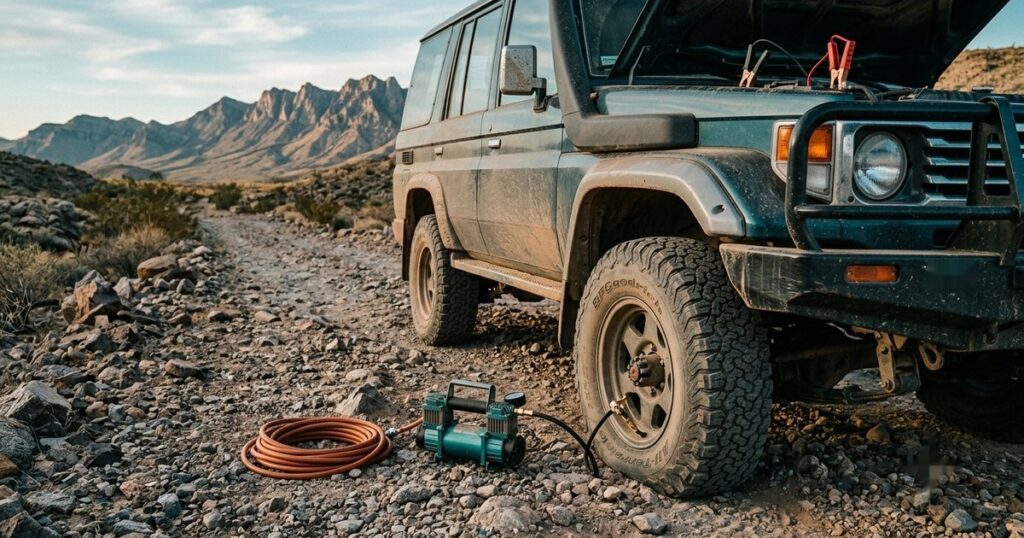
The compressor, because airing down is the cheapest traction there is
Dropping tire pressure is the traction upgrade that costs nothing, and it is only usable if you can air back up before the highway. OVR Mag’s working numbers: 20-30 psi for gravel and washboard, 12-18 psi for rocks, 2-8 psi for deep sand or snow (beadlock territory), and half of street pressure as the safe generic rule without risking a bead. Our air compressor guide does the CFM and duty-cycle math; the short version for a first kit is the VIAIR 400P class, rated for tires up to 35 in, clipped straight to the battery.
VIAIR 400P Portable Compressor
12V, rated for tires up to 35 in, direct-to-battery clips, and a duty cycle that gets four tires back from 15 psi to street pressure without a cooling break in the middle. Bigger tires or a multi-vehicle group want a twin-cylinder unit; everyone else wants this.
Gloves and a tree saver
Synthetic rope fuzz and steel-cable splinters are the injury nobody plans for, and the person handling the rope end is the one who gets it. Expedition Portal’s glove round-up lands on fitted leather palms with a synthetic wear panel: Warn’s Recovery Gloves with the Kevlar panel for winching, the Tillman TrueFit goatskin work glove as the value pick. Loose gauntlets are worse than none because they catch. The tree saver is the only static strap a first kit needs: 3 in polyester, 26,000-35,000 lb MBS, under 7% stretch. Its jobs are anchoring a hand winch or a friend’s winch line, and bridling two recovery points. It is never, ever the snatch strap.
Warn Industries Recovery Gloves (Kevlar wear panel)
Leather palm, Kevlar-reinforced wear panel, impact padding, articulated fingers. Enough for rope and cable both. Cold-weather-only users: Expedition Portal points at an insulated Ergodyne instead.
GearAmerica Heavy Duty Tree Saver Strap 3 in x 8 ft
35,053 lb MBS polyester with reinforced eyes and neoprene sleeves, under 7% stretch. Static anchor and bridle duty only. If you ever find yourself about to snatch with it, stop; that is exactly the mistake that breaks hitches.
The one-box option, and why most first buyers do better assembling it
ARB’s Essentials kit is a credible one-bag start from a brand that publishes ratings: a 17,600 lb snatch strap, a tree trunk protector, two rated bow shackles, a snatch block, gloves and a bag (retailer-listed contents; Trail4Runner’s review of the bigger RK9 kit documents the same component ratings). Two problems for this guide’s buyer. It is strap-and-steel based, so no kinetic rope and no soft shackles. And 17,600 lb is under 3x GVWR for a 4Runner-class truck. For a Wrangler or Tacoma travelling with similar-weight friends it works. For anyone else, the rope, two soft shackles and the HitchLink above cost about the same and out-rate it everywhere.
ARB RK11A Essentials Recovery Kit
Brand-name everything in one bag, with published ratings. The snatch strap is sized for the Wrangler and Tacoma weight class, not a loaded 4Runner or a half-ton, and there’s no soft rigging. Check which variant is live; older RK11 listings exist.
So when do you buy the winch?
When you travel solo, or when you spend real time in sand, snow or mud regions where the second truck will not be there. That’s it. A winch needs rated points, usually a bumper, a battery and alternator that can feed it (which is where our dual-battery guide comes in), and someone who knows a closed-system pull with a damper on the line. Warn’s own sizing rule is GVWR times 1.5 as the minimum rating: 8,400 lb for a Tacoma, 14,850 lb for a Silverado 2500. That is a second-season question. A weekend camper with a second vehicle in the group will use the kinetic rope ten times before a winch would have mattered.
How it goes wrong, from the accident threads
- A drop-hitch ball as the rear recovery point. The 2022 fatality on Exploring Overland. Rated for a steady 3,500 kg trailer, not a shock load, and the drop adds leverage.
- A polyester tow strap used as a snatch strap. Under 7% stretch means the load spikes straight into the recovery points. Same incident.
- Metal hooks on the strap. Hooks unhook under slack and come back at the vehicle. If it came with hooks it’s for towing a dead car down pavement.
- A 4.75 t steel shackle on a stock tie-down loop. The loop breaks first and the shackle is the projectile. Soft shackles on rounded points for a reason.
- Aggressive driving on the rope. The Expedition Portal thread’s Bronco-and-Jeep rope failure into a windshield; members blamed the tow vehicle’s speed, not the gear, and asked why the boards weren’t tried first.
- Soft shackle on a sharp-edged bumper slot. Abrasion is the failure mode; steel or a rounded mount there.
- Sizing from curb weight. A loaded 4Runner is 1,500 lb heavier than the number you googled.
What to skip
- Any tow strap with metal hooks, and any hitch-ball recovery. The two items named in the fatality reports.
- The winch, this season. Unless you travel solo into sand or snow.
- Steel D-rings on the rope ends. They’re for a winch line and a bumper slot, not for connecting two trucks with a rubber band between them.
- A no-name 30-ft rope with a big number on the label. Tacoma World owners endorse Bubba Rope over the random knock-offs because the rating is published and repeatable. MBS you can’t trace is a guess.
- A folding shovel if you have the room. The hardware-store fibreglass one is cheaper and digs faster.
- A tire kit with a plastic T-handle. It bends in a 10-ply tire and you’re stranded with a kit in your hand.
Build the rest of the rig: MAXTRAX versus the cheap boards · the air compressor that airs you back up · the dual-battery setup a winch eventually needs · the 12V fridge that started all this.
The receipts: what I read and watched
- Expert reviewHow to Choose the Correct Size Kinetic Recovery Rope ↗ – Tactical Recovery EquipmentThe 3x vehicle weight rule with a diameter table (3/4 in = 18,000 lb up to 6,000 lb vehicles; 1 in = 34,000 lb up to 10,000 lb) and the 30% stretch figure.
- ManufacturerKinetic Recovery Ropes (sizing guide) ↗ – Factor 557/8 in for Jeeps and mid-size trucks, 1 in for full-size; 4:1 to 6:1 MBS-to-GVWR guidance; size to the lighter vehicle.
- ManufacturerRope Facts ↗ – Bubba Rope3-4x vehicle weight rule, MBS by diameter (Renegade 19,000 lb; 7/8 in 28,600 lb), wet nylon loses up to 10% strength, no official WLL for kinetic ropes.
- Manufacturer7/8 in Kinetic Recovery Rope | Python ↗ – Yankum Ropes28,600 lb MBS, WLL 5,700-9,000 lb via a 3:1 to 5:1 safety factor, sized to the recovery vehicle (5,000-7,199 lb), 20 ft for woods versus 30 ft for dunes.
- Manufacturer39,000 lb MBS, 7,800 lb WLL, UHMWPE, 6.3 oz, rated for GVW up to 7,500 lb.
- ManufacturerHitchLink 2.0 ↗ – Factor 559,500 lb WLL, 51,000 lb ultimate, 5/8 in alloy pin, never exceed the receiver rating, in-line pulls only.
- Expert reviewSoft shackles are lighter, safer on failure and beginner-friendly but abrade and cut; D-rings are the projectile risk.
- Hard numbers4WD Recoveries: forces and correctly sizing recovery gear ↗ – 4WDing Australia3x MBS preferred, 2x the floor; mud recovery forces around 0.7-0.8x vehicle weight; 4.75 t steel shackles are the missile risk; standard towbars top out around 2,800 kg for recovery.
- Expert reviewHow to safely use a snatch strap off-road ↗ – Practical Motoring2-3x vehicle weight rule, size to the heavier vehicle, tow balls rated around 3,500 kg max and a lethal projectile under snatch load.
- Owner reportsAnother hitch-ball recovery, another fatality ↗ – Exploring Overland (Jonathan Hanson)2022 fatality: a drop-hitch ball assembly failed under a kinetic pull done with a non-stretch polyester strap and came through the windshield.
- Owner reportsAn incident worth talking about: kinetic recovery accident ↗ – Expedition Portal forumBronco/Jeep rope failure into a windshield; members blame aggressive tow-vehicle driving and ask whether boards should have been tried first.
- Owner reportsSnatch/kinetic vs tow rope/strap ↗ – Tacoma World forumOwners endorse Bubba Rope over no-name ropes; cite a soft-shackle-on-sharp-edge failure at around 8 t versus 34 t for steel; rounded recovery points only.
- Owner reportsBasic Recovery Gear Setup ↗ – Overland Bound communityMember consensus starter list: kinetic rope, boards, shovel, rated points front and rear, shackles, compressor and gauge; winch only for solo desert travel.
- Expert reviewTire Repair Essentials ↗ – Expedition PortalPlug kit plus a sidewall patch kit, spare valve stems, a jack rated for the loaded vehicle, and gloves; plugs are for tread punctures.
- Expert reviewBest Tire Repair Kit: Comprehensive Review and Guide ↗ – The Gear BunkerARB Speedy Seal II is the top pick (40 punctures, no tire removal); Boulder Tools and Rhino USA as value alternatives.
- ManufacturerSpeedy Seal Tire Repair Kit 10000011 ↗ – ARB USA40 cords, insertion needle, reamer, pliers, blade, gauge, valve cores; refills sold separately.
- Expert reviewARB RK9 Recovery Kit Review ↗ – Trail4RunnerARB kit ratings: 17,600 lb snatch strap, 26,000 lb tree trunk protector, 4.75 t bow shackles at 6:1.
- Expert review3.5 lb, 24-51 in, survived prying and rock strikes; drawbacks are price, chipping coating and a fiddly collapse sequence.
- Expert reviewWork, Winch and Recovery Gloves ↗ – Expedition PortalFitted leather palms with synthetic panels; Warn Recovery Gloves for winching, Tillman TrueFit as the value pick; loose gloves are a hazard.
- Hard numbersTech Tip Tuesday: Determine the Right Winch Capacity ↗ – Warn IndustriesGVWR x 1.5 = minimum winch rating; Tacoma example 8,400 lb; use the door sticker, not curb weight.
- Hard numbersWhat Air Pressure to Run Off-Road ↗ – OVR Mag20-30 psi gravel, 12-18 psi rocks, 2-8 psi sand and snow with beadlocks; half of street pressure as the safe generic rule.
- Hard numbersUnderstanding Gross Vehicle Weight Rating in your 4Runner ↗ – Trail4Runner4Runner curb 4,750 lb, GVWR 6,300 lb, payload 1,550 lb; a typical overland build overshoots GVWR by about 485 lb.
- Field testTESTING Recovery Rope vs Strap: comparison test ↗ – YouTube, Matt’s Off Road Recovery and MadMatt 4WDSide-by-side field pull of a kinetic rope versus a snatch strap on the same stuck vehicle.
- Field testMaxTrax 4×4 recovery kit tested ↗ – YouTube, 4X4 AustraliaMagazine field test of a branded recovery kit in sand and mud.
FAQ
What size kinetic rope do I need for a 4Runner or Tacoma?
7/8 in, 20 ft. A 4Runner’s GVWR is 6,300 lb, three times that is 18,900 lb, and a 3/4 in rope at 18,000-19,000 lb is right at the floor. A 7/8 in rope at 28,600 lb clears it with margin and still works when a half-ton joins the trip. A Tacoma at 5,600 lb GVWR can run 3/4 in if everyone in the group is similar weight.
Can I use a tow strap as a snatch strap?
No. A tow strap is polyester with under 7% stretch; a snatch strap or kinetic rope is nylon with 20-30% stretch. Snatching with the polyester one puts the whole load into the recovery points in an instant, which is how hitches and tow balls end up in windshields. Tow straps are for flat towing on a road and for winch anchoring.
Is it safe to recover from a hitch ball?
No, and not with a soft shackle either. A tow ball is rated for a steady trailer load of around 3,500 kg, not a shock load, and a drop hitch adds leverage. Put a rated shackle mount in the receiver instead; it is the cheapest item in the kit and the biggest safety upgrade.
Soft shackles or steel D-rings?
Soft shackles on the rope ends, rated above the rope so the rope stays the weak link. A 7/16 in soft shackle is 32,000-39,000 lb MBS, which out-rates a 7/8 in rope. Steel D-rings belong on a winch line and a bumper slot, and on any sharp-edged mount where a soft shackle would abrade.
Do I need a winch for my first trip?
Not if you travel with a second vehicle. A winch needs rated points, usually a bumper, a battery that can feed it and someone who knows a closed-system pull. Buy the rope, the boards, the plug kit and the compressor first; if you go solo into sand or snow, the winch moves up the list, and Warn’s rule is GVWR times 1.5 for the minimum rating.
What tire pressure should I run off pavement?
Half of street pressure is the safe generic rule without beadlocks. OVR Mag’s working ranges are 20-30 psi for gravel and washboard, 12-18 psi for rocks, and 2-8 psi for deep sand or snow with beadlocks. Whatever you drop to, you need a compressor to get back up before the highway.